Machine-translated by Google. Questions are authored in English.
Top

Paper Folding and Cutting Questions and Answers

11.

Consider two rectangular sheets, Sheet M and Sheet N of dimensions 6 cm x 4 cm each.

Folding operation 1: The sheet is folded into half by joining the short edges of the current shape.

Folding operation 2: The sheet is folded into half by joining the long edges of the current shape.

Folding operation 1 is carried out on Sheet M three times.

Folding operation 2 is carried out on Sheet N three times.

The ratio of perimeters of the final folded shape of Sheet N to the final folded shape of Sheet M is ______.

Exam Year(s)

GATE Chemistry - 2021,

Answer: A

The ratio is 13 : 7.

Joining the short edges halves the long side; joining the long edges halves the short side. Track each sheet, starting from 6 cm by 4 cm:

  • Sheet M, operation 1 three times: 6 x 4, then 3 x 4, then 3 x 2, then 1.5 x 2. Each fold halves whichever side is currently longer. Perimeter 2(1.5 + 2) = 7 cm.
  • Sheet N, operation 2 three times: 6 x 4, then 6 x 2, then 6 x 1, then 6 x 0.5. The 6 cm side is never folded. Perimeter 2(6 + 0.5) = 13 cm.

So N : M = 13 : 7. The question asks for N first; 7 : 13 would be the ratio the other way round, and none of 3 : 2, 7 : 5 or 5 : 13 matches the two perimeters.

Please log in or register to report this question.
12.

A 100 cm × 32 cm rectangular sheet is folded 5 times. Each time the sheet is folded, the long edge aligns with its opposite side. Eventually, the folded sheet is a rectangle of dimensions 100 cm × 1 cm.

The total number of creases visible when the sheet is unfolded is _______.

Exam Year(s)

GATE Chemistry - 2023,

Answer: C

The unfolded sheet shows 31 creases.

Each fold doubles the number of layers, and the 32 cm side is halved each time: 32, 16, 8, 4, 2, 1 cm after five folds, consistent with the final 100 cm × 1 cm strip. After 5 folds there are \(2^{5} = 32\) layers stacked across the original 32 cm width.

Unfolded, those 32 layers become 32 strips of 1 cm side by side, and 32 strips are separated by \(32 - 1 = 31\) creases.

32 counts the strips, not the lines between them; 5 counts only the folding operations, forgetting that later folds crease several layers at once; and 63 is \(2^{6} - 1\), the count for six folds.

Please log in or register to report this question.
13.

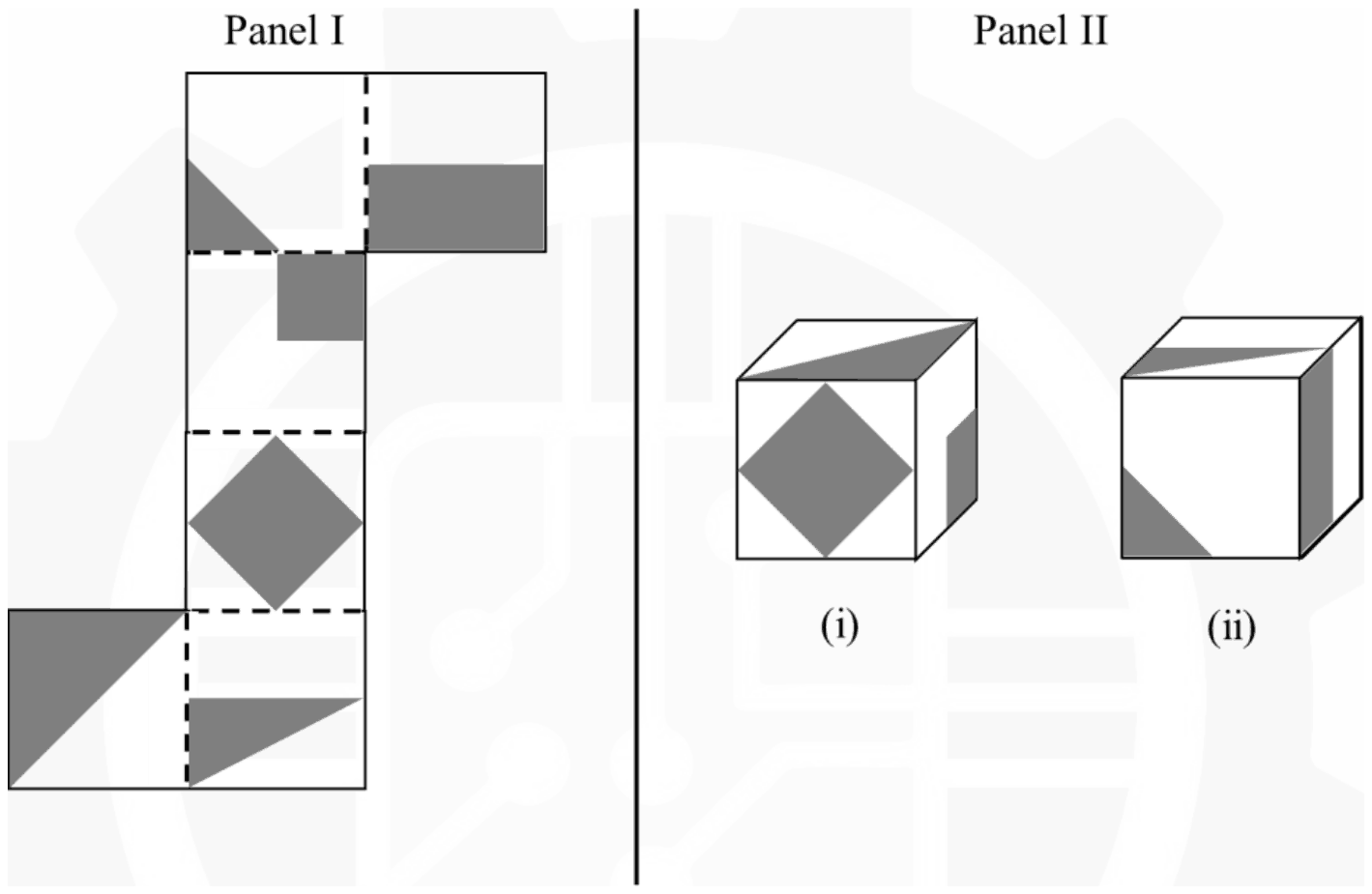
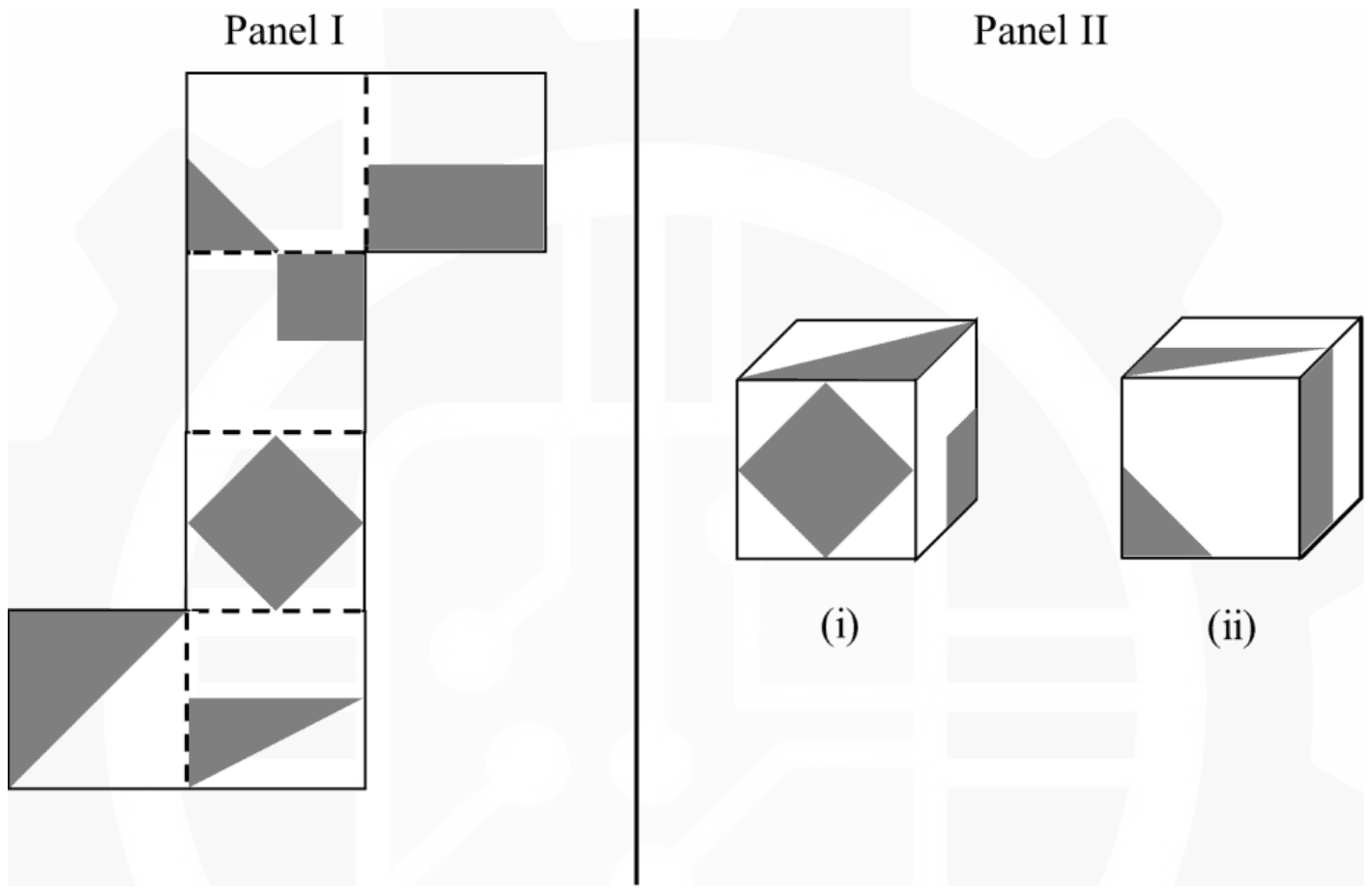
A paper shown in Panel I is folded along the dashed lines (- - -) to construct a cube. The shaded regions shown in Panel I appear on the outer surface of the cube. Referring to cubes shown in Panel II, which one of the options is correct?

Panel I: a six-square net with shaded triangles, squares and a diamond. Panel II: two drawn cubes, (i) and (ii), each showing three shaded faces

Exam Year(s)

GATE Chemistry - 2026,

Answer: A

The correct option is Only (i) can correspond to the unfolded cube in Panel I.

Fold the net with the diamond square as the front face. The square above it in the column becomes the top (its shaded quarter sits at the back right), the square below it becomes the bottom (shaded wedge), and the top square of the column becomes the back (small shaded corner triangle). The rectangle-band square attached to the back face becomes the right face, with its shaded half running horizontally along the upper half, and the half-shaded square at the bottom left becomes the left face.

Cube (i) shows the diamond in front. Give the folded cube a quarter turn about the front-to-back axis so that the left face comes to the top: the half-shaded triangle then lies on top with its shaded half towards the front right, and the former top face comes to the right side with its shaded quarter in the lower back corner. That is exactly what (i) shows.

Cube (ii) shows the small corner triangle in front, so its front is the back face of the net. Bringing that face round to the front by a half turn about the left-right axis puts the bottom wedge on top, as drawn, but it turns the right face's band upside down, still horizontal, along its lower half. Cube (ii) shows that band running vertically, which no folding of this net can produce. So only (i) fits, which rules out the 'only (ii)', 'both' and 'neither' options.

Please log in or register to report this question.
14.

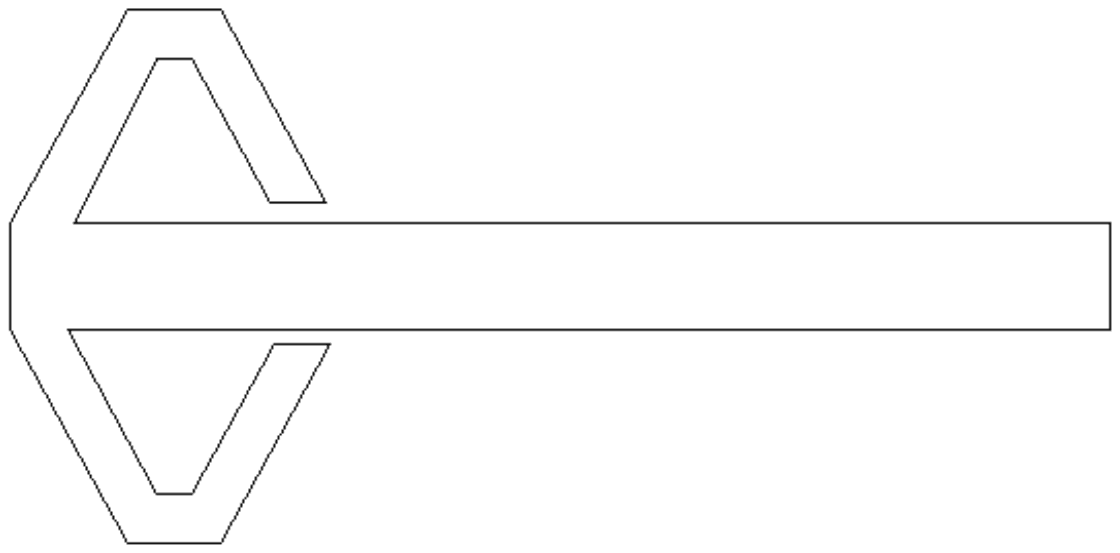
A planar rectangular paper has two V-shaped pieces attached as shown below.

Flat net: a long rectangular strip with two V-shaped pieces attached at its left end, one above and one below

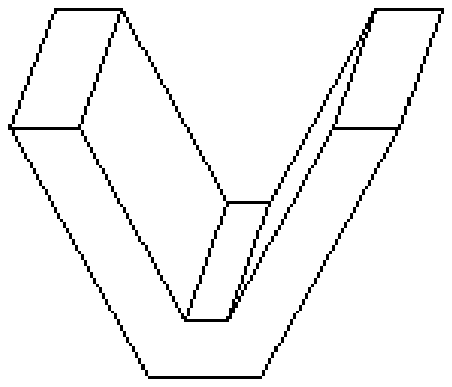
This piece of paper is folded to make the following closed three-dimensional object.

Closed solid shaped like a thick letter V with flat ends and a flat bottom

The number of folds required to form the above object is

Exam Year(s)

GATE ME - 2024,

Answer: A

The number of folds required is 9.

The two V-shaped pieces become the front and back faces of the solid, and the long strip wraps round the edge of the V to form its sides. The V outline has 8 edges: the outer slant, flat bottom and outer slant on the outside, the two flat arm ends, and the inner slant, inner bottom and inner slant of the notch. So the strip must provide 8 side faces.

Turning 8 side faces into a closed band takes a fold between each neighbouring pair: 7 folds along the strip. Each V-piece must then be folded over onto the band, which adds 2 more:

\[ 7 + 2 = 9 \]

7 counts only the folds along the strip, 8 adds just one of the V-pieces, and 11 counts more side faces than the V outline has.

Please log in or register to report this question.
15.

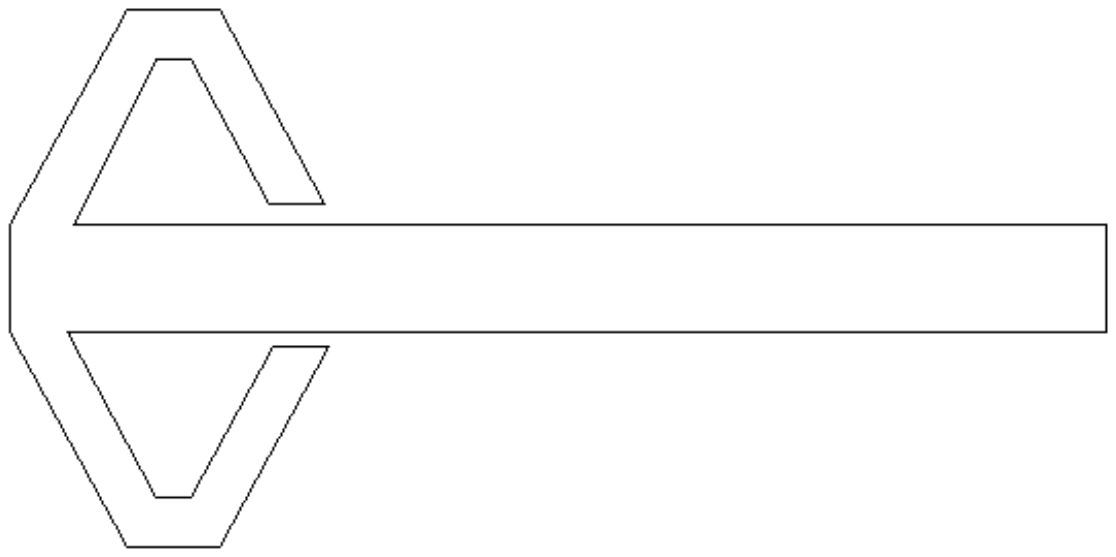
A planar rectangular paper has two V-shaped pieces attached as shown below.

Flat net: a long rectangular strip with a V-shaped flat piece attached above and another below its left end

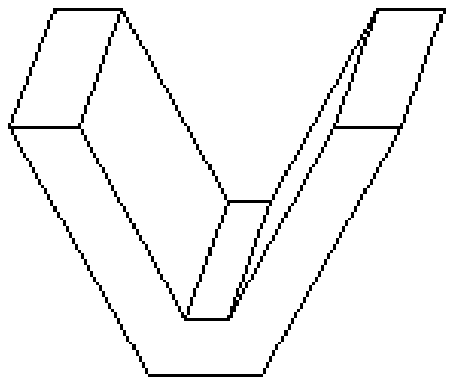
This piece of paper is folded to make the following closed three-dimensional object.

A closed V-shaped solid of uniform thickness, like a thick letter V, with flat tops on both arms and a flat bottom inside and outside

The number of folds required to form the above object is

Exam Year(s)

GATE Physics - 2024,

Answer: A

The object needs 9 folds.

The closed V-shaped object is a prism whose cross-section is the outline of the V. Following the drawing, that outline has 8 sides: the two outer slanted walls, the flat outer bottom, the two inner slanted walls, the small flat inner bottom, and the flat top of each arm.

The long rectangular strip wraps around the V to form these 8 walls. Eight walls in a row need a fold between each neighbouring pair, 7 folds; the last wall meets the first at a joint where the strip's two ends come together, which is a seam, not a fold. The two V-shaped pieces are the end caps, and each is folded once along the edge where it is attached: 2 more folds.

That gives 7 + 2 = 9. 7 counts only the strip, 8 adds just one cap, and 11 counts extra folds the design does not need.

Please log in or register to report this question.
16.

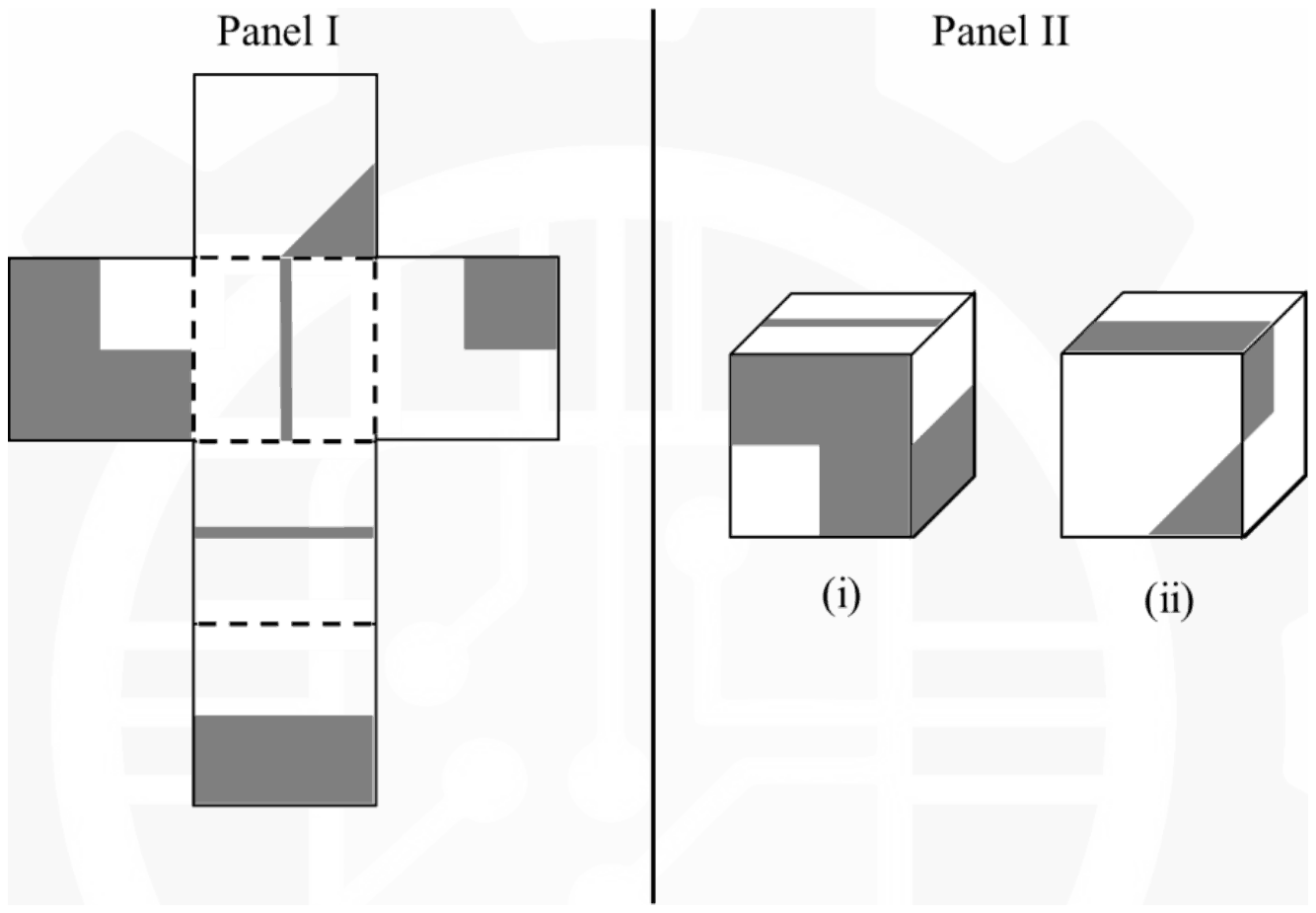
A paper shown in Panel I is folded along the dashed lines (- - -) to construct a cube. The shaded regions shown in Panel I appear on the outer surface of the cube. Referring to cubes shown in Panel II, which one of the options is correct?

Panel I: a cross-shaped net of six squares with shaded regions, a vertical bar on the dashed centre square and a horizontal bar on the square below it. Panel II: two drawn cubes, (i) and (ii), with shaded faces.

Exam Year(s)

GATE XE - 2026,

Answer: B

Only cube (ii) can be made from the net, so the answer is Only (ii) can correspond to the unfolded cube in Panel I.

Label the squares of the net: the centre square (dashed, with a vertical bar) is F2; above it is F1 (a shaded triangle in its lower-right corner); below it, in order, are F3 (a horizontal bar through its middle) and F4 (the lower half shaded); to the left and right of F2 are the left square (an L of gray with a white upper-right quarter) and the right square (a gray upper-right quarter). Folding F2 to the front puts F1 on top, F3 underneath, F4 at the back, and the left and right squares at the sides.

Cube (ii): its front face is white with a gray triangle in a corner, the pattern of F1; its top face is gray over the front half, the pattern of F4; and its right face has a gray quarter, the pattern of the net's right square. These three faces meet at one corner of the folded cube, and the orientations of the patterns agree with how the net folds, so (ii) is possible.

Cube (i): the right face, gray over its lower half and white above, can only be F4. The front face, gray with a white lower-left quarter, can only be the net's left square. The top face must meet both of those, which leaves F3, the barred square. But the bar on F3 runs parallel to the edge that F3 shares with F2, so on the cube it is perpendicular to the edge that F3 shares with the left square. In (i) the top bar is drawn parallel to the front edge, so (i) is impossible.

Please log in or register to report this question.
17.

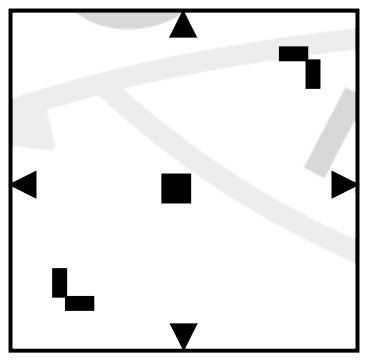
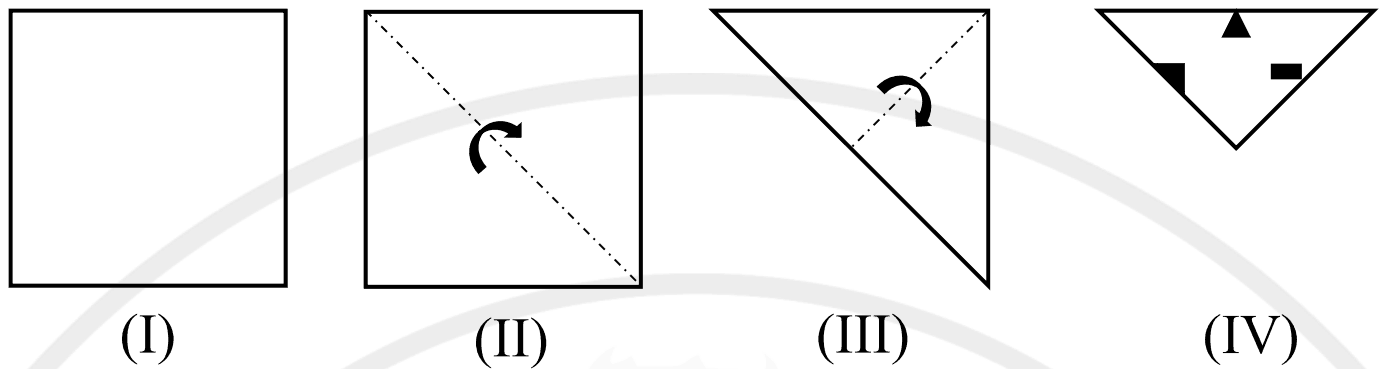
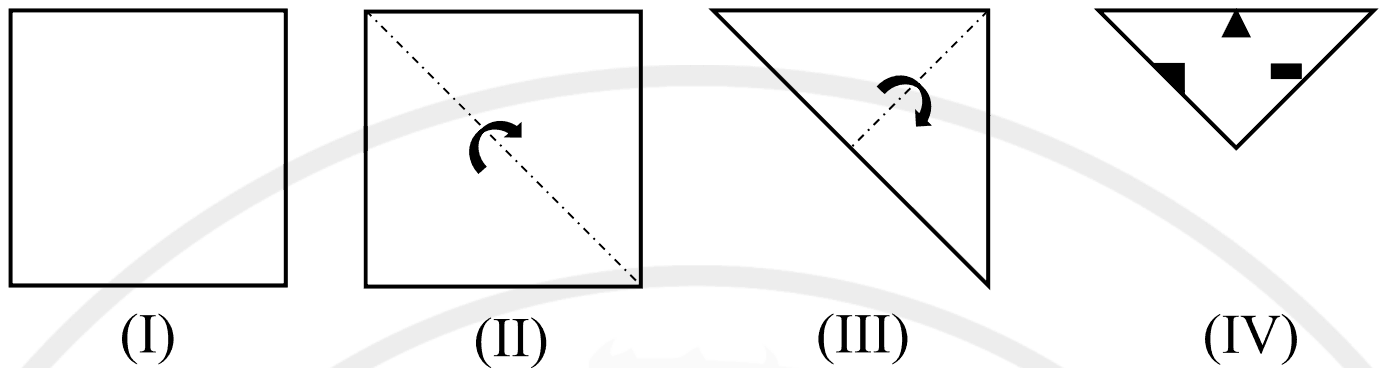
A square paper, shown in figure (I), is folded along the dotted lines as shown in the figures (II) and (III). Then a few cuts are made as shown in figure (IV). Which one of the following patterns will be obtained when the paper is unfolded?

Note: The figures shown are representative.

(I) a square; (II) folded along the diagonal from top-left to bottom-right; (III) the triangle folded again from its right-angle corner to the middle of the long side; (IV) the result, point down, with a triangle cut at the top centre and small cuts on the two slanting edges

Exam Year(s)

GATE CS - 2025,

Answer: A

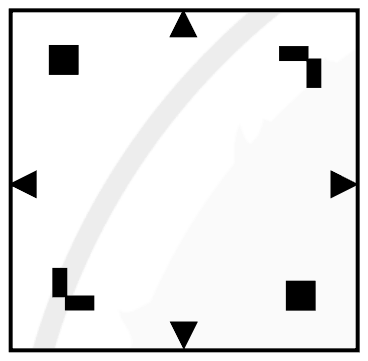
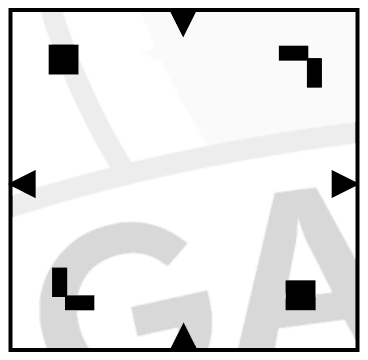
The unfolded pattern is (A).

Follow the folds. The first fold is along the diagonal from top-left to bottom-right; the second folds that triangle along the line from its right-angle corner to the middle of its long side. In figure (IV), the top edge is made of all four original sides of the square laid on top of each other, the left slanting edge is the first fold, and the right slanting edge is the second fold.

  • The triangle cut at the middle of the top edge lies on all four original sides, so it unfolds to a notch at the midpoint of each side, every one pointing out of the square. This rules out (C), whose top and bottom notches point inward.
  • The cut on the left slanting edge is a right-angled triangle whose long side lies on the first fold. Opening a fold doubles a shape across the fold line, and a right triangle doubled across its 45° hypotenuse becomes an upright square. So there are upright squares near the top-left corner and, from the second fold, near the bottom-right corner. This rules out (B), which shows tilted squares, and (D), which has a single square in the centre.
  • The small cut touching the right slanting edge (the second fold) opens into an L-shaped cut near the top-right corner, and the first fold repeats it near the bottom-left corner, as all four options show.

Please log in or register to report this question.
18.

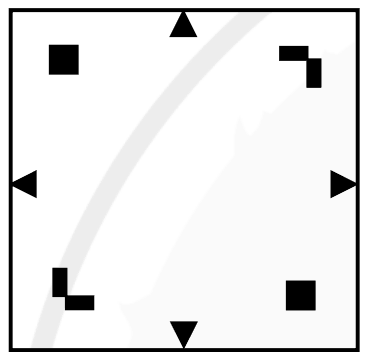
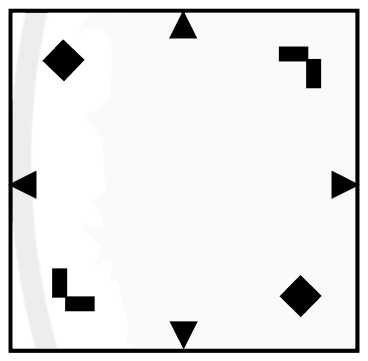
A square paper, shown in figure (I), is folded along the dotted lines as shown in the figures (II) and (III). Then a few cuts are made as shown in figure (IV). Which one of the following patterns will be obtained when the paper is unfolded?

Note: The figures shown are representative.

(I) a square; (II) folded along the diagonal from top-left to bottom-right; (III) the triangle folded again along its axis; (IV) the small triangle with a triangle cut on its top edge, a square cut on its left edge and a bar cut on its right

Exam Year(s)

GATE Mathematics - 2025,

Answer: A

The unfolded pattern is (A).

The paper is folded first along the diagonal from top-left to bottom-right, then along the other diagonal's half, leaving a quarter of the square whose top edge is one side of the original square and whose apex is the centre. Unfolding reflects each cut across both diagonals, so the final pattern must be symmetric about both diagonals.

The triangular notch on the top edge points outward, so every side gets an outward-pointing notch at its midpoint; (C) has the top and bottom notches pointing inward. The square cut sits on the first diagonal fold near the top-left corner, so it unfolds to an upright square at the top-left and, by the second fold, at the bottom-right. Reflection across a diagonal keeps an upright square upright, which rules out the diamonds in (B), and (D) has a single square at the centre instead. The bar near the second fold opens into the hooked shapes at the other two corners, as (A) shows.

Please log in or register to report this question.
19.

A paper shown in Panel I is folded along the dashed lines (- - -) to construct a cube. The shaded regions shown in Panel I appear on the outer surface of the cube. Referring to cubes shown in Panel II, which one of the options is correct?

Panel I: a net of six squares with shaded shapes; Panel II: two folded cubes labelled (i) and (ii)

Exam Year(s)

GATE Physics - 2026,

Answer: A

Only (i) can come from the net in Panel I.

In the net, a column of four squares folds into a ring: the corner-triangle square, the small-square face, the diamond face and the thin-wedge face. The flap with the half-shaded rectangle is joined to the right of the corner-triangle square, and the flap with the large diagonal triangle is joined to the left of the thin-wedge square. Turn the folded cube so that the diamond is in front and the large-diagonal flap is on top: that flap then shows its shaded half along the diagonal of the top face, and the small-square face comes to the right side with its square at the lower back corner. That is cube (i).

In cube (ii) the front is the corner-triangle face, which can sit with its triangle at the lower left in only one way. In that position the thin-wedge face is on top, as drawn, but the right face must be the half-shaded flap with its shaded half as a horizontal band along the bottom. Cube (ii) shows a vertical strip instead, so it cannot be folded from this net. That rules out the options that accept (ii).

Please log in or register to report this question.
20.

When the following shape is folded to form a cube, which is the only one of the options from A to D that can be produced ?

A cube net of six squares: a black dot face above a face with both diagonals; to the right of that face, a face with one diagonal, a black dot on a horizontal line, and a white circle on a vertical line; below it, a white circle on a horizontal line.

Options from A to D

Exam Year(s)

Punjab Civil Service - 2021,

Answer: C

The only cube that can be produced is C.

Fold the net with the X face (both diagonals) in front and the plain black-dot face on top. Then the single-diagonal face is on the right, the dot-on-a-line face at the back, the circle with a vertical line on the left, and the circle with a horizontal line underneath.

  • A shows the black-dot top with the X face and, to its right, the circle with a vertical line; but that circle face lies to the left of the X face.
  • B shows the black-dot top with the single-diagonal face to the left of the X face; it belongs on the right.
  • D has the single-diagonal face on top and the dot-on-a-line face on the left. Turned that way, the face to the right of the dot-on-a-line face is the plain black-dot face, not a circle.
  • C shows the dot-on-a-line face on top above the two circle faces. These three faces meet at one corner of the folded cube, and turning the cube so that the dot-on-a-line face is on top puts the horizontal-line circle on the left and the vertical-line circle on the right, each with its line running horizontally, exactly as drawn.

Please log in or register to report this question.

Loading…