
Machine-translated by Google. Questions are authored in English.
Top

Laplace Transform in System Analysis Questions and Answers

1.

Find the Laplace transform of \(H(t) = e^{-t} + 2te^{-t}\).

Exam Year(s)

DSSSB AE - 2023,

Answer: C

Use the standard transforms \(\mathcal{L}\{e^{-t}\} = \dfrac{1}{s + 1}\) and \(\mathcal{L}\{te^{-t}\} = \dfrac{1}{(s + 1)^2}\).


\[ \begin{aligned} H(s) = \frac{1}{s + 1} + \frac{2}{(s + 1)^2} \\ &= \frac{(s + 1) + 2}{(s + 1)^2} \\ &= \frac{s + 3}{s^2 + 2s + 1} \end{aligned} \]


That is the third option. The denominator \(1 + 2s + s^2\) is \((s + 1)^2\), so the options with \(2 + s + s^2\) are wrong, and the last option, with numerator 3, lacks the \(s\) from the first term. The answer is option C.

Please log in or register to report this question.
2.

The Laplace transform of \(\sin 3t\) is ______.

Exam Year(s)

DSSSB AE - 2023,

Answer: A

The Laplace transform of \(\sin at\) is \(\dfrac{a}{s^2 + a^2}\). With \(a = 3\):


\[ \mathcal{L}\{\sin 3t\} = \frac{3}{s^2 + 9} \]


The option with \(s^2 + 3\) uses \(a\) where \(a^2\) is needed, the one with numerator 9 is \(a^2\) in place of \(a\), and the last option would be \(\dfrac{3}{3(s^2 + 3)}\), which does not equal the transform. The answer is option A.

Please log in or register to report this question.

3.

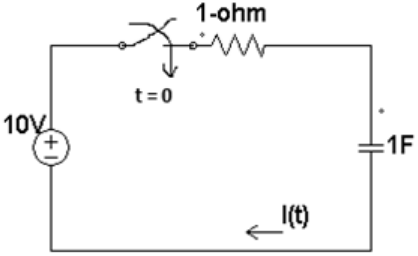
For the given circuit, determine I(t) in Laplace domain i.e. I(s).

Circuit: a 10 V source in series with a switch closing at t = 0, a 1 ohm resistor and a 1 F capacitor in a single loop, with the current I(t) marked

Exam Year(s)

DSSSB AE - 2023,

Answer: A

When the switch closes at \(t = 0\), a 10 V step is applied to the series combination of the 1 ohm resistor and the 1 F capacitor, with no initial charge. In the Laplace domain the source is \(10/s\) and the impedance is \(R + 1/(sC) = 1 + 1/s\).


\[ \begin{aligned} I(s) = \frac{10/s}{1 + 1/s} \\ &= \frac{10/s}{(s+1)/s} = \frac{10}{s + 1} \end{aligned} \]


In the time domain this is \(i(t) = 10e^{-t}\), the current of the charging capacitor, which starts at 10 A and falls to zero. The option \(10/s\) would be the current in a purely inductive path, and \(10/(s-1)\) would grow without limit. The answer is option A.

Please log in or register to report this question.

4.

Laplace transform of \(\delta(t - T)\) is :

Exam Year(s)

MH SET - 2018, SET Exam - 2018,

Answer: C

The Laplace transform of \(\delta(t - T)\) is \(e^{-sT}\).

Using the sifting property of the impulse, for \(T \gt 0\):

\[ \int_{0}^{\infty} \delta(t - T) e^{-st}\, dt = e^{-sT} \]

This is also the time-shift theorem applied to \(\mathcal{L}\{\delta(t)\} = 1\): delaying by T multiplies the transform by \(e^{-sT}\).

'Constant' is the transform of the undelayed impulse \(\delta(t)\). \(1/e^{-sT} = e^{sT}\) would be an advance, not a delay, and \(s e^{-sT}\) is the transform of the derivative of a delayed impulse.

Please log in or register to report this question.

Loading…

Other Subjects

Tags: Laplace Transform in System Analysis Questions and Answers || Laplace Transform in System Analysis MCQ Questions and Answers || Laplace Transform in System Analysis GK Questions and Answers || Laplace Transform in System Analysis GK MCQ Questions || Laplace Transform in System Analysis Multiple Choice Questions and Answers || Laplace Transform in System Analysis GK || GK on Laplace Transform in System Analysis || Signals and Systems Questions and Answers || Signals and Systems MCQ Questions and Answers || Signals and Systems GK Questions and Answers || GK on Signals and Systems