
Machine-translated by Google. Questions are authored in English.
Top

Oscillators Questions and Answers

101.

Which of the following is not a sinusoidal oscillator?

Astable multivibrator

Wien bridge

Colpitts

Hartley

Answer: D

An astable multivibrator is a relaxation circuit producing a square wave by charging and discharging between thresholds, with no resonant element and no sinusoidal behaviour. The other three sustain a sine by satisfying the Barkhausen conditions around a frequency-selective network. The two families are distinguished by whether energy oscillates between two storage elements or is repeatedly dumped, and every other difference between them follows from that.

Please log in or register to report this question.
102.

Which of the following does not improve frequency stability?

Increasing the amplifier's gain margin

Raising the resonator's quality factor

Buffering the output from the load

Holding the resonator at a constant temperature

Answer: A

Extra gain margin helps the circuit start reliably but does nothing for the frequency, and if it leads to hard clipping it can make matters worse. The other three attack the three principal causes of instability: loop phase disturbances, load pulling and thermal drift. Sorting proposed remedies by which disturbance each addresses is what stops effort going into the one that happens to be easiest to change.

Please log in or register to report this question.
103.

The condition of unity loop gain and zero net phase shift is the ______ criterion.

Answer: B

This is the Barkhausen criterion. Nyquist's test examines encirclement in the complex plane, Bode's is the straight-line magnitude and phase construction, and Hartley is an oscillator topology rather than a criterion at all. The same condition appears in the feedback amplifier topic as the thing to avoid and here as the thing to achieve, which is worth noticing since the mathematics is identical and only the intent differs.

Please log in or register to report this question.

104.

A crystal oscillator using the crystal as the inductor of a Colpitts is called a ______ oscillator.

Answer: C

This is the Pierce arrangement, and it is what sits inside almost every microcontroller clock. The Clapp is a Colpitts with an extra series capacitor, the Armstrong uses transformer feedback, and the Wien bridge is an RC audio topology. Three of these are variations on one LC arrangement, so learning the Colpitts thoroughly gives most of the family with one substitution each.

Please log in or register to report this question.

105.

Regulating an oscillator's amplitude with a lamp works because its resistance ______ as the amplitude grows.

Answer: D

A filament lamp's resistance rises as it heats, so more amplitude means more negative feedback and the loop gain settles at exactly one without ever clipping. A falling resistance would produce runaway rather than regulation, and a constant one would provide no control at all. A component whose imperfection is precisely the wanted behaviour is a neat inversion, and its thermal inertia is what keeps the control slow enough not to distort the waveform.

Please log in or register to report this question.

106.

Which of the following devices can be used for a relaxation oscillator?

Exam Year(s)

DSSSB AE - 2023,

Answer: D

A relaxation oscillator makes a non sinusoidal wave (a sawtooth or pulse) by charging a capacitor through a resistor until a switching device fires and discharges it. The unijunction transistor (UJT) is the classic device for this: when the capacitor voltage reaches the peak point of the emitter characteristic the UJT turns on and quickly discharges the capacitor, and the cycle repeats.


An SCR is a latching switch used for power control, and a PN junction diode and a photodiode have no negative resistance region to make the circuit switch back and forth. The answer is UJT, option D.

Please log in or register to report this question.

107.

What is the oscillator frequency of a transistor phase shift oscillator, if the value of \(R = 5\ \mathrm{k\Omega}\), \(C = 10\ \mu\mathrm{F}\), \(R_C = 10\ \mathrm{k\Omega}\) (for a single transistor stage)?

Exam Year(s)

DSSSB AE - 2023,

Answer: A

For a transistor phase shift oscillator the frequency of oscillation is


\[ f = \frac{1}{2\pi RC\sqrt{6 + 4\,(R_C/R)}} \]


With \(R = 5\ \text{k}\Omega\), \(C = 10\ \mu\text{F}\) and \(R_C = 10\ \text{k}\Omega\), so that \(R_C/R = 2\):


\[ \begin{aligned} 2\pi RC \\ &= 2\pi \times 5000 \times 10 \times 10^{-6} \\ &= 0.3142 \end{aligned} \]


\[ \begin{aligned} f = \frac{1}{0.3142 \times \sqrt{6 + 8}} \\ &= \frac{1}{0.3142 \times 3.742} = 0.85\ \text{Hz} \end{aligned} \]


The answer is 0.85 Hz, option A. The larger values would need a capacitance a hundred times or more smaller.

Please log in or register to report this question.

108.

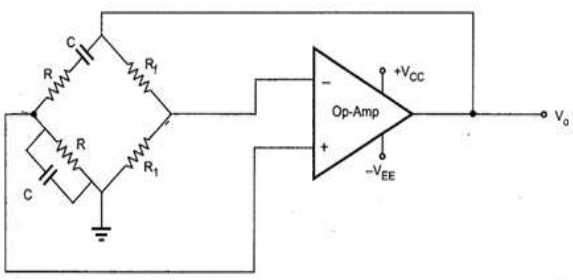
What is the resonant frequency of the given oscillator if \(R = 51\ \mathrm{k\Omega}\) and \(C = 0.001\ \mu\mathrm{F}\)?

Wien bridge oscillator: an op-amp with a bridge of two R1 resistors and a series RC arm and a parallel RC arm, output Vo fed back to the bridge

Exam Year(s)

DSSSB AE - 2023,

Answer: B

The circuit is a Wien bridge oscillator: the op-amp with a series RC and a parallel RC arm in the bridge. The frequency at which the bridge is balanced and the feedback has zero phase shift is


\[ \begin{aligned} f = \frac{1}{2\pi R C} \\ &= \frac{1}{2\pi \times 51 \times 10^{3} \times 0.001 \times 10^{-6}} \end{aligned} \]


\[ f = \frac{1}{3.204 \times 10^{-4}} = 3120.7\ \text{Hz} \]


The other values are factors of ten or a hundred away, which would come from a slip in the capacitance, 0.001 microfarad being \(10^{-9}\) F. The answer is 3120.7 Hz, option B.

Please log in or register to report this question.

109.

An oscillator always needs an amplifier with :

Exam Year(s)

RSMSSB JE - 2025, RSMSSB - 2025,

Answer: D

An oscillator always needs an amplifier with positive feedback.

An oscillator produces an output with no input signal. By the Barkhausen criterion, this needs a loop gain \(A\beta = 1\) with a total phase shift of 0° or 360° around the loop, so that the fed-back signal reinforces itself. That is positive (regenerative) feedback.

An LC tank or an RC network sets the frequency only in particular types of oscillator, so neither is always needed; crystal and relaxation oscillators use neither in that role. Negative feedback is used to stabilise amplifiers and would kill the oscillation.

Please log in or register to report this question.

110.

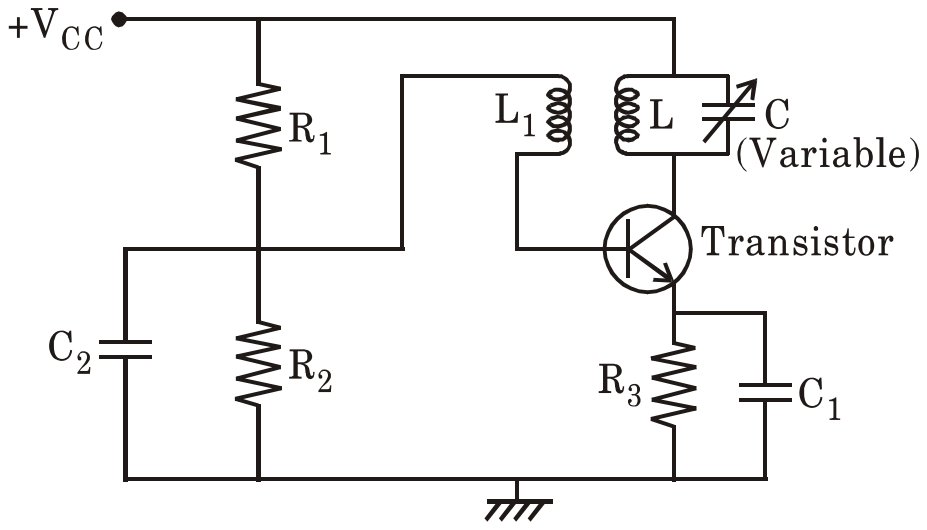
The resonant frequency of the following tuned-collector oscillator is 6 MHz. If the value of the tuned circuit capacitor increased by 50%, the new resonant frequency of the oscillator will be around :

Tuned-collector oscillator: a transistor with the tank circuit of inductor L and variable capacitor C in its collector, feedback coil L1 to the base, bias resistors R1 and R2 with bypass capacitor C2, and emitter resistor R3 bypassed by C1

Exam Year(s)

MH SET - 2018, SET Exam - 2018,

Answer: C

The new frequency is about 4·89 MHz.

The tank circuit fixes the frequency, \( f = \frac{1}{2\pi\sqrt{LC}} \), so \( f \propto 1/\sqrt{C} \). Increasing C by 50% multiplies it by 1.5:

\[ \begin{aligned} f_{2} &= \frac{f_{1}}{\sqrt{1.5}} = \frac{6}{1.2247} \\ &\approx 4.90\ \text{MHz} \end{aligned} \]

3 MHz would need the capacitance to be four times as large, 6·98 MHz is above the original frequency although a larger capacitor lowers it, and 5·89 MHz is far too small a change for a 50% increase in C.

Please log in or register to report this question.

Loading…

Other Subjects

Tags: Oscillators Questions and Answers || Oscillators MCQ Questions and Answers || Oscillators GK Questions and Answers || Oscillators GK MCQ Questions || Oscillators Multiple Choice Questions and Answers || Oscillators GK || GK on Oscillators || Analog Electronics Questions and Answers || Analog Electronics MCQ Questions and Answers || Analog Electronics GK Questions and Answers || GK on Analog Electronics