
Machine-translated by Google. Questions are authored in English.
Top

Kirchhoffs Laws Questions and Answers

1.

In the given figure, find the value of current I
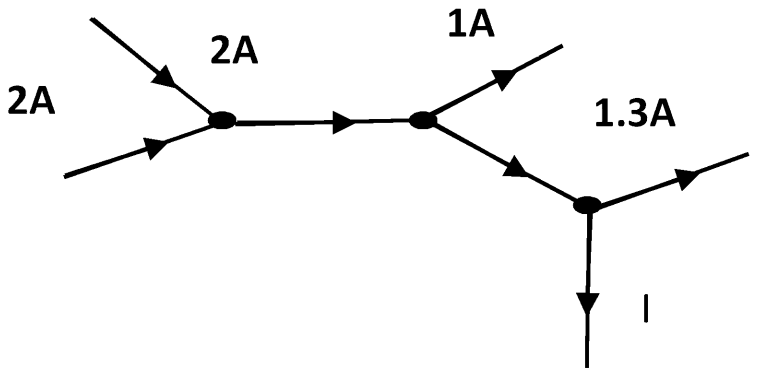
Three junctions in a row: currents of 2 A and 2 A enter the first, one branch joins it to the second, from which 1 A leaves, one branch then runs to the third, from which 1.3 A leaves and the unknown current I leaves downwards

Exam Year(s)

RSMSSB JE - 2025, RSMSSB - 2025,

Answer: A

The current I is 1.7 A.

Apply Kirchhoff's current law at each junction in turn: the current flowing in equals the current flowing out.

\[ \begin{aligned} \text{first junction: } & 2 + 2 = 4\ \text{A out} \\ \text{second: } & 4 - 1 = 3\ \text{A on} \\ \text{third: } & I = 3 - 1.3 = 1.7\ \text{A} \end{aligned} \]

3.7 A adds the 1 A instead of subtracting it, 1.3 A is the other outgoing branch, and 2.7 A ignores the 1.3 A leaving the last junction.

Please log in or register to report this question.

2.

In a given figure, the potential difference between point A and B is ________.

From A to B in series: 3 A enters at A, then a 6 ohm resistor, an 8 V cell with its plus side toward A, a 3 ohm resistor and a 6 V cell with its minus side toward A, ending at B

Exam Year(s)

RSMSSB JE - 2025, RSMSSB - 2025,

Answer: C

The potential difference \(V_{A} - V_{B}\) is 29 V.

Walk from A to B in the direction of the 3 A current, adding the drops: each resistor drops IR, the 8 V cell is entered at its + terminal (a drop of 8 V), and the 6 V cell is entered at its - terminal (a rise of 6 V).

\[ \begin{aligned} V_{A} - V_{B} &= 3(6) + 8 + 3(3) - 6 \\ &= 18 + 8 + 9 - 6 = 29\ \text{V} \end{aligned} \]

18 V counts only the 6 Ω drop, and treating both cells as drops would give 41 V; 12 V and 24 V come from other sign errors.

Please log in or register to report this question.

Answer: C

Kirchhoff's voltage law states that the algebraic sum of voltage drops and emf in a closed loop is zero.

Going round any closed loop of a circuit and returning to the starting point, the potential must come back to its original value. So the emfs met on the way, taken with their signs, are exactly balanced by the IR drops: the algebraic sum of all emfs and drops round the loop is zero, which can also be written as the sum of emfs equalling the sum of drops.

The first option omits the closed loop and the signs, and the sum of emfs alone is zero only in a loop with no current. A total drop being 'finite' says nothing about how voltages are related.

Please log in or register to report this question.

4.

The voltage V in the circuit shown in the following figure is :

Terminals V across a 10 V source; a 3 ohm resistor joins the top of the 10 V source to the top of a 5 V source, whose bottom returns to the lower terminal

Exam Year(s)

MH SET - 2018, SET Exam - 2018,

Answer: A

V is 10 V.

The output terminals are connected directly across the 10 V source: its plus terminal joins the upper terminal and its minus terminal the lower one. An ideal voltage source holds its terminal voltage regardless of the current it supplies, so the voltage between the terminals is 10 V.

The 3 ohm resistor and the 5 V source form a branch connected in parallel with the 10 V source. A current of \((10 - 5)/3 \approx 1.67\) A flows in that branch, but it does not change the voltage of the ideal source. The option 15 V adds the two sources, 5 V takes the other source, and 3 V confuses the resistance with a voltage.

Please log in or register to report this question.

Loading…
Tags: Kirchhoffs Laws Questions and Answers || Kirchhoffs Laws MCQ Questions and Answers || Kirchhoffs Laws GK Questions and Answers || Kirchhoffs Laws GK MCQ Questions || Kirchhoffs Laws Multiple Choice Questions and Answers || Kirchhoffs Laws GK || GK on Kirchhoffs Laws || Network Analysis Questions and Answers || Network Analysis MCQ Questions and Answers || Network Analysis GK Questions and Answers || GK on Network Analysis