
Machine-translated by Google. Questions are authored in English.
Top

Compound Stresses Questions and Answers

1.

Determine the correctness or otherwise of the following statements, [a] and [r]:

[a]: In a plane stress problem, the shear strains along the thickness direction of a body are zero but the normal strain along the thickness is not zero.

[r]: In a plane stress problem, Poisson effect induces the normal strain along the thickness direction of the body.

Exam Year(s)

GATE AE - 2016,

Answer: A

Both [a] and [r] are true, and [r] is the correct reason for [a].

Plane stress means the stresses on the faces normal to the thickness are zero: \(\sigma_{z} = \tau_{xz} = \tau_{yz} = 0\). With no out-of-plane shear stress, the shear strains \(\gamma_{xz}\) and \(\gamma_{yz}\) are zero. But the normal strain in the thickness direction is

\[ \varepsilon_{z} = -\frac{\nu}{E}(\sigma_{x} + \sigma_{y}) \]

which is not zero, so [a] is true. That strain arises because the in-plane stresses make the body contract or expand sideways, the Poisson effect, which is what [r] says, so [r] explains [a]. 'Both false' and '[r] false' are therefore wrong, and so is 'not the correct reason'.

Please log in or register to report this question.
2.

Which of the following statement(s) is/are true about the state of a body in plane strain condition?

P: All the points in the body undergo displacements in one plane only, for example the x-y plane, leading to \(\varepsilon_{zz} = \gamma_{xz} = \gamma_{yz} = 0\).
Q: All the components of stress perpendicular to the plane of deformation, for example the x-y plane, of the body are equal to zero, i.e. \(\sigma_{zz} = \tau_{xz} = \tau_{yz} = 0\).
R: Except the normal component, all the other components of stress perpendicular to the plane of deformation of the body, for example the x-y plane, are equal to zero, i.e. \(\sigma_{zz} \ne 0\), \(\tau_{xz} = \tau_{yz} = 0\).

Exam Year(s)

GATE AE - 2018,

Answer: D

The true statements are P and R.

Plane strain means the body deforms only in one plane, say x-y: the out-of-plane strains are zero, \(\varepsilon_{zz} = \gamma_{xz} = \gamma_{yz} = 0\). That is statement P.

Zero shear strains \(\gamma_{xz}\) and \(\gamma_{yz}\) give zero shear stresses \(\tau_{xz}\) and \(\tau_{yz}\). But stopping the normal strain \(\varepsilon_{zz}\) requires a normal stress: from Hooke's law, \(\varepsilon_{zz} = 0\) gives \(\sigma_{zz} = \nu(\sigma_{xx} + \sigma_{yy})\), which is generally not zero. That is statement R.

Statement Q, with \(\sigma_{zz}\) also zero, describes plane stress, the state of a thin plate, not plane strain. So 'Q only' and 'P and Q' are wrong, and 'P only' leaves out R, which is also true.

Please log in or register to report this question.

3.

A stress field is given by \(\sigma_{xx} = \sigma_{zz} = C_{1}y\); \(\sigma_{yy} = C_{2}y\); \(\tau_{xy} = \tau_{yz} = \tau_{zx} = 0\), where \(C_{1}\) and \(C_{2}\) are non-zero constants. If the stress field satisfies equilibrium, which one of the following options is correct?

Exam Year(s)

GATE AE - 2025,

Answer: B

There is a constant body force per unit volume in the y-direction.

The equilibrium equations are \(\partial\sigma_{ij}/\partial x_{j} + b_{i} = 0\). With all shear stresses zero and the normal stresses depending only on y:

\[ \begin{aligned} x:\ \frac{\partial \sigma_{xx}}{\partial x} + b_{x} = 0 &\Rightarrow b_{x} = 0 \\ y:\ \frac{\partial \sigma_{yy}}{\partial y} + b_{y} = 0 &\Rightarrow b_{y} = -C_{2} \\ z:\ \frac{\partial \sigma_{zz}}{\partial z} + b_{z} = 0 &\Rightarrow b_{z} = 0 \end{aligned} \]

The body force is \(-C_{2}\) in the y-direction, constant and non-zero because \(C_{2} \neq 0\). It does not vary with y, and its direction is set by the sign of \(C_{2}\), not \(C_{1}\), since \(\sigma_{xx}\) and \(\sigma_{zz}\) vary only with y and contribute nothing to the x and z equations.

Please log in or register to report this question.

4.

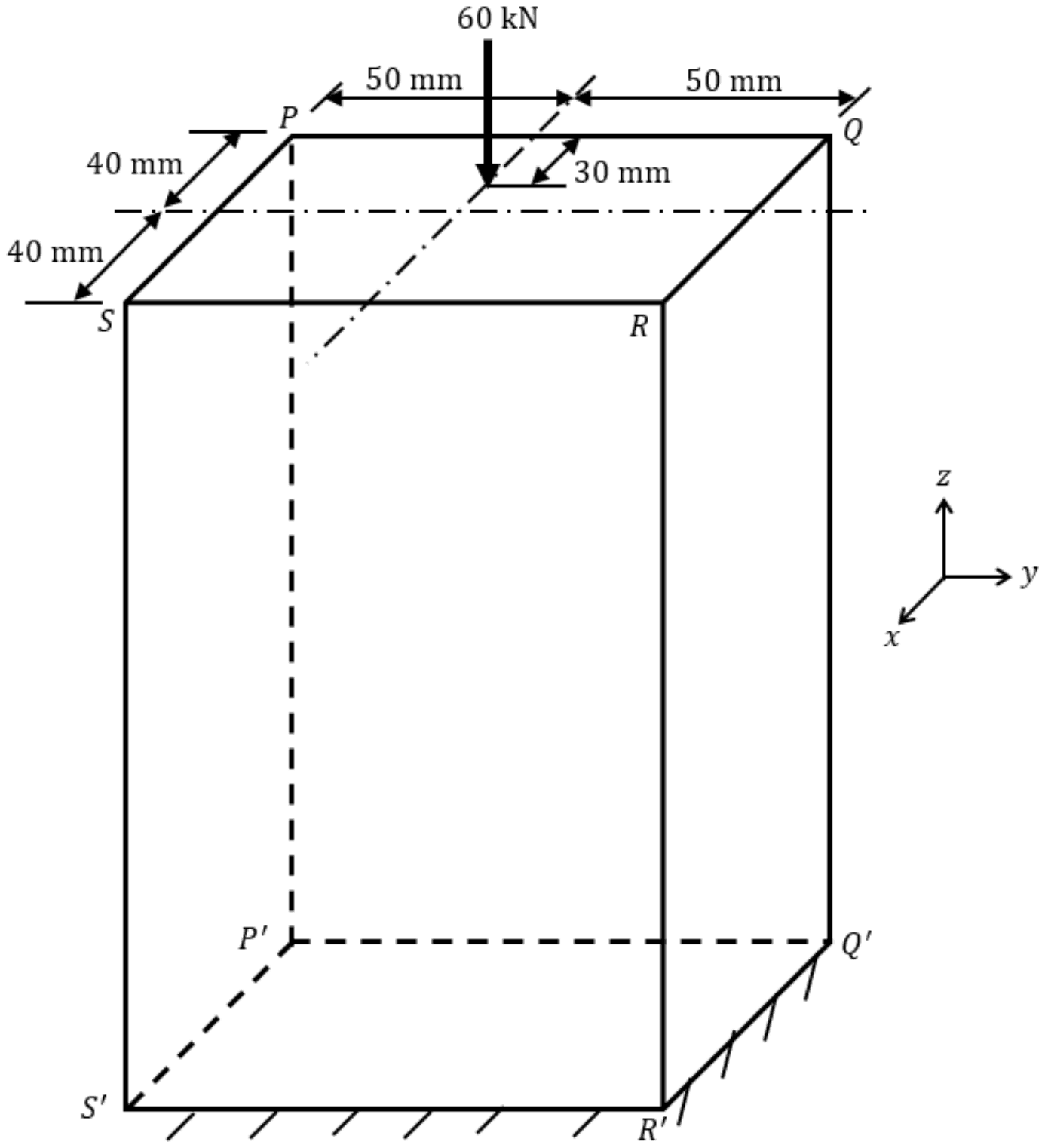
The figure shows a column of rectangular cross section 100 mm × 80 mm. It carries a load of 60 kN at a point 30 mm from the edge \(PQ\). The values of stress component \(\sigma_{zz}\) on surfaces \(PQQ'P'\) and \(SRR'S'\), at points far away from both ends of the column, are respectively

A rectangular column PQRS on a fixed base P'Q'R'S'. Edge PQ is 100 mm long and PS is 80 mm (40 mm on each side of the centre line). A downward load of 60 kN acts on the top face, 50 mm from P and from Q, and 30 mm in from edge PQ

Exam Year(s)

GATE XE - 2023,

Answer: D

The stresses are 13.13 N/mm2 (Compressive) and 1.88 N/mm2 (Compressive).

The section is 100 mm along \(PQ\) and 80 mm across. The load is 30 mm from \(PQ\), so it is offset \(e = 40 - 30 = 10\) mm from the centroid towards \(PQ\), and centred along \(PQ\). Direct and bending stresses:

\[ \begin{aligned} \sigma_{d} &= \frac{60000}{100 \times 80} = 7.5\ \text{N/mm}^{2} \\ \sigma_{b} &= \frac{6Pe}{bh^{2}} = \frac{6 \times 60000 \times 10}{100 \times 80^{2}} \\ &= 5.625\ \text{N/mm}^{2} \end{aligned} \]

On face \(PQQ'P'\), nearer the load, the two add: \(7.5 + 5.625 = 13.13\) compressive. On face \(SRR'S'\) they subtract: \(7.5 - 5.625 = 1.88\), still compressive, because the load lies inside the middle third (the kern, \(e \le 80/6 \approx 13.3\) mm) and the section is nowhere in tension.

18.75 and 3.75 correspond to an eccentricity of 20 mm, twice the true offset, and the tensile options would need the load to lie outside the kern.

Please log in or register to report this question.

Loading…
Tags: Compound Stresses Questions and Answers || Compound Stresses MCQ Questions and Answers || Compound Stresses GK Questions and Answers || Compound Stresses GK MCQ Questions || Compound Stresses Multiple Choice Questions and Answers || Compound Stresses GK || GK on Compound Stresses || Strength of Materials Questions and Answers || Strength of Materials MCQ Questions and Answers || Strength of Materials GK Questions and Answers || GK on Strength of Materials