
Machine-translated by Google. Questions are authored in English.
Top

Shear Stresses in Beams Questions and Answers

1.

What is the maximum shear stress developed for a wooden beam of width 100 mm and depth 250 mm, subjected to shear force of 75 kN?

Exam Year(s)

DSSSB JE - 2023,

Answer: C

For a rectangular section the maximum shear stress is 1.5 times the average shear stress, and it acts at the neutral axis:

\[ \begin{aligned} \tau_{max} = \frac{3}{2}\cdot\frac{V}{bd} \\ &= 1.5 \times \frac{75000}{100 \times 250} \\ &= 4.5\ \text{N/mm}^2 \end{aligned} \]

This is 4.5 MPa. The average shear stress is 3.0 MPa, which is not among the options, and the choices 3.5, 4.0 and 5.0 MPa do not follow from the factor of 1.5.

Please log in or register to report this question.
2.

The shear stress due to a transverse shear force in a linear elastic isotropic beam of rectangular cross-section

Exam Year(s)

GATE XE - 2022,

Answer: C

The transverse shear stress is maximum at the neutral axis.

For a rectangular section of depth h the shear stress is \(\tau = \frac{VQ}{Ib}\), and the first moment Q of the area beyond the level considered varies parabolically with depth:

\[ \tau(y) = \frac{6V}{bh^{3}}(h^{2}/4 - y^{2}) \]

It is zero at the top and bottom faces (\(y = \pm h/2\)) and largest at the neutral axis, \(\tau_{max} = 1.5V/(bh)\). So it is neither linear nor constant through the depth, and it is the bending stress, not the shear stress, that is zero at the neutral axis.

Please log in or register to report this question.

3.

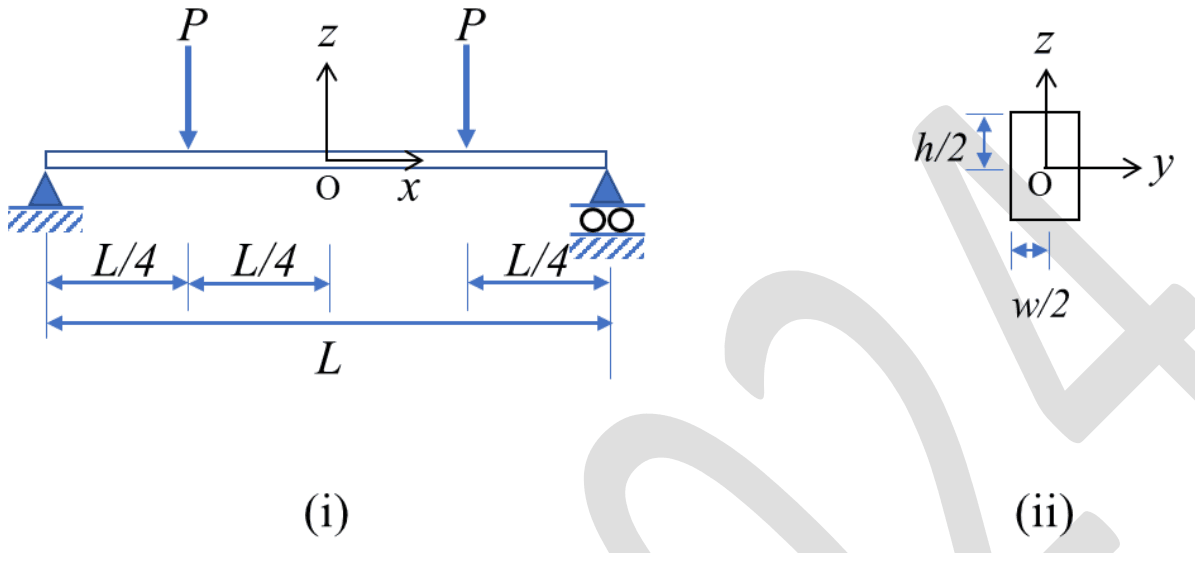
A simply-supported beam of rectangular cross-section (width \(w\) and height \(h\)) is subjected to the loads as shown in the figure (i). The enlarged view of the beam cross-section is shown in figure (ii). The coordinate system is indicated in the figures. Assuming Euler-Bernoulli beam approximation, the shear stress \(\tau_{xz}\) and normal stress \(\sigma_{xx}\) at the origin, O are respectively given by

(i) Simply supported beam of span L with equal downward loads P at L/4 from each support and the origin O at mid-span; (ii) the rectangular cross-section with O at its centre, at h/2 from the top and w/2 from the side

Exam Year(s)

GATE XE - 2024,

Answer: D

Both stresses are zero: 0 , 0.

The origin O is at mid-span and at the centroid of the section. The loading is symmetric (equal loads P at a quarter span from each support), so each support carries P, and between the two loads the shear force is \(P - P = 0\). The shear stress \(\tau_{xz}\) at O is therefore zero.

The bending moment at mid-span is \(PL/4\), which is not zero, but O lies on the neutral axis, where the bending stress \(\sigma_{xx} = Mz/I\) vanishes because z = 0.

\(\frac{3P}{2wh}\) is the peak shear stress where the shear force is P, near the supports, and \(\frac{3PL}{2wh^{2}}\) is the outer-fibre bending stress at mid-span; neither occurs at O.

Please log in or register to report this question.

4.

The nature of shear stress distribution in a rectangular beam is:

Exam Year(s)

RSMSSB JE - 2025, RSMSSB - 2025,

Answer: D

The distribution is parabolic.

The shear stress at a distance y from the neutral axis of a rectangular section is \(\tau = \frac{F}{2I}\left(\frac{d^{2}}{4} - y^{2}\right)\), a quadratic in y. It is zero at the top and bottom fibres and largest at the neutral axis, where it is 1.5 times the average shear stress.

It is not uniform or linear, and 'elliptic' does not describe the quadratic curve. Bending stress, not shear stress, is the one that varies linearly across the depth.

Please log in or register to report this question.

5.

The equivalent moment of inertia of the cross section in terms of timber of a flitched beam made up of steel and timber is (modular ratio, \(m = \frac{E_{s}}{E_{t}}\))

Exam Year(s)

RSMSSB JE - 2025, RSMSSB - 2025,

Answer: C

The equivalent moment of inertia is \(I_{t} + mI_{s}\).

In a flitched beam the steel plate is converted into an equivalent area of timber. Since steel is m times stiffer, with \(m = E_{s}/E_{t}\), the steel's width is multiplied by m, and so is its moment of inertia about the common neutral axis:

\[ I_{eq} = I_{t} + m I_{s} \]

Dividing by m (\(I_{s}/m\)) would be right only if the section were expressed in terms of steel. \(m/I_{s}\) has the wrong dimensions, and \(I_{t} + 2mI_{t}\) applies the modular ratio to the timber itself.

Please log in or register to report this question.

6.

Ratio of maximum shear stress to the average shear stress in a rectangular beam subjected to torsion is ________.

Exam Year(s)

RSMSSB JE - 2025, RSMSSB - 2025,

Answer: B

The Board's key is 1.5, the standard textbook ratio for a rectangular section.

For a rectangular beam of width \(b\) and depth \(d\) carrying a shear force \(V\), the shear stress varies parabolically across the depth. It is zero at the top and bottom faces and largest at the neutral axis.

\[ \begin{aligned} \tau_{avg} &= \frac{V}{bd} \\ \tau_{max} &= \frac{3V}{2bd} \end{aligned} \]

\[ \frac{\tau_{max}}{\tau_{avg}} = 1.5 \]

The stem says the beam is subjected to torsion, but the 1.5 ratio belongs to transverse shear in bending; a twisted rectangular bar has a different stress pattern with no such simple average. The item is therefore best read as the transverse shear case, and 1.5 is the only option that matches it. A solid circular section gives 4/3 and a thin-walled circular tube gives 2, so those values do not describe a rectangle.

Please log in or register to report this question.

7.

For a channel section, with its axis of symmetry horizontal, the shear centre lies at :

Exam Year(s)

RSMSSB JE - 2025, RSMSSB - 2025,

Answer: B

The shear centre lies outside the section.

The shear centre is the point through which a transverse load must act for the beam to bend without twisting. For a channel with its axis of symmetry horizontal, it lies on that axis but beyond the web, on the side away from the flanges, because the shear flows in the two flanges form a couple that has to be balanced by moving the load line back past the web.

It does not coincide with the centroid, which is inside the section between the web and the flange tips. It is also not at the junction of the axis and the web centre line; it is a definite distance behind the web.

Please log in or register to report this question.

Loading…
Tags: Shear Stresses in Beams Questions and Answers || Shear Stresses in Beams MCQ Questions and Answers || Shear Stresses in Beams GK Questions and Answers || Shear Stresses in Beams GK MCQ Questions || Shear Stresses in Beams Multiple Choice Questions and Answers || Shear Stresses in Beams GK || GK on Shear Stresses in Beams || Strength of Materials Questions and Answers || Strength of Materials MCQ Questions and Answers || Strength of Materials GK Questions and Answers || GK on Strength of Materials