
Machine-translated by Google. Questions are authored in English.
Top

Damped Free Vibration Questions and Answers

1.

The logarithmic decrement measured for a viscously damped single degree of freedom system is 0.125. The value of the damping factor in % is closest to

Exam Year(s)

GATE AE - 2012,

Answer: D

The damping factor is closest to 2.0%.

Logarithmic decrement \(\delta\) and damping factor \(\zeta\) are related by

\[ \begin{aligned} \delta &= \frac{2\pi\zeta}{\sqrt{1 - \zeta^{2}}} \\ \zeta &\approx \frac{\delta}{2\pi} = \frac{0.125}{6.283} \\ &= 0.0199 \approx 2\% \end{aligned} \]

The exact form \(\zeta = \delta/\sqrt{4\pi^{2} + \delta^{2}}\) gives the same 1.99%. 1.0% is what dividing by \(4\pi\) instead of \(2\pi\) gives, and 0.5% and 1.5% are smaller and larger than any reading of the formula allows.

Please log in or register to report this question.
2.

A spring-mass system is viscously damped with a viscous damping constant c. The energy dissipated per cycle when the system is undergoing a harmonic vibration \(XCos\omega_{d}t\) is given by

Exam Year(s)

GATE AE - 2012,

Answer: A

The energy dissipated per cycle is \(\pi c\omega_{d}X^{2}\).

The damping force is \(c\dot{x}\), so the energy lost over one cycle of \(x = X\cos\omega_{d}t\) is

\[ \begin{aligned} W_{d} &= \oint c\dot{x}\,dx = \int_{0}^{2\pi/\omega_{d}} c\dot{x}^{2}\,dt \\ &= c\omega_{d}^{2}X^{2}\int_{0}^{2\pi/\omega_{d}}\sin^{2}\omega_{d}t\,dt \\ &= \pi c\omega_{d}X^{2} \end{aligned} \]

Energy must scale with amplitude squared and with the damping constant, so \(\pi\omega_{d}X^{2}\) (no c) and the two forms linear in X cannot be right, and \(\omega_{d}^{2}\) has the wrong dimensions for energy.

Please log in or register to report this question.
3.

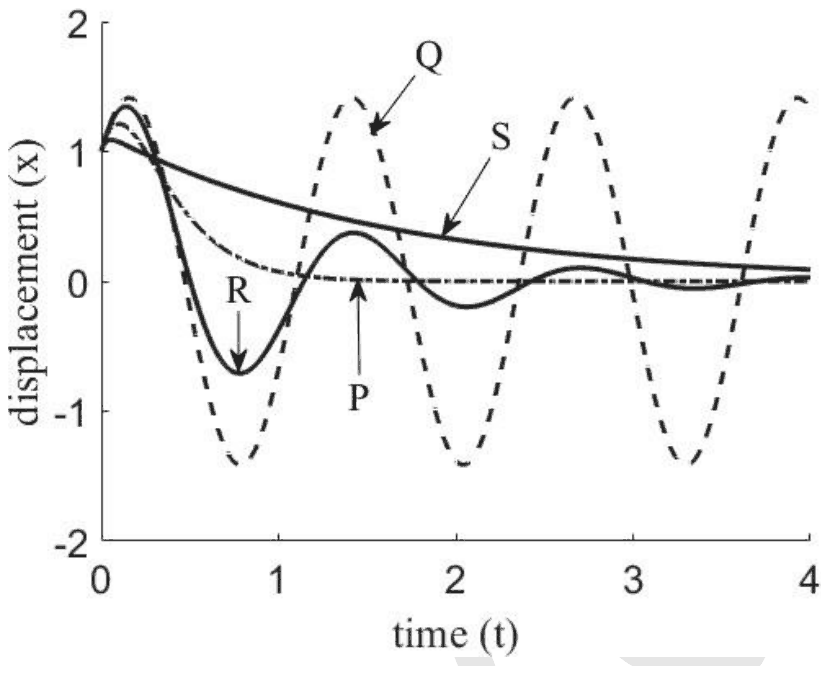
Consider the free vibration responses P, Q, R and S (shown in the figure) of a single degree of freedom spring-mass-damper system with the same initial conditions. For the different damping cases listed below, which one of the following options is correct?

1. Overdamped
2. Underdamped
3. Critically damped
4. Undamped

Displacement x against time t from 0 to 4 for four responses: Q oscillates with constant amplitude, R oscillates with decaying amplitude, P returns quickly to zero without oscillating, S decays slowly without oscillating

Exam Year(s)

GATE AE - 2024,

Answer: C

The matching is P - 3, Q - 4, R - 2, S - 1.

  • Q oscillates with a constant amplitude that never decays: undamped (4).
  • R oscillates about zero with a shrinking amplitude: underdamped (2).
  • P returns to zero without crossing it and faster than any non-oscillating curve: critically damped (3).
  • S also creeps back without oscillating, but much more slowly than P: overdamped (1).

The key distinction is between P and S. Critical damping is the smallest damping that prevents oscillation and gives the quickest non-oscillatory return; more damping than that (overdamping) only slows the return. Options that call P overdamped and S critically damped have them the wrong way round, and those that swap Q and R confuse constant with decaying oscillation.

Please log in or register to report this question.

4.

The damping ratio for a viscously damped spring mass system, governed by the relationship \(m\frac{d^{2}x}{dt^{2}} + c\frac{dx}{dt} + kx = F(t)\), is given by

Exam Year(s)

GATE ME - 2017,

Answer: B

The damping ratio is \(\frac{c}{2\sqrt{km}}\).

The damping ratio is the actual damping coefficient divided by the critical damping coefficient, the value at which the system just stops oscillating:

\[ \begin{aligned} c_{c} &= 2\sqrt{km} = 2m\omega_{n} \\ \zeta &= \frac{c}{c_{c}} = \frac{c}{2\sqrt{km}} \end{aligned} \]

\(c/\sqrt{km}\) is twice the damping ratio. The square-root forms are dimensionally wrong: c/(mk) has units of s3/kg, so its square root is not a pure number.

Please log in or register to report this question.

5.

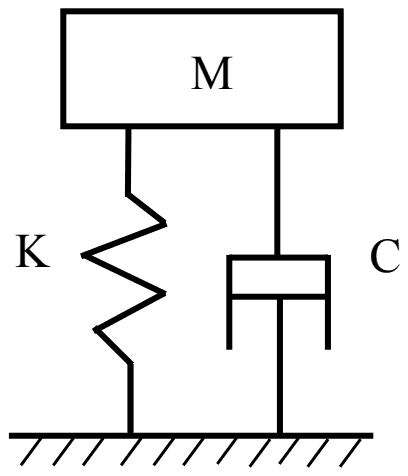
In a single degree of freedom underdamped spring-mass-damper system as shown in the figure, an additional damper is added in parallel such that the system still remains underdamped. Which one of the following statements is ALWAYS true?

Mass M supported on the ground by a spring K and a damper C side by side

Exam Year(s)

GATE ME - 2018,

Answer: C

The statement that is always true is that the time period of free oscillations will increase.

A second damper in parallel adds to the damping coefficient, so the damping ratio ζ rises while the mass and stiffness, and hence the natural frequency ωn, are unchanged. The damped frequency is \(\omega_{d} = \omega_{n}\sqrt{1-\zeta^{2}}\), which falls as ζ rises, so the damped period \(2\pi/\omega_{d}\) gets longer. Because the system stays underdamped, it still oscillates, and this holds whatever the size of the extra damper.

Transmissibility does not change one way always: more damping lowers it for frequency ratios below √2 but raises it above √2. So neither transmissibility option is always true, and a shorter period is the opposite of the correct effect.

Please log in or register to report this question.

6.

A linear spring-mass-dashpot system with a mass of 2 kg is set in motion with viscous damping. If the natural frequency is 15 Hz, and the amplitudes of two successive cycles measured are 7.75 mm and 7.20 mm, the coefficient of viscous damping (in N.s/m) is

Exam Year(s)

GATE ME - 2024,

Answer: A

The damping coefficient is 4.41 N.s/m.

From two successive amplitudes, the logarithmic decrement and damping ratio are

\[ \begin{aligned} \delta &= \ln\frac{7.75}{7.20} = 0.0736 \\ \zeta &= \frac{\delta}{\sqrt{4\pi^{2} + \delta^{2}}} = 0.01171 \end{aligned} \]

The natural frequency is \(\omega_{n} = 2\pi \times 15 = 94.25\) rad/s, so

\[ \begin{aligned} c &= 2\zeta m\omega_{n} \\ &= 2 \times 0.01171 \times 2 \times 94.25 = 4.41 \end{aligned} \]

Forgetting to convert 15 Hz to rad/s would give a value about six times too small, and the other options do not follow from the measured amplitudes.

Please log in or register to report this question.

7.

In a single degree of freedom vibrating system with only viscous damping, the critical damping coefficient is 350 N s/m and the damping coefficient is 35 N s/m.

The logarithmic decrement of the vibrating system is

Exam Year(s)

GATE ME - 2026,

Answer: A

The logarithmic decrement is about 0.63.

The damping ratio is \(\zeta = c/c_{c} = 35/350 = 0.1\). Then

\[ \begin{aligned} \delta &= \frac{2\pi\zeta}{\sqrt{1 - \zeta^{2}}} \\ &= \frac{0.6283}{0.995} = 0.631 \end{aligned} \]

For light damping \(\delta \approx 2\pi\zeta = 0.628\) anyway. 1.26 and 1.89 are two and three times the correct value, and 0.32 is half of it, as if \(\pi\zeta\) were used.

Please log in or register to report this question.

Loading…
Tags: Damped Free Vibration Questions and Answers || Damped Free Vibration MCQ Questions and Answers || Damped Free Vibration GK Questions and Answers || Damped Free Vibration GK MCQ Questions || Damped Free Vibration Multiple Choice Questions and Answers || Damped Free Vibration GK || GK on Damped Free Vibration || Mechanical Vibrations Questions and Answers || Mechanical Vibrations MCQ Questions and Answers || Mechanical Vibrations GK Questions and Answers || GK on Mechanical Vibrations