
Machine-translated by Google. Questions are authored in English.
Top

Free Convection Questions and Answers

1.

In the following two-dimensional momentum equation for natural convection over a surface immersed in a quiescent fluid at temperature \(T_{\infty}\) (\(g\) is the gravitational acceleration, \(\beta\) is the volumetric thermal expansion coefficient, \(\nu\) is the kinematic viscosity, \(u\) and \(v\) are the velocities in \(x\) and \(y\) directions, respectively, and T is the temperature)

\[ \begin{aligned} u\frac{\partial u}{\partial x} + v\frac{\partial u}{\partial y} &= g\beta(T - T_{\infty}) \\ &\quad + \nu\frac{\partial^{2}u}{\partial y^{2}} , \end{aligned} \]

the term \(g\beta(T - T_{\infty})\) represents

Exam Year(s)

GATE ME - 2022,

Answer: D

The term \(g\beta(T - T_{\infty})\) is the buoyancy force per unit mass.

Each term of the boundary-layer momentum equation is a force per unit mass (an acceleration). Where the fluid is warmer than the far field, its density is lower by about \(\rho\beta(T - T_{\infty})\), and gravity acting on that density deficit gives an upward force \(\rho g\beta(T - T_{\infty})\) per unit volume, which is \(g\beta(T - T_{\infty})\) per unit mass. This term drives natural convection.

The viscous force per unit mass is the last term, \(\nu\,\partial^{2}u/\partial y^{2}\). The ratios of forces in the first two options are dimensionless groups (the Reynolds and Grashof numbers), not individual terms of this equation.

Please log in or register to report this question.
2.

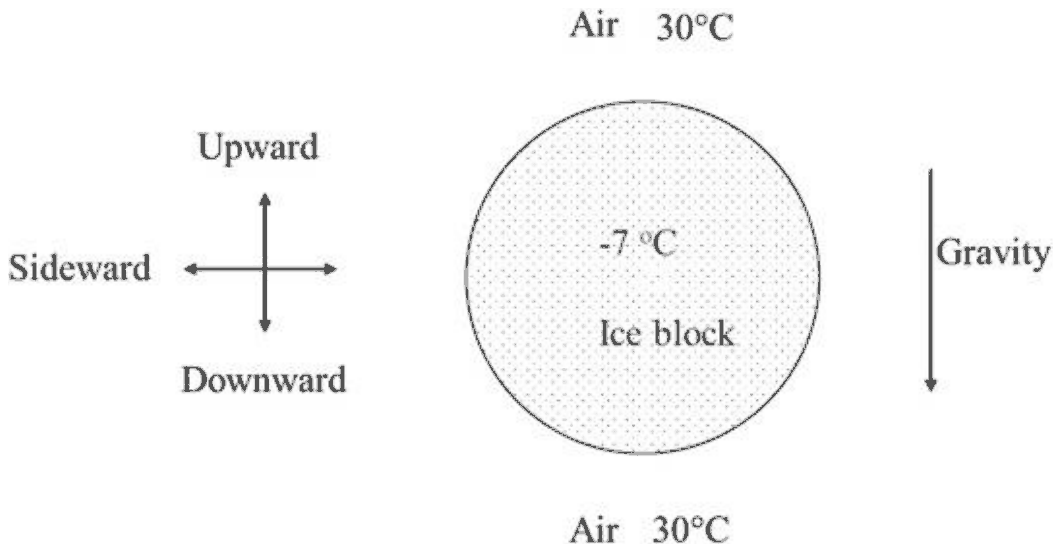
Let a spherical block of ice at -7 °C be exposed to atmospheric air at 30 °C with the gravitational direction as shown in the figure below. What will be the overall direction of air flow in this situation?

A spherical ice block at -7 degrees C surrounded by air at 30 degrees C above and below, gravity pointing down, with a key showing upward, downward and sideward directions

Exam Year(s)

GATE ME - 2025,

Answer: B

The overall air flow is downward.

Air touching the ice is cooled from 30 °C towards -7 °C. Cooler air is denser, so under gravity it sinks, and warmer air from above replaces it. The result is a natural convection current that flows down past the sphere.

Upward flow is what a hot body produces. There is motion because the temperature difference sets up buoyancy forces, and there is no sideward driving force, since gravity acts vertically.

Please log in or register to report this question.
3.

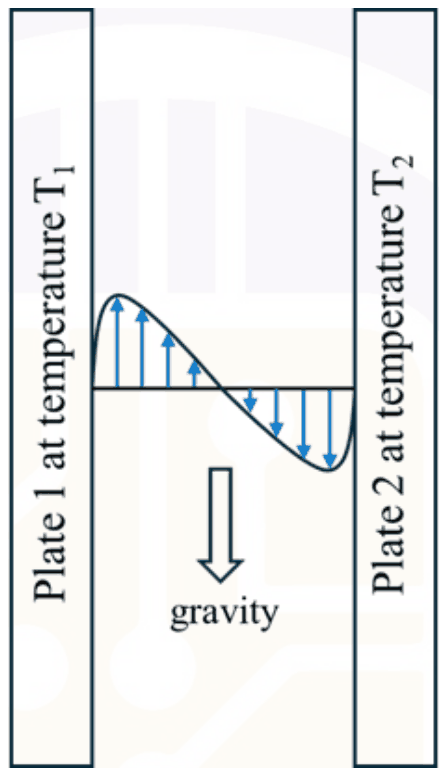
A quiescent fluid at temperature \(T_{3}\) is confined between two vertical parallel plates. While plate 1 is kept at temperature \(T_{1}\) and plate 2 is maintained at temperature \(T_{2}\), a velocity profile between the plates, as shown in the figure below, is generated due to heat transfer. Which one of the following options shows the correct relations among \(T_{1}, T_{2}\), and \(T_{3}\)?

Two vertical plates, plate 1 at T1 on the left and plate 2 at T2 on the right; the velocity profile between them points upward near plate 1 and downward near plate 2; gravity acts downward

Exam Year(s)

GATE ME - 2026,

Answer: A

The relations are \(T_{1} \gt T_{3}\) and \(T_{3} \gt T_{2}\).

The flow is natural convection. Fluid moves upward next to plate 1, so it is lighter there, which means it has been heated: plate 1 is hotter than the fluid, \(T_{1} \gt T_{3}\). Fluid moves downward next to plate 2, so it is heavier there and has been cooled: plate 2 is colder than the fluid, \(T_{3} \gt T_{2}\).

Each of the other options reverses at least one of these, which would reverse the direction of flow at that plate.

Please log in or register to report this question.

4.

The Nusselt number in natural convection heat transfer is a function of Prandtl number and __________.

Exam Year(s)

RSMSSB JE - 2025, RSMSSB - 2025,

Answer: D

In natural convection, Nusselt number is a function of Prandtl number and Grashof number.

Natural convection is driven by buoyancy from density differences, and the Grashof number, \(Gr = \frac{g\beta\Delta T L^{3}}{\nu^{2}}\), measures buoyancy against viscous forces. So the correlations take the form \(Nu = f(Gr, Pr)\), often written through the Rayleigh number \(Ra = Gr \cdot Pr\).

In forced convection the flow is imposed, and Nu is a function of the Reynolds number and Pr. The Stanton number is another way of expressing the forced-convection result, and the Biot number belongs to conduction with surface convection, not to convection correlations.

Please log in or register to report this question.

Loading…
Tags: Free Convection Questions and Answers || Free Convection MCQ Questions and Answers || Free Convection GK Questions and Answers || Free Convection GK MCQ Questions || Free Convection Multiple Choice Questions and Answers || Free Convection GK || GK on Free Convection || Heat Transfer Questions and Answers || Heat Transfer MCQ Questions and Answers || Heat Transfer GK Questions and Answers || GK on Heat Transfer