
Machine-translated by Google. Questions are authored in English.
Top

Vorticity and Circulation Questions and Answers

Answer: A

Vertical alignment removes the westward tilt required for the conversion of available potential energy, so the system stops deepening and begins to decay under friction. This is the classical occlusion signature. Reinforcement requires the tilt rather than the alignment, and the movement of a system is governed by the steering flow, which does not reverse simply because the structure has become upright.

Please log in or register to report this question.
Answer: B

Occlusion is the stage at which the cold front overtakes the warm front and the vorticity maximum becomes vertically aligned with the surface low. Cyclolysis is the subsequent decay, frontogenesis is the sharpening of a temperature gradient, and warm seclusion is a particular structure occurring in some very intense maritime cyclones. The terms describe successive or distinct stages and are worth keeping in order.

Please log in or register to report this question.

Answer: C

In natural coordinates the curvature contribution to vorticity is \( V/R \), where the square of the speed over the radius belongs to the centrifugal acceleration rather than to the vorticity. Confusing the two is a common error, since both involve speed and radius. The shear contribution completes the decomposition, and the Coriolis parameter enters absolute vorticity separately rather than through the curvature.

Please log in or register to report this question.

Answer: D

Dividing 20 metres per second by a radius of \( 5 \times 10^{5} \) metres gives \( 4 \times 10^{-5} \) per second from curvature alone, which is a substantial fraction of the Coriolis parameter and a clearly significant vorticity maximum. Shear would add to this but the curvature term alone gives a useful estimate, which is exactly why the natural coordinate decomposition is so handy for reading a chart by eye.

Please log in or register to report this question.

105.

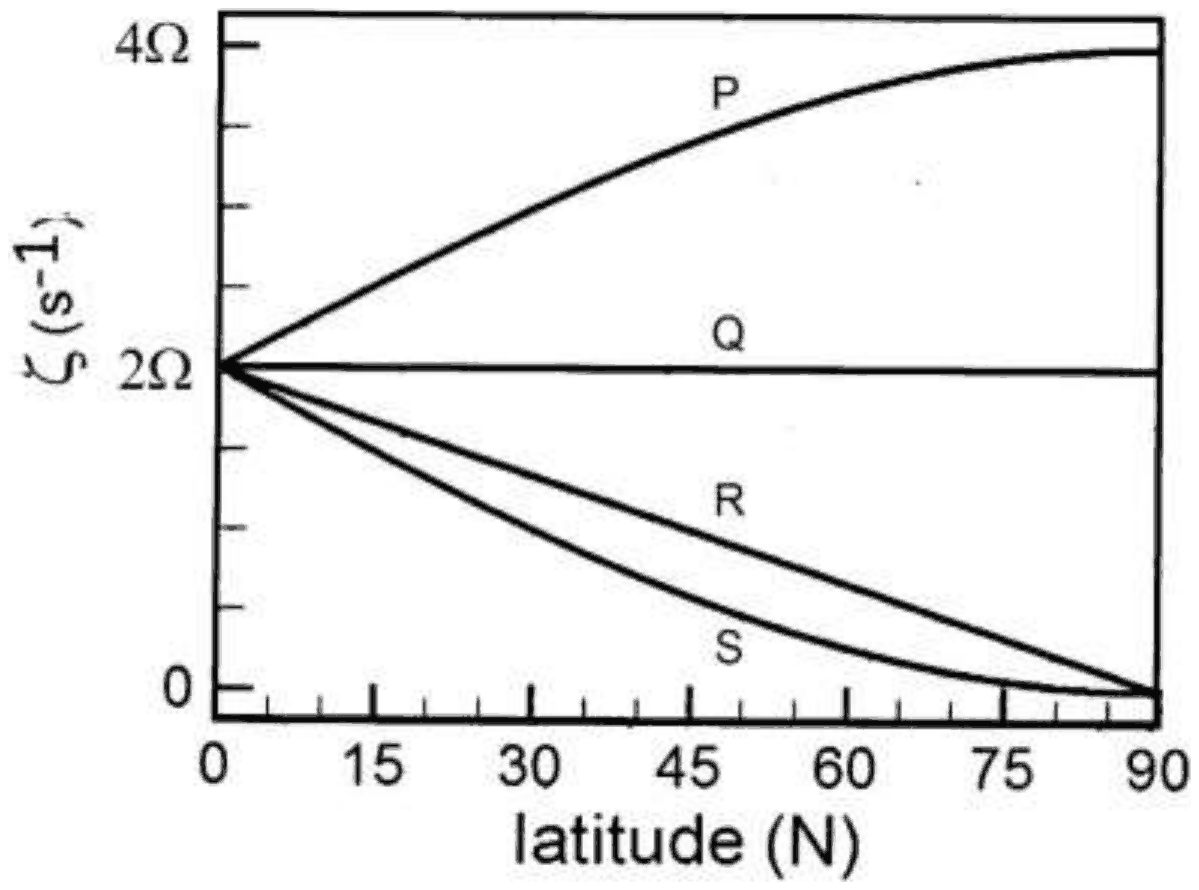
For an inviscid and barotropic ocean of constant depth (D), a water parcel with initial vorticity 2Ω is displaced from the equator to the north pole. Latitudinal variation of the parcel vorticity (ζ) is well represented by the curve

Vorticity zeta against latitude from 0 to 90 N, all curves starting at 2 Omega: P rises to 4 Omega, Q stays at 2 Omega, R falls linearly to 0 and S falls to 0 along a curve that bends below R and flattens near the pole

Exam Year(s)

GATE XE - 2018,

Answer: A

The curve is S.

For an inviscid barotropic ocean of constant depth, potential vorticity conservation reduces to conservation of absolute vorticity, \(\zeta + f\), where \(f = 2\Omega\sin\phi\). At the equator f = 0, so \(\zeta + f = 2\Omega\) throughout, and

\[ \zeta = 2\Omega(1 - \sin\phi) \]

This falls from \(2\Omega\) at the equator to 0 at the pole. It falls fastest near the equator, where \(\sin\phi\) grows quickly, and flattens near the pole, so it bends below the straight line: curve S.

R falls linearly with latitude, which would need \(\sin\phi\) to grow uniformly. Q keeps the relative vorticity constant, ignoring the change in f, and P adds f instead of subtracting it.

Please log in or register to report this question.

106.

A fluid is in solid body rotation in a cylindrical container of radius \(R\) rotating with an angular velocity \(\boldsymbol{\Omega} = (0, 0, \Omega)\). The circulation per unit area around a circular loop in the horizontal plane of radius \(r\) (\(r \lt R\)), whose center coincides with the axis of rotation is

Exam Year(s)

GATE XE - 2022,

Answer: A

The circulation per unit area is \(2\Omega\).

In solid body rotation the speed at radius r is \(v = \Omega r\). Around the circle of radius r:

\[ \begin{aligned} \Gamma &= \oint \mathbf{v}\cdot d\mathbf{l} = \Omega r \cdot 2\pi r = 2\pi\Omega r^{2} \\ \frac{\Gamma}{\pi r^{2}} &= 2\Omega \end{aligned} \]

This is the vorticity of solid body rotation, twice the angular velocity (Stokes' theorem). \(\Omega/2\) and \(\Omega/4\) divide instead of multiply, and \(\Omega^{2}\) has the wrong dimensions for a vorticity.

Please log in or register to report this question.

Answer: B

The vertical component of relative vorticity is \(Y = \frac{\delta v}{\delta x} - \frac{\delta u}{\delta y}\) (the paper writes the vorticity as Y).

Relative vorticity is the curl of the wind, and its vertical component, usually written \(\zeta\), is

\[ \zeta = \partial v/\partial x - \partial u/\partial y \]

where \(u\) and \(v\) are the eastward and northward wind components. It is positive for anticlockwise rotation in the northern hemisphere.

The sum of \(\partial u/\partial x\) and \(\partial v/\partial y\) is the horizontal divergence, not vorticity. The difference \(\partial u/\partial x - \partial v/\partial y\) is a stretching deformation, and the sum of second derivatives is not a vorticity expression.

Please log in or register to report this question.

108.

The angular velocity of the Earth is \(\Omega\), then the vorticity of the earth is :

Exam Year(s)

MH SET - 2019, SET Exam - 2019,

Answer: B

The vorticity of the Earth is 2 \(\Omega\).

A body rotating as a solid with angular velocity \(\Omega\) has velocity \(\mathbf{v} = \boldsymbol{\Omega} \times \mathbf{r}\), and its vorticity is

\[ \begin{aligned} \zeta &= \nabla \times (\Omega \times r) \\ &= 2\Omega \end{aligned} \]

So the planetary vorticity is twice the angular velocity, and its local vertical component is \(2\Omega\sin\phi\), the Coriolis parameter f.

Taking the vorticity equal to \(\Omega\) confuses vorticity with angular velocity, and the factors 3 and 1/2 have no basis in solid-body rotation.

Please log in or register to report this question.

Loading…
Tags: Vorticity and Circulation Questions and Answers || Vorticity and Circulation MCQ Questions and Answers || Vorticity and Circulation GK Questions and Answers || Vorticity and Circulation GK MCQ Questions || Vorticity and Circulation Multiple Choice Questions and Answers || Vorticity and Circulation GK || GK on Vorticity and Circulation || Atmospheric Dynamics Questions and Answers || Atmospheric Dynamics MCQ Questions and Answers || Atmospheric Dynamics GK Questions and Answers || GK on Atmospheric Dynamics