
Machine-translated by Google. Questions are authored in English.
Top

Central Forces and Kepler Problem Questions and Answers

1.

An interstellar object has speed \(v\) at the point of its shortest distance \(R\) from a star of much larger mass \(M\). Given \(v^{2} = 2GM/R\), the trajectory of the object is

Exam Year(s)

GATE Physics - 2018,

Answer: C

The trajectory is a parabola.

The total energy per unit mass at closest approach is

\[ \begin{aligned} \varepsilon &= \frac{v^{2}}{2} - \frac{GM}{R} \\ &= \frac{GM}{R} - \frac{GM}{R} = 0 \end{aligned} \]

The sign of the energy fixes the conic: negative for bound orbits (circle or ellipse), zero for a parabola, positive for a hyperbola. Here \(v\) is exactly the escape speed \(\sqrt{2GM/R}\), so the energy is zero and the path is a parabola.

A circular orbit would need \(v^{2} = GM/R\), and any speed between that and escape speed gives an ellipse. A hyperbola needs \(v^{2} \gt 2GM/R\).

Please log in or register to report this question.

2.

An \(\alpha\) particle moves towards a fixed nucleus carrying charge \(Ze\), with initial speed \(v_{0}\) and impact parameter \(b\). Starting from a large distance from the nucleus, its distance of closest approach is \(r_{m}\) and its speed there is \(v_{m}\). Then which of the following options is/are correct?

(\(k = \frac{1}{4\pi\epsilon_{0}}\) and \(r_{0} = k\frac{Ze^{2}}{mv_{0}^{2}}\))

Exam Year(s)

GATE Physics - 2026,

Answer: A

The correct statement is \(v_{0}b = v_{m}r_{m}\).

The Coulomb force is central, so angular momentum about the nucleus is conserved. Far away it is \(mv_{0}b\); at closest approach the velocity is perpendicular to the radius, so it is \(mv_{m}r_{m}\). Hence \(v_{0}b = v_{m}r_{m}\).

Energy conservation, with the alpha particle's charge 2e, gives \(v_{0}^{2} = v_{m}^{2} + 4r_{0}v_{0}^{2}/r_{m}\). Using \(v_{m} = v_{0}b/r_{m}\):

\[ \begin{aligned} r_{m}^{2} - 4r_{0}r_{m} - b^{2} &= 0 \\ r_{m} &= 2r_{0} + \sqrt{4r_{0}^{2} + b^{2}} \\ &\approx 4r_{0} + \frac{b^{2}}{4r_{0}} \end{aligned} \]

So the correction is \(b^{2}/4r_{0}\), not \(b^{2}/2r_{0}\) or \(b^{2}/8r_{0}\). And \(v_{0}b = 2v_{m}r_{0}\) would need \(r_{m} = 2r_{0}\), less than the head-on value \(4r_{0}\). Only the angular momentum statement holds.

Please log in or register to report this question.

3.

There are three planets in circular orbits around a star at distances a, 4a and 9a, respectively. At time \(t = t_{0}\), the star and the three planets are in a straight line. The period of revolution of the closest planet is T. How long after \(t_{0}\) will they again be in the same straight line?

Exam Year(s)

IIT JAM - 2018,

Answer: C

The key gives 216T.

By Kepler's third law the period grows as the radius to the power 3/2:

\[ \begin{aligned} T_{4a} &= T(4)^{3/2} = 8T \\ T_{9a} &= T(9)^{3/2} = 27T \end{aligned} \]

All three planets are back where they started, in the same line as at \(t_{0}\), after a whole number of each period: the least common multiple of \(T\), \(8T\) and \(27T\), which is \(216T\).

The key reads 'the same straight line' as the same configuration, all planets on the same side as at \(t_{0}\). If a planet on the opposite side of the star also counted, an earlier alignment (at \(108T\)) would qualify, but that is not offered. \(8T\) and \(27T\) are single periods, and \(512T\) is \(8^{3}\), not a common multiple built from these periods.

Please log in or register to report this question.
4.

A satellite is moving around the earth in a circular orbit at a height of 2R, from the earth surface. R is the radius of the earth. The speed of satellite is :

Exam Year(s)

MH SET - 2018, SET Exam - 2018,

Answer: C

The speed is \((gR/3)^{1/2}\).

At a height 2R above the surface the orbital radius is \(r = R + 2R = 3R\). Gravity provides the centripetal force, and \(GM = gR^{2}\) at the surface:

\[ \begin{aligned} \frac{mv^{2}}{r} &= \frac{GMm}{r^{2}} \\ v^{2} &= \frac{GM}{3R} = \frac{gR^{2}}{3R} = \frac{gR}{3} \\ v &= (gR/3)^{1/2} \end{aligned} \]

The option \((gR/2)^{1/2}\) takes the radius as 2R, forgetting to add the earth's radius to the height. The options gR/3 and gR/2 are values of \(v^{2}\), not of v, and do not have the dimensions of speed.

Please log in or register to report this question.
5.

An artificial satellite revolves about the earth at height H (H \(\ll\) R, R = radius of earth). The orbital period, for which a man in the satellite will be in state of weightlessness is given as :

Exam Year(s)

MH SET - 2019, SET Exam - 2019,

Answer: B

The period is \(2\pi\sqrt{R/g}\).

For a satellite close to the earth (\(H \ll R\)), gravity supplies the centripetal force, and \(GM = gR^{2}\):

\[ \begin{aligned} \frac{mv^{2}}{R} &= mg \Rightarrow v = \sqrt{gR} \\ T &= \frac{2\pi R}{v} = 2\pi\sqrt{\frac{R}{g}} \end{aligned} \]

In such an orbit the man and the satellite fall freely together, so he is weightless. This is about 84 minutes. The option \(2\pi\sqrt{g/R}\) has the ratio inverted and is not even a time, and the \(1/2\pi\) options are frequencies rather than periods.

Please log in or register to report this question.

6.

For repulsive inverse square force, the shape of the orbit is :

Exam Year(s)

MH SET - 2019, SET Exam - 2019,

Answer: C

For a repulsive inverse square force the orbit is Hyperbolic.

With a repulsive force, such as an alpha particle approaching a nucleus in Rutherford scattering, the effective potential is positive everywhere and the total energy is always positive. A positive-energy orbit in an inverse square field is a hyperbola, with the force centre at the outer focus.

Circular and elliptical orbits are bound orbits, possible only for an attractive force with negative total energy, and the parabola is the zero-energy boundary case of an attractive force.

Please log in or register to report this question.

7.

For a particle moving under the action of a central force, the correct relation between the energy (E) of the particle, eccentricity (e) of the conic section describing the orbit, reduced mass (μ), angular momentum (\(\bar{l}\)), and the force constant (k) is given by :

Exam Year(s)

MH SET - 2023, SET Exam - 2023,

Answer: A

The relation is \(E = \frac{\mu k^{2}}{2l^{2}}(e^{2} - 1)\).

For the inverse-square force with potential \(-k/r\), the orbit equation gives the eccentricity in terms of energy and angular momentum:

\[ \begin{aligned} e &= \sqrt{1 + \frac{2El^{2}}{\mu k^{2}}} \\ e^{2} - 1 &= \frac{2El^{2}}{\mu k^{2}} \end{aligned} \]

Rearranging gives the first option. It also has the right physics: bound orbits (e < 1) have negative energy, the parabola (e = 1) has zero energy and hyperbolas (e > 1) positive energy. The options with \(1 + e^{2}\) or \(e^{2} + 1\) are always positive, and \((1 - e^{2})\) without the factor 1/2 has the wrong sign and size.

Please log in or register to report this question.

8.

The velocities of a satellite (orbiting around earth) at perigee and apogee points are 25 km/s and 10 km/s respectively. If the perigee distance from the centre of the earth is 10000 km, what is the apogee distance ?

Exam Year(s)

MH SET - 2024, SET Exam - 2024,

Answer: A

The apogee distance is 25000 km.

At perigee and apogee the velocity is perpendicular to the radius, so conservation of angular momentum gives \(v_{p}r_{p} = v_{a}r_{a}\):

\[ \begin{aligned} r_{a} &= \frac{v_{p}r_{p}}{v_{a}} \\ &= \frac{25 \times 10000}{10} \\ &= 25000\ \text{km} \end{aligned} \]

The satellite moves slowest when farthest away, so the apogee distance must exceed 10000 km; 2500 km and 2000 km get the ratio upside down, and 20000 km does not satisfy \(v_{p}r_{p} = v_{a}r_{a}\).

Please log in or register to report this question.

9.

Laplace-Runge Lenz vector \(\vec{A}\) is defined as :

\[ \vec{A} = \vec{p} \times \vec{l} - \frac{\mu k \vec{r}}{r} \]

where \(\vec{l}\) is angular momentum vector, \(\vec{p}\) is linear momentum vector, \(\mu\) is the reduced mass, and \(\vec{r}\) is the radius vector. If \(\vec{A}\) is conserved for motion in \(-k/r\) potential, then the direction of \(\vec{A}\) in an elliptical orbit is :

Exam Year(s)

MH SET - 2024, SET Exam - 2024,

Answer: C

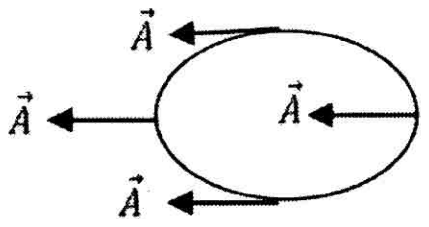
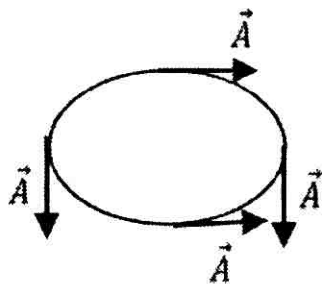
The Laplace-Runge-Lenz vector stays fixed in direction, so the answer is the figure in which every arrow points the same way: (C).

For a \(-k/r\) potential the vector \(\vec{A}\) is a constant of the motion. It lies along the major axis of the ellipse, pointing from the focus towards the perihelion, and neither its length nor its direction changes as the particle goes round the orbit. That is also why the orbit closes and does not precess.

In (C) all four arrows are parallel to the major axis and point the same way. In (A) the arrows turn through left, up, right and down as the particle moves around the ellipse, as a tangent or a velocity would. In (B) and (D) the arrows also change direction from point to point. A vector that changes direction around the orbit cannot be conserved.

Please log in or register to report this question.

Loading…
Tags: Central Forces and Kepler Problem Questions and Answers