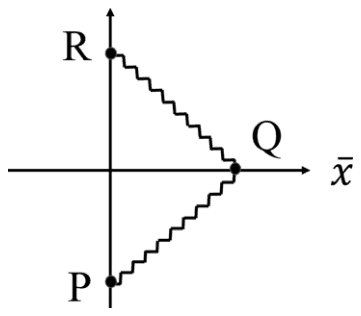
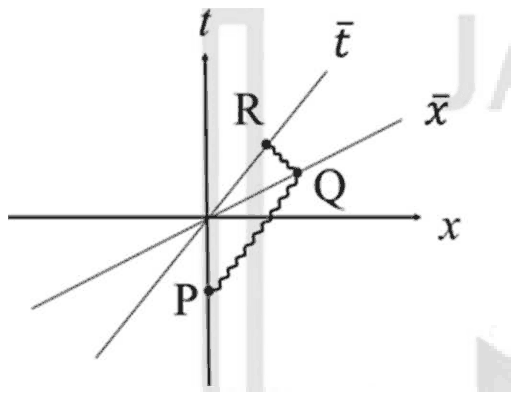
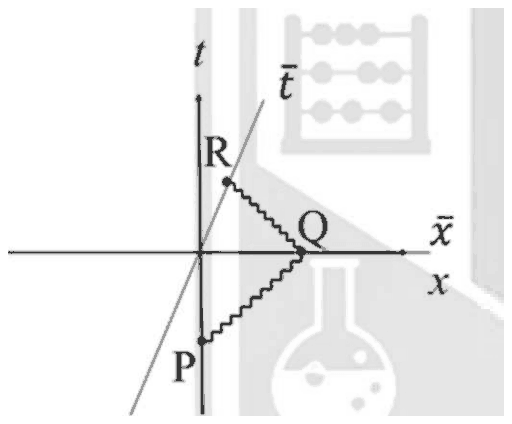
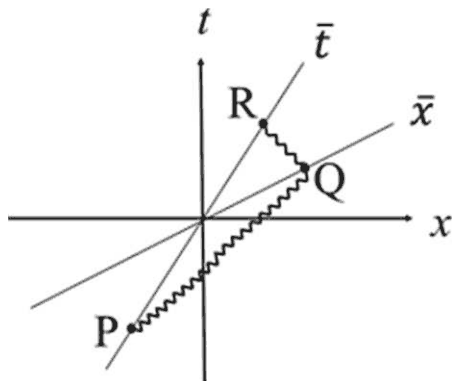
A rod \(PQ\) of proper length \(L\) lies along the \(x\)-axis and moves towards the positive \(x\) direction with speed \(v = \frac{3c}{5}\) with respect to the ground (see figure), where \(c\) is the speed of light in vacuum. An observer on the ground measures the positions of \(P\) and \(Q\) at different times \(t_{P}\) and \(t_{Q}\) respectively in the ground frame, and finds the difference betwen them to be \(\frac{9L}{10}\). What is the value of \(t_{Q} - t_{P}\)?
(The figure shows the rod on the \(x\)-axis with \(P\) at its rear end and \(Q\) at its front end, moving with velocity \(v\) away from the origin \(O\).)
GATE Physics - 2023,
Answer: C
The time difference is \(t_{Q} - t_{P} = \frac{L}{6c}\).
In the ground frame the rod is contracted to \(L/\gamma\), with \(\gamma = 1/\sqrt{1 - 9/25} = 5/4\), so its length there is \(4L/5\). Q is the front end. If P's position is read at \(t_{P}\) and Q's at the later time \(t_{Q}\), Q has moved on by \(v(t_{Q} - t_{P})\) in the meantime:
\[ \begin{aligned} \frac{4L}{5} + \frac{3c}{5}(t_{Q} - t_{P}) &= \frac{9L}{10} \\ t_{Q} - t_{P} &= \frac{L/10}{3c/5} = \frac{L}{6c} \end{aligned} \]
The other values do not satisfy this relation: \(L/3c\), for example, would put the ends \(L\) apart, and \(2L/3c\) even further.
Please log in or register to report this question.