
Machine-translated by Google. Questions are authored in English.
Top

Newtonian Mechanics and Conservation Laws Questions and Answers

1.

On a horizontal plane, a projectile of mass \(m\) is launched from the ground with speed \(v_{0}\) at an angle \(\theta_{0}\) with the horizontal. In addition to the gravitational force (\(mg\)), it also experiences a drag force \(\vec{F}_{drag} = -\gamma\vec{v}\), where \(\vec{v}\) is its velocity and \(\gamma\) is a constant. It hits the ground at a distance \(R\) from the point of launch with its velocity making an angle \(\theta\) with the horizontal, as shown schematically in the figure. Then which of the following options is correct?
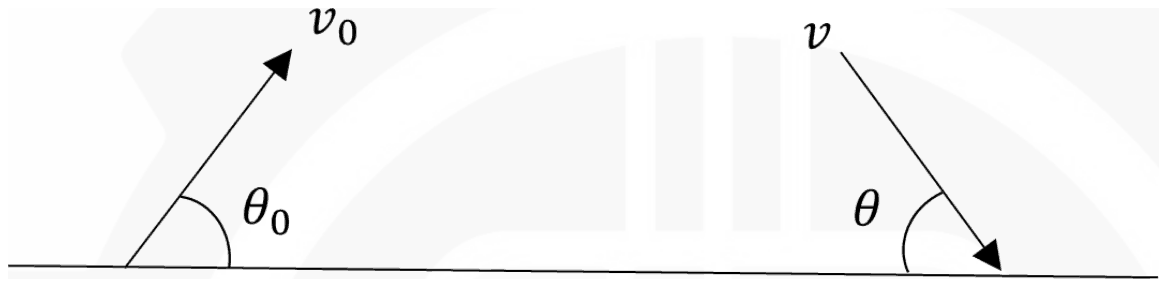
Launch velocity v0 at angle theta0 above the ground and impact velocity v at angle theta below the horizontal

Exam Year(s)

GATE Physics - 2026,

Answer: C

The correct option is \(R \lt v_{0}^{2}\sin 2\theta_{0}/g\) and \(\theta \gt \theta_{0}\).

Without drag the range is \(v_{0}^{2}\sin 2\theta_{0}/g\) and the path is symmetric, landing at the launch angle. A drag force opposite to the velocity takes energy out throughout the flight, so the projectile cannot go as far: \(R\) is less than the drag-free range.

Drag also keeps reducing the horizontal velocity, \(dv_{x}/dt = -(\gamma/m)v_{x}\), so the horizontal speed at impact is less than \(v_{0}\cos\theta_{0}\). The descent is therefore steeper than the ascent, and the impact angle exceeds the launch angle. The options with '=' apply a drag-free formula, and the options with \(\theta \lt \theta_{0}\) get the asymmetry the wrong way round.

Please log in or register to report this question.
2.

A raindrop falls under gravity and captures water molecules from atmosphere. Its mass changes at the rate \(\lambda m(t)\), where \(\lambda\) is a positive constant and m(t) is the instantaneous mass. Assume that acceleration due to gravity is constant and water molecules are at rest with respect to earth before capture. Which of the following statements is correct?

Exam Year(s)

IIT JAM - 2018,

Answer: C

The answer is the speed approaches a constant value when \(\lambda t \gg 1\).

The captured molecules start at rest, so Newton's law for variable mass reads

\[ \begin{aligned} \frac{d(mv)}{dt} &= mg \\ m\frac{dv}{dt} + \lambda m v &= mg \\ v(t) &= \frac{g}{\lambda}\left(1 - e^{-\lambda t}\right) \end{aligned} \]

For \(\lambda t \gg 1\) the exponential dies away and the drop approaches the terminal speed \(g/\lambda\). For \(\lambda t \ll 1\) the speed is about \(gt\), growing linearly, not constant. The speed never grows exponentially; the exponential term decays.

Please log in or register to report this question.
3.

A particle of mass \(m\) moves in a potential given by

\[ V(x,y,z) = -k\frac{y}{(x^{2}+y^{2}+z^{2})}, \]

where \(k\) is a constant.

Which of the following statements is correct?

Exam Year(s)

IIT JAM - 2026,

Answer: B

The correct statement is that angular momentum of the system is not conserved.

The potential \(V = -k\,y/r^2\) depends on direction as well as on \(r = \sqrt{x^2 + y^2 + z^2}\). A central force needs a potential that depends on \(r\) alone; this one does not, so the force has components across the radius and exerts a torque \(\vec{r} \times \vec{F} \neq 0\). Angular momentum therefore changes.

The force is not central, so that statement is false. \(V\) depends on \(y\), so \(F_y = -\partial V/\partial y \neq 0\) and linear momentum along \(y\) is not conserved. \(V\) does not depend on time, so the force is conservative and the total energy is conserved, which rules out the last statement.

Please log in or register to report this question.
4.

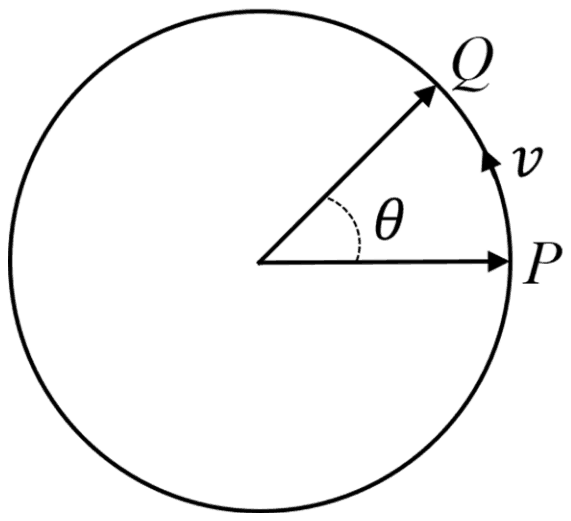
A particle is rotating along a circular path with uniform speed \(v\), as shown in the figure. While moving from the point \(P\) to \(Q\) subtending an angle \(\theta\), the magnitude of the change in its velocity is:

Circle with radii from the centre to P and to Q making the angle theta at the centre; the particle moves along the circle from P to Q with speed v

Exam Year(s)

IIT JAM - 2026,

Answer: C

The magnitude of the change in velocity is \(2v\sin\frac{\theta}{2}\).

The speed stays \(v\), but the velocity, which is tangent to the circle, turns through the same angle \(\theta\) as the radius. Placed tail to tail, the initial and final velocities form an isosceles triangle with two sides \(v\) and angle \(\theta\) between them, and \(\Delta\vec{v}\) is its third side:

\[ \begin{aligned} |\Delta\vec{v}|^{2} &= v^{2} + v^{2} - 2v^{2}\cos\theta \\ &= 4v^{2}\sin^{2}\tfrac{\theta}{2} \end{aligned} \]

So \(|\Delta\vec{v}| = 2v\sin\frac{\theta}{2}\). Zero is the change in speed, not velocity. \(v\cos\theta\) and \(v\cos\frac{\theta}{2}\) are projections, not the length of the difference vector; for \(\theta = 180^\circ\) the correct form gives \(2v\), a full reversal.

Please log in or register to report this question.
5.

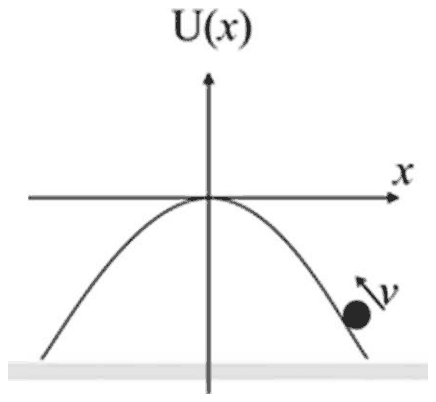
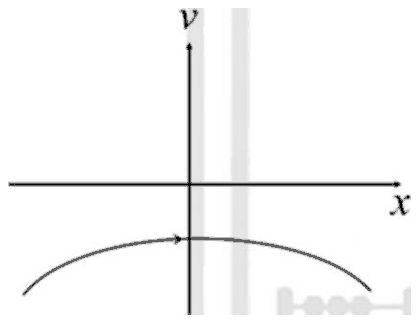
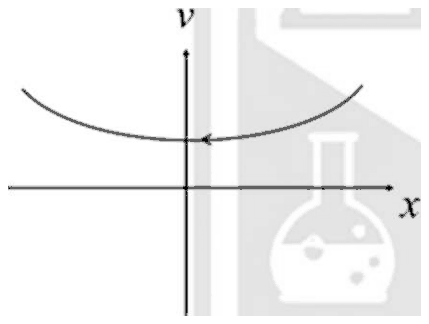
A ball of mass \(m\) climbs the potential \(U(x) = -\frac{1}{2}kx^{2}\), as shown in the figure. Assuming that the total energy of the system \(E = \frac{1}{2}mv^{2} + U(x)\) is conserved, which of the following correctly describe(s) the plot of velocity (\(v\)) as a function of position (\(x\)) of the system for \(E \lt 0\)?

Plot of U(x) against x: an inverted parabola with its maximum at the origin, with a ball on the right-hand slope moving up with velocity v

Exam Year(s)

IIT JAM - 2026,

Answer: D

The correct plot is (D), a hyperbola branch that starts at a positive \(x\) and never reaches the \(v\) axis.

Energy conservation gives \(\frac{1}{2}mv^{2} = E - U = E + \frac{1}{2}kx^{2}\), so

\[ v^{2} = \frac{k}{m}\left(x^{2} - x_{0}^{2}\right), \]

where \(x_{0}^{2} = -\frac{2E}{k}\).

With \(E \lt 0\), \(x_{0}^{2} \gt 0\). Real velocities exist only for \(|x| \geq x_{0}\), where the particle is on the hill below its energy level; for \(|x| \lt x_{0}\) the potential energy \(U\) is higher than \(E\), which is forbidden. The curve \(v\) against \(x\) is a hyperbola whose branch on the right (the side the ball climbs on) crosses the \(x\) axis at \(x_{0}\), at the turning point where the ball stops.

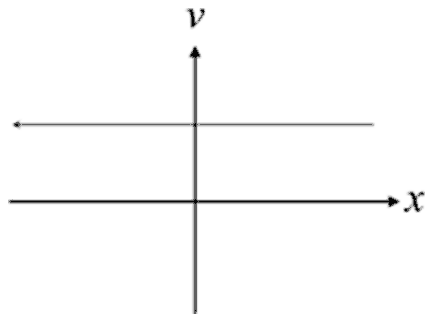
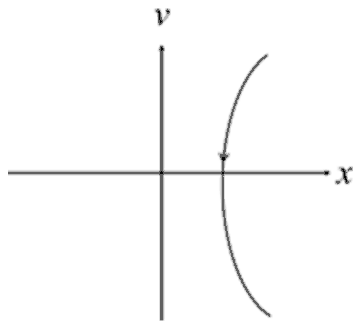
(A) and (B) are closed arcs of the kind \(v^{2} = c - \frac{k}{m}x^{2}\), the trace of an oscillation in a well. (C) is a constant speed, which happens only with no force. Only (D) matches \(v^{2} \propto x^{2} - x_{0}^{2}\). The official key lists only D.

Please log in or register to report this question.
6.

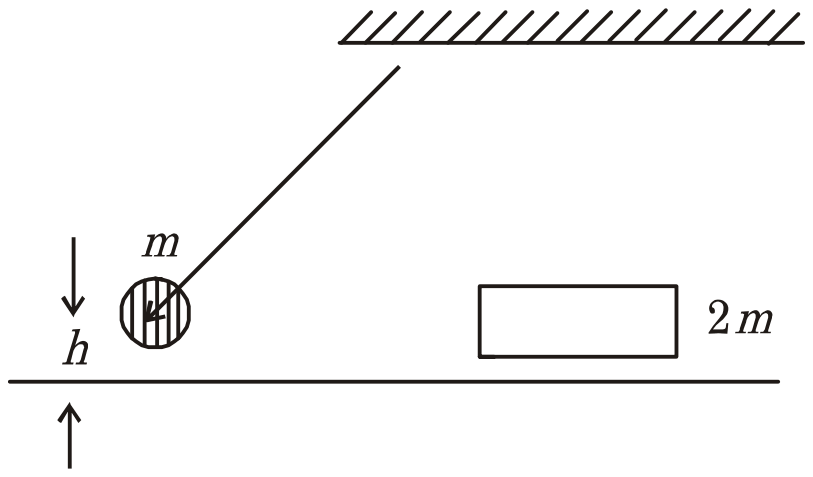
As shown in the figure a ball of mass m suspended by an inextensible massless string is released from height h and collides elastically when it is at its lowest point with a block of mass 2m at rest on a frictionless surface. After the collision the ball will rise to a total height equal to :

A ball of mass m hanging from a string fixed to the ceiling, the height h marked beside it, and a block of mass 2m on the floor

Exam Year(s)

MH SET - 2018, SET Exam - 2018,

Answer: A

The ball rises to h/9.

Just before impact the ball's speed is \(u = \sqrt{2gh}\). In a one-dimensional elastic collision of mass \(m_{1} = m\) with a stationary \(m_{2} = 2m\), the first body's velocity after impact is

\[ \begin{aligned} v_{1} &= \frac{m_{1} - m_{2}}{m_{1} + m_{2}}\,u \\ &= \frac{m - 2m}{3m}\,u = -\frac{u}{3} \end{aligned} \]

The ball rebounds with a third of its speed. The height reached scales as the square of the speed:

\[ \begin{aligned} h' &= \frac{v_{1}^{2}}{2g} \\ &= \frac{1}{9}\cdot\frac{u^{2}}{2g} = \frac{h}{9} \end{aligned} \]

The option h/3 forgets to square the speed ratio, and 2h/3 and h/8 do not follow from the elastic collision formulas.

Please log in or register to report this question.
7.

A man jumps from a height in a deep pool of water. If the net frictional force of water F is proportional to the instantaneous speed V of the man, i.e., F = kV; what is the terminal velocity of the man ? The mass of the man is m.

Exam Year(s)

MH SET - 2018, SET Exam - 2018,

Answer: A

The terminal velocity is \( mg/k \).

The man accelerates until the resisting force balances his weight; then the net force is zero and the speed stays constant:

\[ kV_{t} = mg \quad \Rightarrow \quad V_{t} = \frac{mg}{k} \]

Solving \( m\,dV/dt = mg - kV \) gives \( V = \frac{mg}{k}(1 - e^{-kt/m}) \), which approaches the same value. (Buoyancy is ignored, as the question does.)

The multiples \( 2mg/k \), \( \frac{1}{2}mg/k \) and \( \frac{3}{2}mg/k \) do not satisfy the force balance for a resistance that is simply \( kV \).

Please log in or register to report this question.
8.

A man of mass m in an initially stationary boat of mass M gets off the boat by jumping to the left in an exact horizontal direction. Immediately after the jump, the boat is observed to be moving to the right at speed v. How much total work did the man do ? (Neglect friction)

Exam Year(s)

MH SET - 2018, SET Exam - 2018,

Answer: D

The man does work \( \frac{1}{2}\left(M + \frac{M^{2}}{m}\right)v^{2} \).

Momentum is conserved horizontally, so the man's speed \( u \) is fixed by \( mu = Mv \). The work he does appears as the kinetic energy of both bodies:

\[ \begin{aligned} u &= \frac{Mv}{m} \\ W &= \frac{1}{2}Mv^{2} + \frac{1}{2}m\left(\frac{Mv}{m}\right)^{2} \\ &= \frac{1}{2}\left(M + \frac{M^{2}}{m}\right)v^{2} \end{aligned} \]

\( \frac{1}{2}Mv^{2} \) counts only the boat's energy. \( \frac{1}{2}mv^{2} \) gives the man the boat's speed, and \( \frac{1}{2}(M + m)v^{2} \) gives both bodies the speed \( v \), which momentum conservation forbids unless \( m = M \).

Please log in or register to report this question.

9.

A projectile is fired with initial velocity \(v_{0}\) making an angle \(\alpha\) with the horizontal axis. The range (R) of the projectile is proportional to, (Neglect the air resistance) :

Exam Year(s)

MH SET - 2019, SET Exam - 2019,

Answer: D

The range is proportional to \(v_{0}^{2}\) and sin 2\(\alpha\).

The time of flight is \(T = 2v_{0}\sin\alpha/g\), and the horizontal velocity is \(v_{0}\cos\alpha\), so:

\[ \begin{aligned} R &= v_{0}\cos\alpha \cdot \frac{2v_{0}\sin\alpha}{g} \\ &= \frac{v_{0}^{2}\sin 2\alpha}{g} \end{aligned} \]

The range therefore grows as the square of the launch speed and as \(\sin 2\alpha\), which is why it is greatest at 45°. Options with \(v_{0}\) to the first power, or with \(\sin\alpha\), each miss one of the two factors.

Please log in or register to report this question.

10.

A mouse of mass m jumps on a freely rotating disc of moment of inertia I and radius R. If \(\omega_{0}\) and \(\omega\) are the angular velocities of the disc before and after mouse jumps, then the ratio \(\omega/\omega_{0}\) is :

Exam Year(s)

MH SET - 2020, SET Exam - 2020,

Answer: C

The ratio is I/(I + mR\(^{2}\)), printed as 'I/I + mR\(^{2}\)'.

No external torque acts about the axis, so angular momentum is conserved. The mouse lands at the rim, adding a moment of inertia \(mR^{2}\):

\[ \begin{aligned} I\omega_{0} &= (I + mR^{2})\omega \\ \frac{\omega}{\omega_{0}} &= \frac{I}{I + mR^{2}} \end{aligned} \]

The disc slows down, so the ratio is less than 1. \(I/mR^{2}\) and \((I - mR^{2})/I\) do not follow from conservation, and \(I/(I - mR^{2})\) would mean the disc speeds up when mass is added.

Please log in or register to report this question.

Loading…
Tags: Newtonian Mechanics and Conservation Laws Questions and Answers