
Machine-translated by Google. Questions are authored in English.
Top

Memory Hierarchy Questions and Answers

1.

Select the option that best describes the truthfulness of the following statements. i) RAM is a volatile memory having a limited storage capacity. ii) Secondary memory is storage other than the RAM and ROM.

Exam Year(s)

DSSSB TGT - 2023,

Answer: A

Both statements are true. RAM is volatile memory, which loses its contents when power is switched off, and it has a limited storage capacity. Secondary memory is the storage other than RAM and ROM, such as hard disks, and it keeps data permanently. Marking either statement as false would be wrong, so the first option is correct. RAM is the main working memory of the computer, and secondary memory such as a hard disk or an SSD is where files are kept when the power is off.

Please log in or register to report this question.
2.

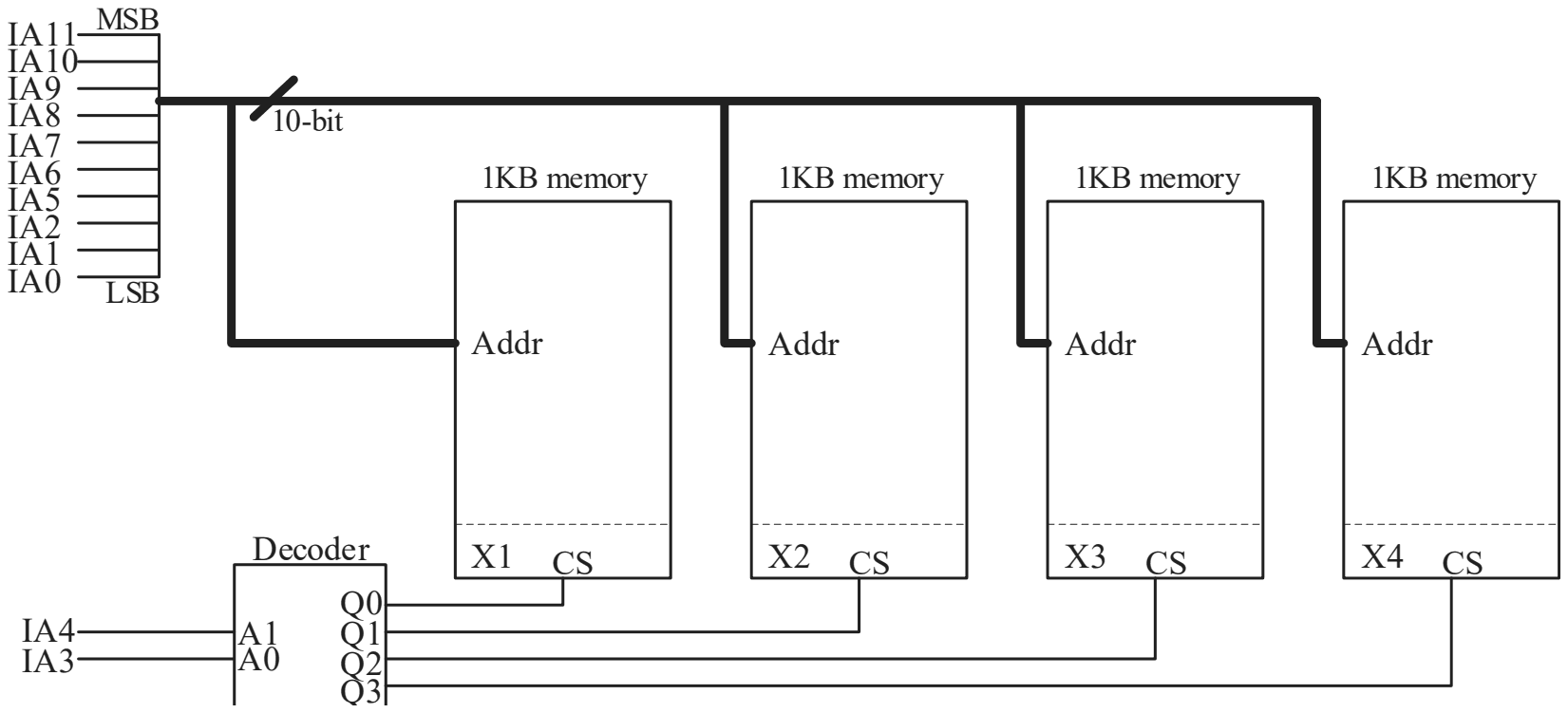
A 4 kilobyte (KB) byte-addressable memory is realized using four 1 KB memory blocks. Two input address lines (IA4 and IA3) are connected to the chip select (CS) port of these memory blocks through a decoder as shown in the figure. The remaining ten input address lines from IA11-IA0 are connected to the address port of these blocks. The chip select (CS) is active high.

Lines IA11 to IA5 and IA2 to IA0 form a 10-bit bus to the Addr port of four 1KB memory blocks X1 to X4; IA4 and IA3 drive decoder inputs A1 and A0, whose outputs Q0 to Q3 drive the CS of X1 to X4

The input memory addresses (IA11-IA0), in decimal, for the starting locations (Addr=0) of each block (indicated as X1, X2, X3, X4 in the figure) are among the options given below. Which one of the following options is CORRECT?

Exam Year(s)

GATE CS - 2023,

Answer: C

The starting addresses are (0, 8, 16, 24).

Each block is selected by IA4 and IA3 through the decoder: IA4 IA3 = 00 enables X1, 01 enables X2, 10 enables X3 and 11 enables X4. The other ten lines (IA11 to IA5 and IA2 to IA0) form the address inside the block. The starting location of a block, Addr = 0, has all ten of those lines at 0, so only IA4 and IA3 can be 1:

\[ \begin{aligned} X1&: 0,\quad X2: 2^{3} = 8 \\ X3&: 2^{4} = 16,\quad X4: 2^{4} + 2^{3} = 24 \end{aligned} \]

(0, 1024, 2048, 3072) is what the usual design gives, with the two top lines IA11 and IA10 on the decoder; here the decoder sits on bits 4 and 3. (0, 1, 2, 3) would need IA1 and IA0 on the decoder. The four blocks cannot all start at address 0, because each address enables exactly one block.

Please log in or register to report this question.

3.

Which of the following are the performance parameters of memory ?

(i) Latency
(ii) Memory Cycle Time
(iii) Transfer Rate

Exam Year(s)

MH SET - 2019, SET Exam - 2019,

Answer: D

All three are memory performance parameters, so the answer is (i), (ii) and (iii).

William Stallings gives three performance parameters for memory: access time (latency), the time to perform a read or write; memory cycle time, the access time plus any further time before a second access can start; and transfer rate, the rate at which data can be moved into or out of the memory unit.

Each option that leaves one of them out is therefore incomplete.

Please log in or register to report this question.

Loading…
Tags: Memory Hierarchy Questions and Answers || Memory Hierarchy MCQ Questions and Answers || Memory Hierarchy GK Questions and Answers || Memory Hierarchy GK MCQ Questions || Memory Hierarchy Multiple Choice Questions and Answers || Memory Hierarchy GK || GK on Memory Hierarchy || Computer Organization and Architecture Questions and Answers || Computer Organization and Architecture MCQ Questions and Answers || Computer Organization and Architecture GK Questions and Answers || GK on Computer Organization and Architecture