
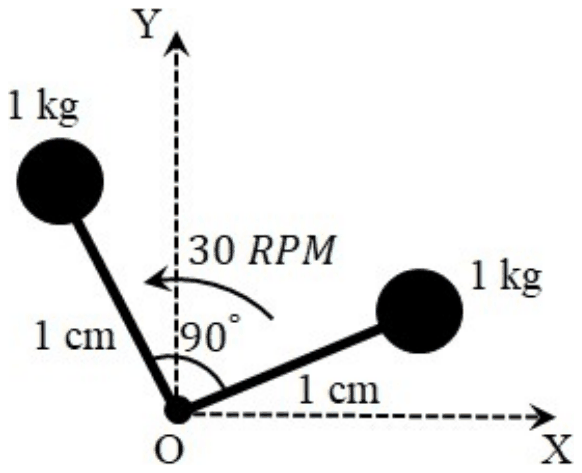
A rigid body in the X-Y plane consists of two point masses (1 kg each) attached to the ends of two massless rods, each of 1 cm length, as shown in the figure. It rotates at 30 RPM counter-clockwise about the Z-axis passing through point O. A point mass of \(\sqrt{2}\) kg, attached to one end of a third massless rod, is used for balancing the body by attaching the free end of the rod to point O. The length of the third rod is ________ cm.
GATE ME - 2022,
Answer: A
The third rod must be 1 cm long.
For static (single-plane) balance of a rotating body, the vector sum of \(m\vec{r}\) for all masses must be zero. The two 1 kg masses sit on 1 cm rods at 90 degrees to each other, so their \(m\vec{r}\) vectors have magnitude 1 kg cm each and are perpendicular:
\[ \begin{aligned} |m\vec{r}|_{\text{resultant}} &= \sqrt{1^{2} + 1^{2}} = \sqrt{2}\ \text{kg cm} \\ \sqrt{2} \times r &= \sqrt{2} \Rightarrow r = 1\ \text{cm} \end{aligned} \]
The balancing mass is placed opposite the resultant, along the bisector of the 90 degree angle. The speed of 30 RPM does not affect the answer: every unbalanced force scales with \(\omega^{2}\), so balance at one speed is balance at all speeds.
\(\sqrt{2}\) cm would need a 1 kg mass, and \(1/\sqrt{2}\) cm a 2 kg mass; \(1/2\sqrt{2}\) cm halves the resultant again.
Please log in or register to report this question.