Machine-translated by Google. Questions are authored in English.
Top

Friction Questions and Answers

1.

A block of weight W, connected to two springs with spring constants \(k_{1}\) and \(k_{2}\), rests initially on a horizontal frictional surface. The coefficient of static friction between the block and the surface is \(\mu\). Both springs are initially undeformed. The magnitude of force F, applied to the second spring, is now gradually increased. The block will start to slide when F becomes
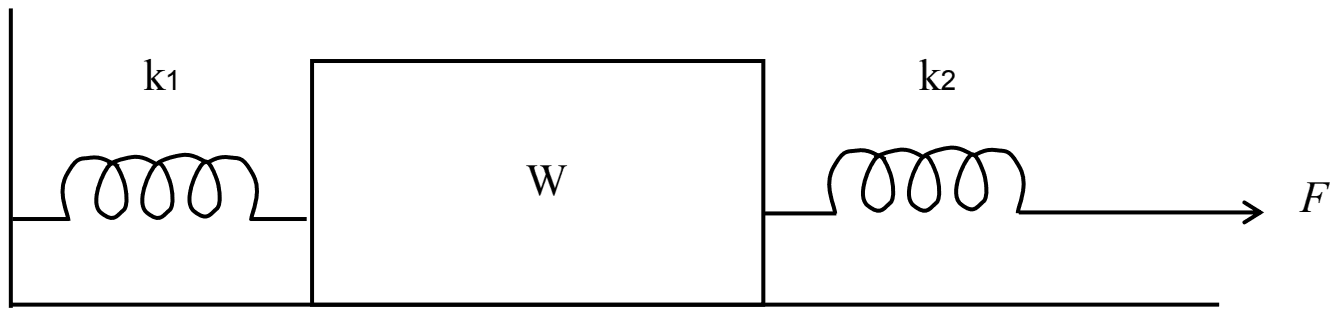
Block of weight W with spring k1 joining its left side to a fixed wall and spring k2 on its right side, pulled horizontally by force F

Exam Year(s)

GATE XE - 2012,

Answer: A

The block starts to slide when F = \(\mu W\).

Spring \(k_{2}\) transmits the full pull F to the block, whatever its stiffness, since it is massless and in series with the applied force. Spring \(k_{1}\) is tied to the wall and is undeformed at the start; it can only exert a force once the block moves and stretches it.

So while the block is at rest, static friction alone resists F, and slipping begins when F reaches the limiting friction \(\mu W\). The options with stiffness ratios would apply only if the block had already been displaced, so that \(k_{1}\) were carrying part of the load.

Please log in or register to report this question.
2.

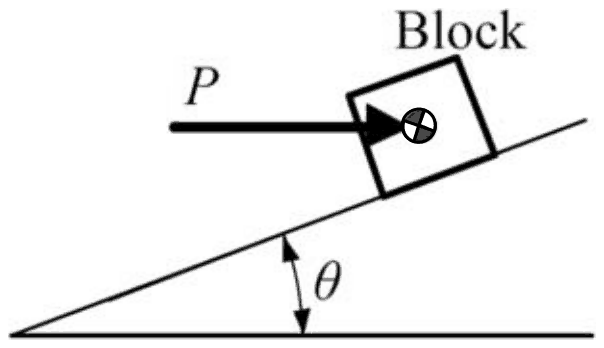
A horizontal effort P is applied to raise a block of weight W on a rough surface inclined at an angle θ with the horizontal. If \(\mu_{s}\) is the coefficient of static friction between the block and the surface, the minimum effort P required to impend the upward motion of the block along the surface is

A block on a plane inclined at angle theta to the horizontal, pushed by a horizontal force P

Exam Year(s)

GATE XE - 2018,

Answer: B

The minimum effort is \(W\left(\frac{\mu_{s} + \tan\theta}{1 - \mu_{s}\tan\theta}\right)\).

When upward motion impends, friction \(\mu_{s}N\) acts down the slope. Resolve along and normal to the incline for the horizontal force P:

\[ \begin{aligned} P\cos\theta &= W\sin\theta + \mu_{s}N \\ N &= W\cos\theta + P\sin\theta \end{aligned} \]

Substituting and dividing by \(\cos\theta\) gives \(P(1 - \mu_{s}\tan\theta) = W(\tan\theta + \mu_{s})\), the keyed expression (equal to \(W\tan(\theta + \phi)\) with \(\tan\phi = \mu_{s}\)).

The expressions with \(\mu_{s} - \tan\theta\) belong to a block about to slide down, and the one with \(1 + \mu_{s}\tan\theta\) in the denominator gets the sign of the normal-force contribution of P wrong.

Please log in or register to report this question.
3.

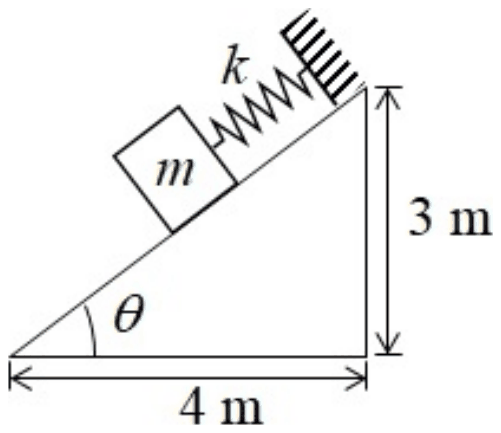
A mass \(m\) = 10 kg is attached to a spring as shown in the figure. The coefficient of friction between the mass and the inclined plane is 0.25. Assume that the acceleration due to gravity is 10 m/s2 and that static and kinematic friction coefficients are the same. Equilibrium of the mass is impossible if the spring force is

A mass m on an incline of base 4 m and height 3 m at angle theta, attached by a spring k to a support at the top of the incline

Exam Year(s)

GATE XE - 2022,

Answer: A

Equilibrium is impossible for a spring force of 30 N.

The incline rises 3 m over 4 m, so \(\sin\theta = 0.6\) and \(\cos\theta = 0.8\). The spring pulls the mass up the slope. Along the incline:

\[ \begin{aligned} mg\sin\theta &= 100 \times 0.6 = 60\ \text{N (down the slope)} \\ \mu N &= 0.25 \times 100 \times 0.8 = 20\ \text{N} \end{aligned} \]

Friction can act either way, up to 20 N, so the spring force S must satisfy \(60 - 20 \le S \le 60 + 20\), that is \(40 \le S \le 80\) N. 45, 60 and 75 N all lie in this range; 30 N is too small to hold the mass even with full friction helping.

Please log in or register to report this question.
4.

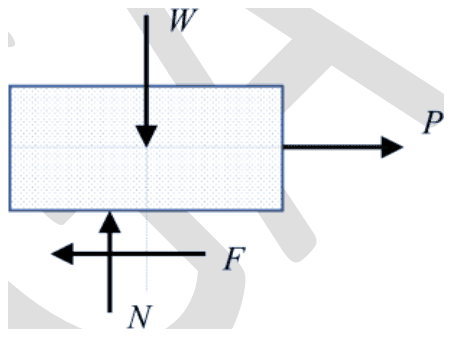
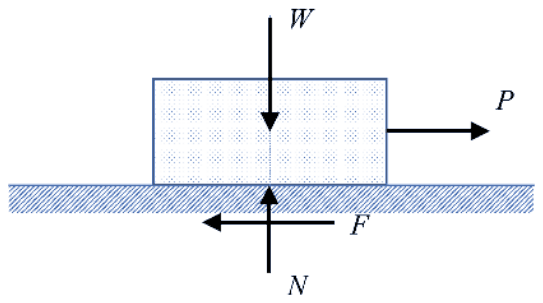
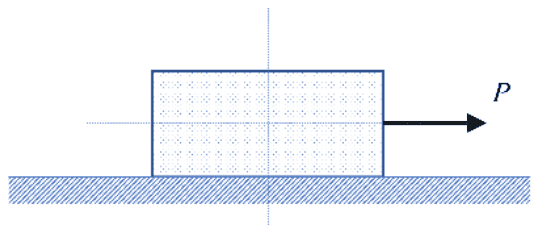
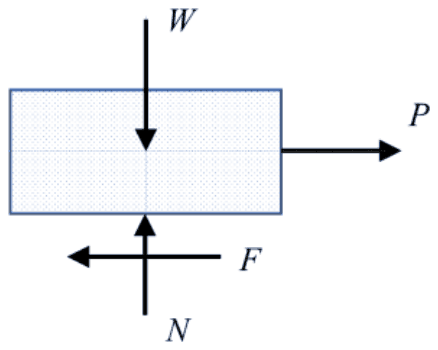
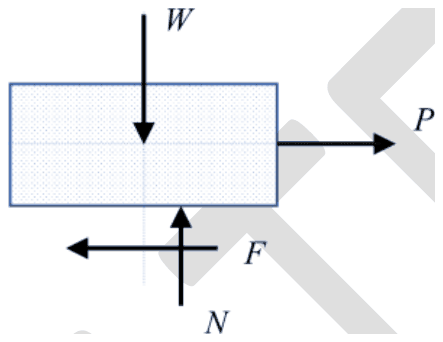
A block of weight \(W\), placed on a surface, is subjected to a horizontal force \(P\) as shown in the figure. The line of action of force \(P\) passes through the center-of-gravity of the block. The magnitude of \(P\) is such that the block remains at rest. If \(N\) is the resultant normal reaction exerted by the surface, and \(F\) is the frictional force acting on the bottom surface of the block, then which of the following represents the correct free body diagram of the block?

A block on a horizontal surface pulled to the right by a horizontal force P through its centre of gravity

Exam Year(s)

GATE XE - 2024,

Answer: B

The correct free body diagram is (B).

A free body diagram shows the block alone, with every external force: W at the centre of gravity, P through the centre of gravity, friction F at the base opposing P, and the normal reaction N. Horizontal balance gives F = P and vertical balance N = W.

F acts at the base, below the line of P, so P and F form a couple that tends to tip the block forward. To balance it, N must act at a point shifted forward of W's line, in the direction of P, by \(x = Ph/W\) for P at height h. Diagram (B) shows this shift.

In (A) N and W are collinear, leaving the P-F couple unbalanced. In (C) N is shifted the wrong way. (D) draws the supporting surface, which a free body diagram must leave out, and has N in line with W.

Please log in or register to report this question.
5.

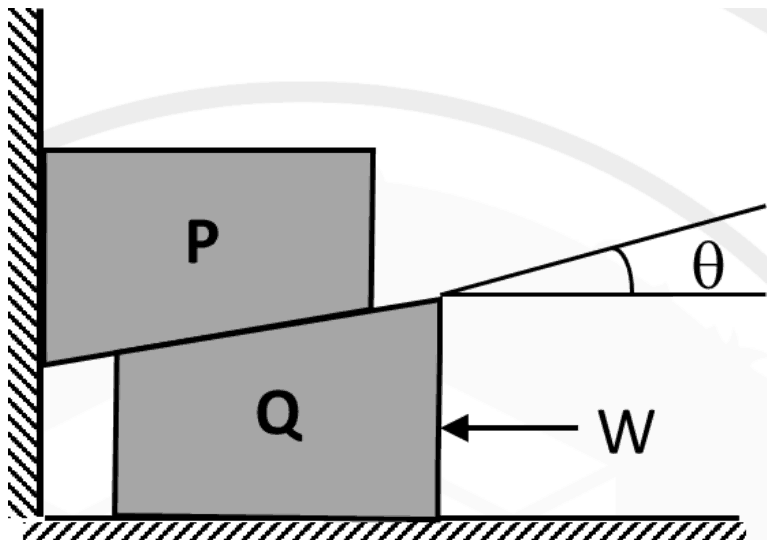
Consider two blocks, P of mass 100 kg and Q of mass 150 kg, resting as shown in the figure. The angle \(\theta = 30^{\circ}\). The coefficient of friction between the two blocks is 0.2. Assume no friction exists at all other interfaces. The minimum force required to move the block P upward is W.

Block P rests against a vertical wall on top of wedge block Q, which sits on the floor; their contact face rises to the right at angle theta, and a horizontal force W pushes Q toward the wall

Which one of the following options is closest to the CORRECT magnitude of W (in N)?

Exam Year(s)

GATE XE - 2025,

Answer: A

The minimum force is about 862.2 N.

As W pushes Q toward the wall, the inclined face of Q lifts P up the frictionless wall. Relative to Q, P slides up the incline, so friction on P (0.2N) acts down the incline. Take N as the normal force between the blocks and \(\theta = 30^{\circ}\).

Vertical equilibrium of P, weight 100 × 9.81 = 981 N:

\[ \begin{aligned} N\cos\theta - 0.2N\sin\theta &= 981 \\ N(0.866 - 0.1) &= 981 \\ N &= 1280.7\ \text{N} \end{aligned} \]

Horizontally, Q has only W on one side and the horizontal parts of N and the friction from P on the other (the floor is frictionless):

\[ \begin{aligned} W &= N\sin\theta + 0.2N\cos\theta \\ &= 1280.7(0.5 + 0.1732) = 862.2\ \text{N} \end{aligned} \]

Q's own weight acts vertically and is carried by the floor, so it does not enter W. Leaving out friction gives \(981\tan 30^{\circ} = 566\) N, which is not offered; the larger options do not satisfy the two equilibrium equations.

Please log in or register to report this question.
Loading…
Tags: Friction Questions and Answers || Friction MCQ Questions and Answers || Friction GK Questions and Answers || Friction GK MCQ Questions || Friction Multiple Choice Questions and Answers || Friction GK || GK on Friction || Engineering Mechanics Questions and Answers || Engineering Mechanics MCQ Questions and Answers || Engineering Mechanics GK Questions and Answers || GK on Engineering Mechanics