
Machine-translated by Google. Questions are authored in English.
Top

Thermal Processing and Pasteurisation Questions and Answers

1.

The microbial death kinetics for a food suspension follows the equation:

\[ log \frac{N_{0}}{N} = 1 + \frac{t - t_{l}}{D} \]

where No= initial microbial load, N = microbial load after time t, tl = lag time and D = decimal reduction time.

The correct statement for this equation is

Exam Year(s)

GATE AG - 2023,

Answer: B

The correct statement is that the time required to reduce the initial 90% of the population is the lag time.

Put \(t = t_{l}\) in the equation:

\[ \begin{aligned} log\frac{N_{0}}{N} &= 1 + 0 = 1 \\ \frac{N_{0}}{N} &= 10, \ N = 0.1N_{0} \end{aligned} \]

So at the end of the lag time one log cycle, 90% of the population, has already been destroyed. Thereafter each further D minutes removes another 90%.

Reducing only 10% of the population is a far smaller change than one log cycle, so the first option is wrong. The other two statements compare the lag time with D, but the equation treats them as independent constants: nothing in it makes the time for the first 90% shorter than D, or makes the lag time approach D as N0 and the temperature fall.

Please log in or register to report this question.
2.

The decimal reduction time D121 and the z value of thermophilic spores in milk were found to be 60 seconds and 11 °C, respectively. Heating time required at 141 °C for a 10 log cycle reduction in population, in seconds, is __________. (Rounded off to 2 decimal places)

Exam Year(s)

GATE AG - 2024,

Answer: D

The heating time is 9.12 s.

The z value is the temperature rise that cuts the D value tenfold. From 121 °C to 141 °C is 20 °C, or 20/11 of a log cycle:

\[ \begin{aligned} D_{141} &= D_{121} \times 10^{-(141-121)/11} \\ &= 60 \times 10^{-1.818} = 0.912\ \text{s} \end{aligned} \]

A 10 log cycle reduction needs 10 D values, so the time is \(10 \times 0.912 = 9.12\) s.

0.91 s is a single D value, one log cycle only. 2.81 and 0.28 s do not follow from the given D and z values.

Please log in or register to report this question.

3.

Pasteurisation of milk can be carried out either at 91 °C for 3 s or at 73 °C for 30 s to inactivate vegetative cells of microorganism(s). The sterilisation value is 10 in both the cases. Thermal death time constant (z value) for reference temperatures of 73 °C and 91 °C, in °C, is nearest to

Exam Year(s)

GATE AG - 2026,

Answer: A

The z value is 18.0 °C.

The two treatments are equally lethal, so their times lie on the same thermal death time curve. The z value is the temperature rise that cuts the required time tenfold:

\[ \begin{aligned} z &= \frac{T_{2} - T_{1}}{\log_{10}(t_{1}/t_{2})} \\ &= \frac{91 - 73}{\log_{10}(30/3)} = \frac{18}{1} = 18 \end{aligned} \]

Here the times differ by exactly a factor of 10, so z is simply the 18 °C difference between the two temperatures. The stated sterilisation value of 10 is the same for both processes and does not change z. 1.8 and 0.9 shift the decimal point, and 9.0 halves the temperature difference.

Please log in or register to report this question.

4.

A mild heat treatment of foods that destroys pathogens and extends its shelf life is called

Exam Year(s)

GATE Life Sciences - 2012, GATE XE - 2012,

Answer: D

The treatment is Pasteurization.

Pasteurisation is a mild heat treatment, such as 63°C for 30 minutes or 72°C for 15 seconds for milk, that destroys pathogens and reduces spoilage organisms, extending shelf life while keeping most of the food's flavour and nutrients. The product usually still needs refrigeration.

Sterilisation is a severe treatment, around 121°C, that destroys all viable organisms including spores. Blanching is a brief heating of vegetables mainly to inactivate enzymes before freezing or drying. Baking is a cooking process, not a preservation treatment of this kind.

Please log in or register to report this question.

5.

Thermal destruction of microorganisms follows a kinetics of

Exam Year(s)

GATE Life Sciences - 2012, GATE XE - 2012,

Answer: B

Thermal destruction of microorganisms follows First order kinetics.

At a constant lethal temperature the number of surviving cells falls by the same fraction in each equal interval of time:

\[ \log\frac{N}{N_{0}} = -\frac{t}{D} \]

so a plot of log survivors against time is a straight line. The decimal reduction time D, the time to kill 90 percent of the population, and the related z and F values of thermal process design all rest on this first-order model.

Zero order would mean a constant number killed per minute, and second or fractional orders do not describe the logarithmic death curve.

Please log in or register to report this question.

6.

Thermal death time (TDT) of Clostridium botulinum at 121 °C is 2.78 min with a z-value of 10 °C. The TDT of the microorganism at 116 °C (in min) is

Exam Year(s)

GATE Life Sciences - 2012, GATE XE - 2012,

Answer: B

The TDT at 116°C is about 8.791 min.

The z-value is the temperature change that alters the thermal death time tenfold. A drop of 5°C is half of z, so the time rises by a factor of \(10^{0.5}\):

\[ \begin{aligned} TDT_{116} &= TDT_{121} \times 10^{(121 - 116)/z} \\ &= 2.78 \times 10^{0.5} = 2.78 \times 3.162 = 8.791\ \text{min} \end{aligned} \]

A lower temperature needs a longer time, so the options smaller than 2.78 min (1.390 and 0.712) have the direction wrong. 5.270 does not follow from the 100.5 factor.

Please log in or register to report this question.

7.

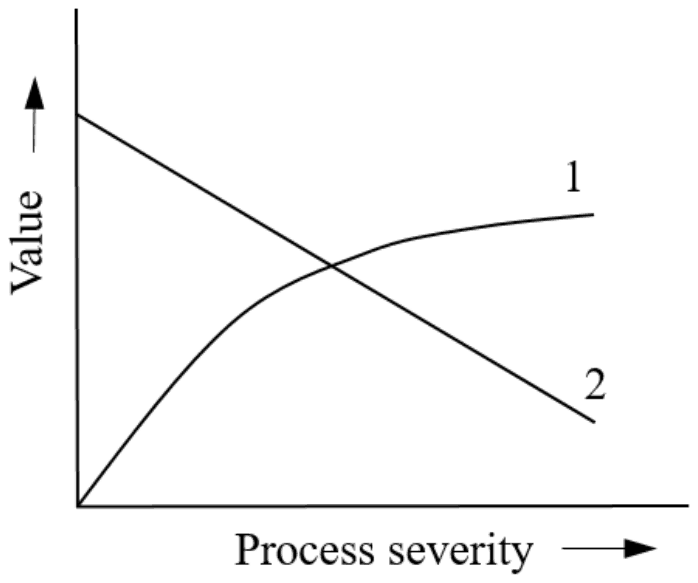
Which among the given options truly depict the lines 1 and 2 in the figure below with respect to the effect of heat processing on food?

Value against process severity: line 1 rises from zero and levels off; line 2 falls steadily from a high starting value

Exam Year(s)

GATE XE - 2022,

Answer: A

Line 1 is safety and line 2 is quality.

Increasing the severity of heat treatment kills more micro-organisms and inactivates more enzymes, so safety rises quickly at first and then levels off once the target organisms are destroyed: the shape of line 1. The same heat also degrades vitamins, colour, flavour and texture, so quality falls steadily with severity: line 2.

Yield is not the property that the safety-quality trade-off of thermal processing describes, and putting safety on the falling line reverses the effect of heat on micro-organisms.

Please log in or register to report this question.

8.

The time required for stipulated destruction of a microbial population at a given temperature is

Exam Year(s)

GATE Life Sciences - 2023, GATE XE - 2023,

Answer: B

The time is the F-value.

The F-value is the time, at a stated temperature, needed to achieve a specified (stipulated) destruction of a microbial population, for example the 12-log reduction of Clostridium botulinum spores used for low-acid canned foods. It is usually quoted at a reference temperature, \(F_{0}\) at 121.1°C.

The D-value is the time for one tenfold (90%) reduction only, not an arbitrary stipulated destruction. The z-value is the temperature change that alters the D-value tenfold, a temperature, not a time. Q10 is the factor by which a reaction rate changes for a 10°C rise.

Please log in or register to report this question.

9.

Processing of fluid milk at 72 °C for 15 seconds is termed as

Exam Year(s)

GATE Life Sciences - 2024, GATE XE - 2024,

Answer: A

Heating milk to 72 °C for 15 seconds is High-temperature, short-time (HTST) pasteurization.

HTST pasteurization, 71.7-72 °C for at least 15 s in a plate heat exchanger with immediate cooling, destroys pathogens such as Coxiella burnetii and Mycobacterium tuberculosis while keeping flavour change small.

LTLT (batch) pasteurization uses about 63 °C for 30 minutes. UHT treatment uses about 135-150 °C for a few seconds and gives a shelf-stable product. Homogenization reduces fat globule size by pressure and is not a heat treatment.

Please log in or register to report this question.

10.

In canning and retorting of foods, which of the following is the correct expression of Ball process time (B)?

Assume: \(t_{p}\) = processor’s process time; \(t_{c}\) = come-up time

Exam Year(s)

GATE XE - 2025,

Answer: A

Ball's process time is \(B = t_{p} + 0.42\,t_{c}\).

During the come-up time the retort is still heating toward its operating temperature, so this period contributes only part of the lethality of a full period at retort temperature. Ball's method credits 42% of the come-up time as if it were at retort temperature. The process time B used in Ball's formula is therefore the operator's process time, timed from when the retort reaches temperature, plus 0.42 of the come-up time.

The factors 0.30, 0.50 and 0.25 are not Ball's correction. The 0.42 assumes a retort temperature that rises roughly linearly during come-up.

Please log in or register to report this question.

Loading…
Tags: Thermal Processing and Pasteurisation Questions and Answers || Thermal Processing and Pasteurisation MCQ Questions and Answers || Thermal Processing and Pasteurisation GK Questions and Answers || Thermal Processing and Pasteurisation GK MCQ Questions || Thermal Processing and Pasteurisation Multiple Choice Questions and Answers || Thermal Processing and Pasteurisation GK || GK on Thermal Processing and Pasteurisation || Food Processing Technology Questions and Answers || Food Processing Technology MCQ Questions and Answers || Food Processing Technology GK Questions and Answers || GK on Food Processing Technology