
Machine-translated by Google. Questions are authored in English.
Top

Thermal Processing and Pasteurisation Questions and Answers

11.

Which among the given options truly depict the lines 1 and 2 in the figure below with respect to the effect of heat processing on food?
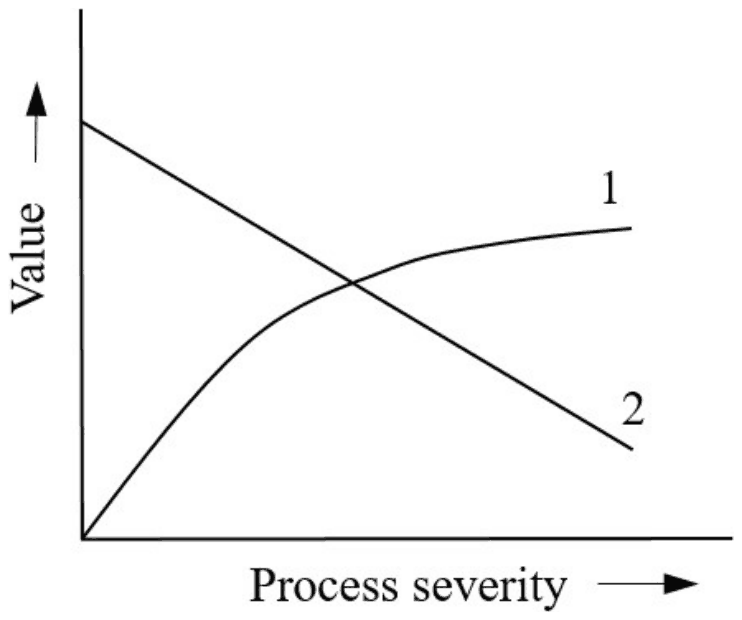
Value plotted against Process severity: line 1 rises steeply from the origin and then levels off, line 2 starts high on the Value axis and falls steadily, crossing line 1

Exam Year(s)

GATE Life Sciences - 2022,

Answer: A

Line 1 is safety and line 2 is quality.

As heat processing becomes more severe, with higher temperature or longer time, more microorganisms and their spores are destroyed, so microbial safety rises steeply at first and then approaches a plateau once the target lethality is reached. That is line 1.

The same heat steadily degrades vitamins, colour, flavour and texture, so sensory and nutritional quality falls as severity increases. That is line 2. Choosing a process is a trade-off between the two curves.

Yield is not the variable this trade-off is drawn for, which rules out options B and C, and option D reverses the two curves: quality does not rise with heating, and safety does not fall.

Please log in or register to report this question.

12.

In canning and retorting of foods, which of the following is the correct expression of Ball process time (B)?

Assume: \(t_{p}\) = processor's process time; \(t_{c}\) = come-up time

Exam Year(s)

GATE Life Sciences - 2025,

Answer: A

Ball's process time is \(B = t_{p} + 0.42\,t_{c}\).

During the come-up time \(t_{c}\), the retort is still heating towards its operating temperature, so the food receives less lethality than it would at full temperature. Ball's method credits only part of the come-up time as equivalent to time at retort temperature, and the established fraction is 42%. The process time used in calculations is therefore the time at retort temperature plus 0.42 of the come-up time.

The coefficients 0.30, 0.50 and 0.25 are not Ball's correction. The value 0.42 is empirical, based on an assumed linear rise in retort temperature during come-up.

Please log in or register to report this question.

13.

The temperature for thermal processing of food materials depends upon the heat sensitivity of-

Exam Year(s)

RSMSSB JE - 2025, RSMSSB JE Agriculture - 2025, RSMSSB - 2025,

Answer: B

It depends on the heat sensitivity of Bacteria.

Thermal processes such as pasteurization and canning are designed around the heat resistance of the target bacteria and their spores, because they are the most heat-resistant organisms of concern in food. Low-acid canned foods, for example, are processed to destroy spores of Clostridium botulinum, using its D and z values to set time and temperature.

Protozoa, fungi (yeasts and moulds) and most viruses are destroyed at lower temperatures, so a process that kills the target bacteria also takes care of them.

Please log in or register to report this question.

Loading…
Tags: Thermal Processing and Pasteurisation Questions and Answers || Thermal Processing and Pasteurisation MCQ Questions and Answers || Thermal Processing and Pasteurisation GK Questions and Answers || Thermal Processing and Pasteurisation GK MCQ Questions || Thermal Processing and Pasteurisation Multiple Choice Questions and Answers || Thermal Processing and Pasteurisation GK || GK on Thermal Processing and Pasteurisation || Food Processing Technology Questions and Answers || Food Processing Technology MCQ Questions and Answers || Food Processing Technology GK Questions and Answers || GK on Food Processing Technology