
Machine-translated by Google. Questions are authored in English.
Top

Milling and Drilling Operations Questions and Answers

Answer: C

The feed rate is the product of rpm, feed per tooth and number of teeth in the cutter.

In milling, each tooth advances the work by the feed per tooth \(f_{z}\). In one revolution all Z teeth of the cutter pass, so the table feed per minute is

\[ f_{m} = f_{z} \times Z \times N \]

with N in revolutions per minute.

rpm alone is a speed, not a feed. rpm times the number of teeth gives tooth passes per minute without any distance. Using only the teeth in contact undercounts, because every tooth on the cutter takes its cut once per revolution, whether or not it is engaged at a given instant.

Please log in or register to report this question.
2.

In a single pass drilling operation, a through hole of 15 mm diameter is to be drilled in a steel plate of 50 mm thickness. Drill spindle speed is 500 rpm, feed is 0.2 mm/rev and drill point angle is 118°. Assuming 2 mm clearance at approach and exit, the total drill time (in seconds) is

Exam Year(s)

GATE ME - 2012,

Answer: A

The total drilling time is about 35.1 s.

The drill must travel the plate thickness, the two clearances, and the height of its own conical point to break through fully:

\[ \begin{aligned} h &= \frac{D/2}{\tan(118^{\circ}/2)} = \frac{7.5}{\tan 59^{\circ}} = 4.51\ \text{mm} \\ L &= 50+2+2+4.51 = 58.51\ \text{mm} \end{aligned} \]

\[ \begin{aligned} f N &= 0.2 \times 500 = 100\ \text{mm/min} \\ t &= \frac{58.51}{100} = 0.585\ \text{min} = 35.1\ \text{s} \end{aligned} \]

Leaving out the cone height gives 54 mm and 32.4 s, and leaving out the cone and one clearance gives 52 mm and 31.2 s. The break-through allowance for the drill point is what the question tests.

Please log in or register to report this question.

3.

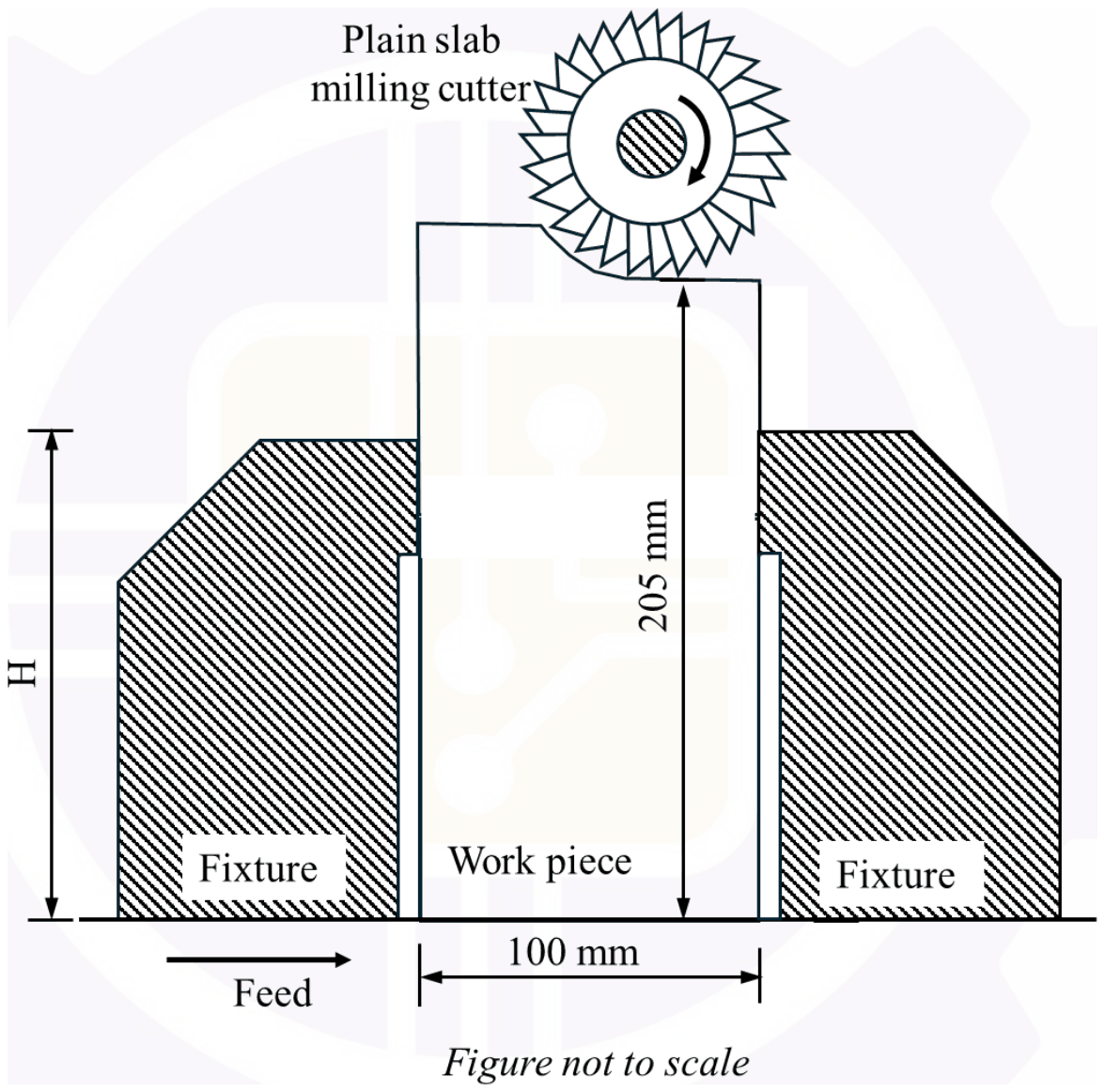
A work piece is to be firmly held in a fixture. It is to be machined by using a plain slab milling cutter as shown in the figure below.

Which one of the following options is the most suitable value of height H of the fixture in mm?

A work piece 100 mm wide and 205 mm high clamped between two fixtures of height H, with a plain slab milling cutter cutting its top surface; feed to the right; figure not to scale

Exam Year(s)

GATE ME - 2026,

Answer: A

The most suitable height is 200 mm.

A fixture should grip the work piece as high as possible, close to where the cutting forces act, to resist the push of the cutter and limit vibration. But it must stay below the top surface of the 205 mm work piece, or the slab milling cutter would cut into it.

200 mm meets both needs, sitting just below the top surface. 210 mm is taller than the work piece and would foul the cutter. 150 mm and 70 mm leave a long unsupported length above the fixture, so the work piece would not be held firmly against the cutting forces.

Please log in or register to report this question.

4.

In a drill bit angle between chisel edge and cutting lip is known as :

Exam Year(s)

Northern Coalfields Limited - 2020, NCL Technician - 2020,

Answer: C

The answer is the web angle.

At the point of a twist drill the two cutting lips are joined by the chisel edge, which is the end of the web, the solid core between the flutes. The angle between this chisel edge and a cutting lip, usually 120 to 135 degrees, is the chisel edge angle, which the paper calls the web angle after the part that forms it.

The other angles do not involve the chisel edge. The lip angle is the angle of the cutting wedge at the lip itself. The rake angle is the angle of the cutting face, and on a twist drill it is set by the helix angle, the angle of the flutes to the drill axis.

Please log in or register to report this question.

5.

A drift is used for :

Exam Year(s)

Northern Coalfields Limited - 2020, NCL Technician - 2020,

Answer: C

A drift is used for removing the drill from the machine spindle.

A taper-shank drill or sleeve is held in the spindle's Morse taper by friction. The drift is a flat, tapered steel wedge pushed through the slot in the spindle so that it bears on the tang and forces the taper shank out.

Marking drill locations is done with a scriber and centre punch. Removing a broken drill from work needs an extractor or other method. A chuck is fitted on its arbor by pressing the tapers together, not with a drift.

Please log in or register to report this question.

6.

The process of beveling the end of hole is called:

Exam Year(s)

Northern Coalfields Limited - 2020, NCL Technician - 2020,

Answer: D

Bevelling the end of a hole is counter sinking.

A countersink cuts a conical recess at the mouth of a hole, typically at 90 degrees included, so that a countersunk screw or rivet head sits flush, or simply to remove the burr.

Counter boring enlarges the end of a hole to a flat-bottomed, larger diameter step for a socket head screw. Spot facing machines a flat seat round the hole for a nut or washer. Reaming finishes the bore to size and does not bevel the end.

Please log in or register to report this question.

7.

If the cutting speed is 20 m/ min, what is the rotational speed required for a 20 mm drill bit?

Exam Year(s)

Northern Coalfields Limited - 2020, NCL Technician - 2020,

Answer: B

The required speed is about 320 rpm.

Cutting speed \(v = \frac{\pi d N}{1000}\) with \(v\) in m/min and \(d\) in mm, so

\[ \begin{aligned} N &= \frac{1000\,v}{\pi d} = \frac{1000 \times 20}{3.14 \times 20} \\ &\approx 318\ \text{rpm} \end{aligned} \]

which rounds to 320 rpm. 400 rpm would suit a drill of about 16 mm and 160 rpm one of about 40 mm, so both use the wrong diameter; 120 rpm would need a drill of about 53 mm.

Please log in or register to report this question.

8.

The point angle in general purpose drill bit is:

Exam Year(s)

Northern Coalfields Limited - 2020, NCL Technician - 2020,

Answer: C

A general purpose drill has a point angle of 118 degrees.

The 118 degree point is the standard grind for drilling mild steel and most general work, with the two cutting lips each at 59 degrees to the drill axis. A gauge is used to check the angle and the equal length of the lips.

Smaller points, around 90 degrees, are used for soft materials such as plastics and wood, and 60 degrees is for very soft or brittle materials. Larger points, up to 135 to 140 degrees, are for hard steels. 108 degrees is not a standard point angle.

Please log in or register to report this question.

9.

The recommended drill point angle for drilling moulded plastic is

Exam Year(s)

Northern Coalfields Limited - 2020, NCL Technician - 2020,

Answer: C

The recommended point angle for moulded plastic is 75 degree.

The standard drill point angle of 118° suits general work in steel and cast iron. Soft, brittle or easily torn materials such as moulded plastics, hard rubber and fibre need a sharper (smaller) point angle, commonly in the range of about 60° to 90°, so that the drill enters gently and does not chip or crack the material. Of the options, only 75° falls in that range.

130° is a flatter point of the kind used for harder materials, and 100° is still too blunt for plastics; both would tend to grab and chip moulded parts.

Please log in or register to report this question.

10.

1.5 mm displacement of tool point in boring operation will result in change in diameter equal to

Exam Year(s)

Northern Coalfields Limited - 2020, NCL Technician - 2020,

Answer: A

The diameter changes by 3 mm.

In boring, the tool point lies on the radius of the hole being cut. Moving the tool point by 1.5 mm changes the radius by 1.5 mm, and the diameter, which is twice the radius, by \(2 \times 1.5 = 3\) mm.

1.5 mm is the trap answer: it forgets that a radial setting acts on both sides of the bore. 0.75 mm halves the movement instead of doubling it. This is why the cross-slide graduations on many lathes are marked to read directly in diameter.

Please log in or register to report this question.

Loading…
Tags: Milling and Drilling Operations Questions and Answers || Milling and Drilling Operations MCQ Questions and Answers || Milling and Drilling Operations GK Questions and Answers || Milling and Drilling Operations GK MCQ Questions || Milling and Drilling Operations Multiple Choice Questions and Answers || Milling and Drilling Operations GK || GK on Milling and Drilling Operations || Manufacturing Technology Questions and Answers || Manufacturing Technology MCQ Questions and Answers || Manufacturing Technology GK Questions and Answers || GK on Manufacturing Technology