
Machine-translated by Google. Questions are authored in English.
Top

Numerical Control and CNC Questions and Answers

1.

Circular arc on a part profile is being machined on a vertical CNC milling machine. CNC part program using metric units with absolute dimensions is listed below:

--------------------------------
N60 G01 X 30 Y 55 Z -5 F50
N70 G02 X 50 Y 35 R 20
N80 G01 Z 5
--------------------------------

The coordinates of the centre of the circular arc are:

Exam Year(s)

GATE ME - 2017,

Answer: D

The centre of the arc is (30, 35).

The tool starts the arc at (30, 55), the end point of block N60, and G02 moves it clockwise to (50, 35) with radius 20. Two points 20 from both ends exist: (30, 35) and (50, 55).

About (30, 35), the start is directly above the centre and the end directly to its right, so the tool sweeps a quarter circle clockwise, as G02 requires. About (50, 55), going from the point on its left to the point below it clockwise would take three quarters of a circle, which a positive R does not program (R gives the arc of 180 degrees or less).

(30, 55) and (50, 35) are the arc's own end points, not its centre.

Please log in or register to report this question.
2.

Interpolator in a CNC machine

Exam Year(s)

GATE ME - 2018,

Answer: B

An interpolator coordinates axes movements.

To cut a straight line at an angle, a circular arc or another contour, two or more axes must move at the same time with continuously related velocities. The interpolator (linear, circular or parabolic) computes the intermediate points and feeds coordinated position commands to each axis drive so that the tool follows the programmed path.

Spindle speed is set by the S word and controlled by the spindle drive, the automatic tool changer is a separate machine function, and canned cycles (G81 and the like) are preprogrammed sequences of moves, not the interpolation that generates them.

Please log in or register to report this question.

3.

A CNC worktable is driven in a linear direction by a lead screw connected directly to a stepper motor. The pitch of the lead screw is 5 mm. The stepper motor completes one full revolution upon receiving 600 pulses. If the worktable speed is 5 m/minute and there is no missed pulse, then the pulse rate being received by the stepper motor is

Exam Year(s)

GATE ME - 2022,

Answer: B

The pulse rate is 10 kHz.

Each revolution moves the table one pitch, 5 mm, and needs 600 pulses:

\[ \begin{aligned} \text{rev/min} &= \frac{5000\ \text{mm/min}}{5\ \text{mm/rev}} = 1000 \\ \text{pulses/s} &= \frac{1000 \times 600}{60} = 10000 \end{aligned} \]

That is 10 kHz.

20 kHz doubles the result, as if the pitch were 2.5 mm. 3 kHz and 15 kHz do not follow from these data.

Please log in or register to report this question.

4.

Which one of the following CANNOT impart linear motion in a CNC machine?

Exam Year(s)

GATE ME - 2022,

Answer: D

The answer is chain and sprocket.

A CNC axis needs a drive that converts motor rotation into precise, stiff, backlash-free linear motion of the table or slide. The three other options are the standard ways of doing this. A linear motor produces linear motion directly. A ball screw turns rotation into translation through recirculating balls, with very low friction and backlash, and is the usual CNC feed drive. A lead screw does the same through sliding threads and is used on simpler machines.

A chain and sprocket transmits rotation between shafts. Its slack, stretch and the polygonal action of the chain on the sprocket rule it out as the means of imparting the accurate linear motion a CNC axis needs.

Please log in or register to report this question.

5.

A CNC vertical milling machine has to cut a straight slot of 10 mm width and 2 mm depth by a cutter of 10 mm diameter between points (0, 0) and (100, 100) on the XY plane (dimensions in mm). The feed rate used for milling is 50 mm/min. Milling time for the slot (in seconds) is

Exam Year(s)

GATE ME - 2012,

Answer: B

The milling time is about 170 seconds.

The cutter diameter equals the slot width, so one straight pass along the diagonal from (0, 0) to (100, 100) cuts the slot:

\[ \begin{aligned} L &= \sqrt{100^{2}+100^{2}} = 141.42\ \text{mm} \\ t &= \frac{141.42}{50} = 2.828\ \text{min} \\ &= 169.7\ \text{s} \approx 170\ \text{s} \end{aligned} \]

120 s is the time for 100 mm, the travel along one axis only, which ignores that the tool moves diagonally. 180 s and 240 s overstate the path.

Please log in or register to report this question.

6.

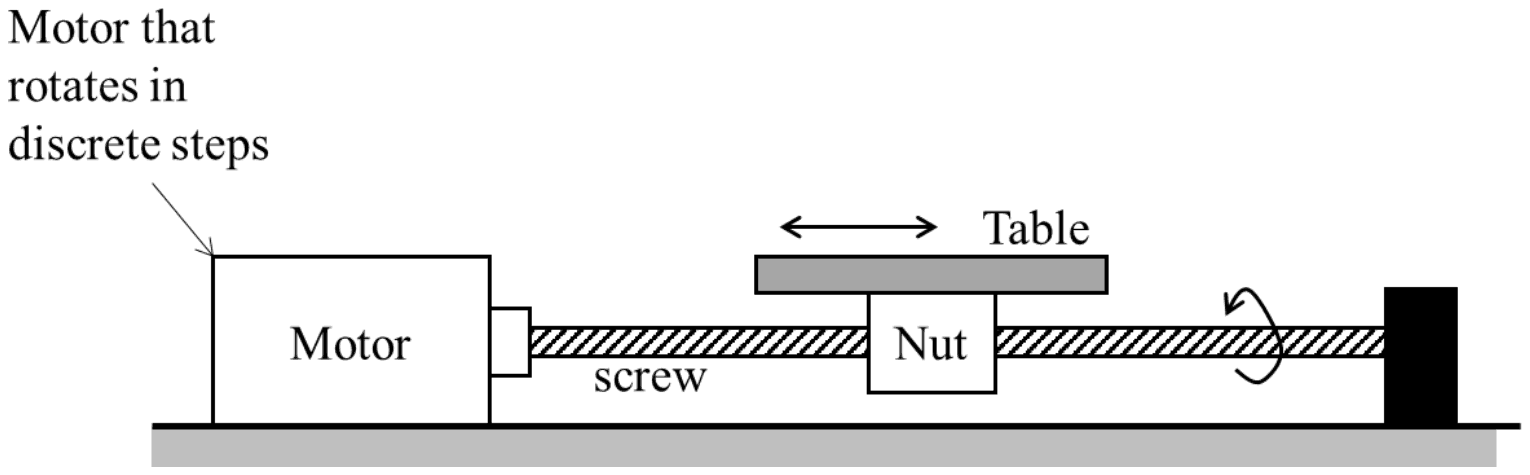
A CNC machine has one of its linear positioning axes as shown in the figure, consisting of a motor rotating a lead screw, which in turn moves a nut horizontally on which a table is mounted. The motor moves in discrete rotational steps of 50 steps per revolution. The pitch of the screw is 5 mm and the total horizontal traverse length of the table is 100 mm. What is the total number of controllable locations at which the table can be positioned on this axis?

Motor that rotates in discrete steps turns a lead screw; a nut on the screw carries a table that moves back and forth along the screw

Exam Year(s)

GATE ME - 2023,

Answer: C

The table can be placed at 1000 controllable locations.

One revolution of the screw moves the nut by one pitch, 5 mm, and takes 50 motor steps, so the smallest move, the resolution, is

\[ \begin{aligned} \Delta x &= \frac{5\ \text{mm}}{50} = 0.1\ \text{mm} \\ n &= \frac{100\ \text{mm}}{0.1\ \text{mm}} = 1000 \end{aligned} \]

The 100 mm traverse is therefore covered in 1000 equal increments, which is the count the official key takes. (Counting both end positions as well would give 1001, which is not among the options.)

5000 multiplies the travel by the steps per revolution, as if the screw advanced 1 mm per turn instead of 5 mm. 200 and 2 do not follow from the pitch and the step count: 20 revolutions times 50 steps is 1000, not 200, and 2 counts only the two ends of the travel.

Please log in or register to report this question.

7.

The preparatory functions in Computer Numerical Controlled (CNC) machine programing are denoted by the alphabet

Exam Year(s)

GATE ME - 2024,

Answer: A

Preparatory functions are denoted by G.

In CNC part programming, G-codes are the preparatory functions that set the mode of motion and machining, for example G00 rapid positioning, G01 linear interpolation, G02 and G03 circular interpolation, G90 absolute and G91 incremental coordinates.

M-codes are miscellaneous functions such as spindle on (M03), coolant on (M08) and program end (M30). O introduces the program number, and P is used for parameters such as dwell time or a subprogram number. None of these is the preparatory function.

Please log in or register to report this question.

8.

In computer aided design (CAD), solid models can be constructed using

Exam Year(s)

GATE ME - 2025,

Answer: A

Solid models can be built with boundary representation (B-rep).

B-rep describes a solid by its bounding faces, edges and vertices and the topology linking them, so it defines an enclosed volume. Together with constructive solid geometry it is one of the two main solid modelling schemes.

Bezier curves, B-splines and NURBS are methods for representing curves and surfaces. They can describe the faces of a solid, but on their own they do not define a closed volume, so they are not solid modelling schemes.

Please log in or register to report this question.

9.

Consider the Euler variables of polyhedral objects namely, P1, P2, P3, and P4 as given in the table below.

Which one of the following options is NOT a topologically valid closed polyhedral object as per Euler's law?

Polyhedral objectsFaces (F)Edges (E)Vertices (V)Faces' inner loops (L)Bodies (B)Genus (G)
P16128010
P2585010
P35128010
P4102416010

Exam Year(s)

GATE ME - 2026,

Answer: A

The invalid object is P3.

The Euler-Poincare formula for solids is \(F - E + V - L = 2(B - G)\). Every object here has \(L = 0\), \(B = 1\) and \(G = 0\), so the right side is 2.

\[ \begin{aligned} P1 &: 6 - 12 + 8 = 2 \\ P2 &: 5 - 8 + 5 = 2 \\ P3 &: 5 - 12 + 8 = 1 \\ P4 &: 10 - 24 + 16 = 2 \end{aligned} \]

Only P3 fails. P1 is a cube, P2 a square pyramid, and P4 a valid object with 10 faces such as an octagonal prism, so they are all topologically valid.

Please log in or register to report this question.

Loading…
Tags: Numerical Control and CNC Questions and Answers || Numerical Control and CNC MCQ Questions and Answers || Numerical Control and CNC GK Questions and Answers || Numerical Control and CNC GK MCQ Questions || Numerical Control and CNC Multiple Choice Questions and Answers || Numerical Control and CNC GK || GK on Numerical Control and CNC || Manufacturing Technology Questions and Answers || Manufacturing Technology MCQ Questions and Answers || Manufacturing Technology GK Questions and Answers || GK on Manufacturing Technology