
Machine-translated by Google. Questions are authored in English.
Top

Crystal Structures and Imperfections Questions and Answers

Direction for [ Question No: 1 To 1 ] :

Chromium has the bcc structure with atomic diameter of 2.494 Å.

1.

Calculate the lattice parameter of chromium assuming tight atomic bonding.

Exam Year(s)

GATE XE - 2012,

Answer: B

The lattice parameter is 2.880 Å.

In bcc the atoms touch along the body diagonal, which spans four atomic radii, or two diameters:

\[ \begin{aligned} \sqrt{3}\,a &= 4r = 2d \\ a &= \frac{2(2.494)}{\sqrt{3}} = 2.880\ \text{Å} \end{aligned} \]

1.442 Å is half of that, using the radius where the diameter belongs. 4.323 Å and 5.764 Å come from the wrong geometry, for example treating the face diagonal or the cube edge as the touching direction.

Please log in or register to report this question.
Direction for [ Question No: 2 To 5 ] :

Useful data

Boltzmann's constant\(1.38 \times 10^{-23}\) J K-1
Charge on an electron\(1.602 \times 10^{-19}\) C
Gas Constant8.314 J mol-1 K-1
Electron rest mass\(9.1 \times 10^{-31}\) kg
Permittivity of vacuum (εo)\(8.854 \times 10^{-12}\) F m-1
Bohr Magneton\(9.274 \times 10^{-24}\) A/m2

2.

Which of the following is NOT a Bravais lattice?

Exam Year(s)

GATE XE - 2012,

Answer: D

The one that is not a Bravais lattice is Face centred tetragonal.

There are 14 Bravais lattices. The tetragonal system has only two: simple (primitive) and body centred. A face centred tetragonal arrangement can always be redrawn as a smaller body centred tetragonal cell, rotated by 45 degrees about the c axis, so it is not a distinct lattice.

Simple tetragonal and body centred tetragonal are the two tetragonal Bravais lattices, and base centred orthorhombic is one of the four orthorhombic lattices (with simple, body centred and face centred), so all three are genuine Bravais lattices.

Please log in or register to report this question.

3.

A Schottky defect in an ionic crystal is a stochiometric defect of

Exam Year(s)

GATE XE - 2012,

Answer: C

A Schottky defect is a cation and anion vacancy.

In an ionic crystal such as NaCl, a Schottky defect is a pair (more generally a stoichiometric group) of vacancies: one cation and one anion missing from their lattice sites, the ions having moved to the surface. Removing them in that ratio keeps the crystal electrically neutral and the composition stoichiometric. It lowers the density.

A cation vacancy or an anion vacancy alone would leave a net charge. Interstitial ions belong to the Frenkel defect, in which an ion (usually the smaller cation) leaves its site for an interstitial position, creating a vacancy-interstitial pair.

Please log in or register to report this question.

4.

Which of the following techniques is NOT used to grow single crystals of semiconductors?

Exam Year(s)

GATE XE - 2012,

Answer: A

The technique not used is Calendering.

Calendering presses a material between heated rollers to make sheets or films; it is used for plastics, rubber, paper and textiles, and produces no crystal at all.

The other three are standard single-crystal growth methods for semiconductors. In the Czochralski method a seed crystal is slowly pulled and rotated from a melt, and it supplies most silicon wafers. The float zone method passes a molten zone along a rod, giving very pure silicon. The Bridgman method moves a crucible of melt through a temperature gradient so that it solidifies from one end, and is widely used for compound semiconductors such as GaAs.

Please log in or register to report this question.

5.

Calculate the saturation magnetization (Msat) for bcc iron of lattice parameter 2.866 Å.

Exam Year(s)

GATE XE - 2012,

Answer: C

The key's answer is \(3.15 \times 10^{6}\) A/m.

A bcc cell holds 2 atoms, so the number of atoms per unit volume is

\[ \begin{aligned} N &= \frac{2}{(2.866 \times 10^{-10})^{3}} = 8.50 \times 10^{28}\ \text{m}^{-3} \\ M_{sat} &= N n_{B}\mu_{B} = 8.50 \times 10^{28}(4)(9.274 \times 10^{-24}) \\ &\approx 3.15 \times 10^{6}\ \text{A/m} \end{aligned} \]

The key takes 4 Bohr magnetons per atom, the spin-only moment of the four unpaired 3d electrons of an isolated Fe atom. In metallic iron the measured moment is about 2.2 Bohr magnetons, which gives about \(1.7 \times 10^{6}\) A/m; the paper's options follow the four-electron model. 0.79 and 4.73 correspond to one and six magnetons per atom.

Please log in or register to report this question.

6.

In a BCC (Body-Centered Cubic) unit cell of a crystalline material, how many atoms are present at the corners and within the unit cell respectively?

Exam Year(s)

DSSSB - 2023,

Answer: A

A body-centred cubic unit cell has 8 atoms at the corners, each shared among 8 cells, and 1 atom in the centre of the cell, within it. The effective number of atoms per cell is \[ 8\times\frac{1}{8} + 1 = 2 \] The other options give wrong numbers of corner and centre atoms, and 4 at the corners with 1 within does not describe BCC.

Please log in or register to report this question.

7.

The number of atoms per unit cell and the number of slip systems, respectively, for a face-centered cubic (FCC) crystal are

Exam Year(s)

GATE ME - 2018,

Answer: C

An FCC crystal has 4 atoms per unit cell and 12 slip systems.

Atoms per cell: 8 corner atoms each shared by 8 cells give 1, and 6 face-centred atoms each shared by 2 cells give 3, a total of 4.

Slip in FCC occurs on the close-packed {111} planes in the close-packed 110-type directions. There are 4 distinct {111} planes, each with 3 slip directions, giving 4 × 3 = 12 slip systems.

3 atoms forgets the corners. 48 slip systems is the figure sometimes quoted for BCC when the {110}, {211} and {321} planes are all counted, not for FCC.

Please log in or register to report this question.

8.

Minimum symmetry that a cubic crystal must possess is

Exam Year(s)

GATE XE - 2018,

Answer: A

A cubic crystal must have four 3-fold rotation axes.

The defining symmetry of the cubic system is four three-fold axes along the body diagonals of the cube. Every cubic point group, including the lowest one (23, tetrahedral rotations only), has them.

Three 4-fold axes are present only in the higher cubic classes (432 and m3m), not in all, so they are not the minimum. Three orthogonal mirror planes or a centre of symmetry are likewise absent from some cubic classes (for example 23 has neither), and many non-cubic crystals have them.

Please log in or register to report this question.

Answer: A

A screw dislocation has its dislocation line and Burgers vector parallel.

In a screw dislocation the atomic planes form a helical ramp around the line, and the slip displacement (the Burgers vector) runs along the line itself. In an edge dislocation, by contrast, the Burgers vector is perpendicular to the line.

The other statements describe an edge dislocation: it moves parallel to its Burgers vector, the atoms are displaced in the direction the line moves, and because line and Burgers vector are not parallel they define a unique slip plane. A screw dislocation moves perpendicular to its Burgers vector and has no unique slip plane, which is why it can cross-slip.

Please log in or register to report this question.

10.

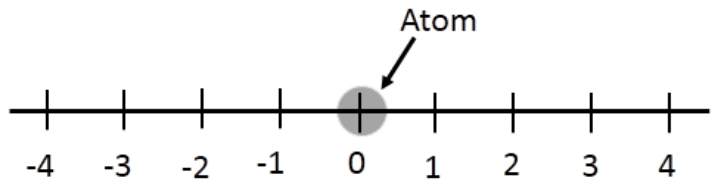
An atom is restricted to move in one dimension by making unit jumps either to the left or right, as shown in the figure. Assuming that a jump to the left or right is equally probable, the probability of the atom returning back to the starting point after four jumps is

A number line marked from -4 to 4 with the atom sitting at 0

Exam Year(s)

GATE XE - 2018,

Answer: C

The probability is 0.375.

Four jumps of +1 or -1, each equally likely, give \(2^{4} = 16\) equally likely sequences. To return to 0 the atom needs two jumps right and two left, in any order:

\[ P = \frac{\binom{4}{2}}{2^{4}} = \frac{6}{16} = 0.375 \]

0.250 (4 of 16) and 0.500 (8 of 16) miscount the six favourable orderings, and 0.333 cannot arise at all, since every probability here is a whole number of sixteenths.

Please log in or register to report this question.

Loading…
Tags: Crystal Structures and Imperfections Questions and Answers || Crystal Structures and Imperfections MCQ Questions and Answers || Crystal Structures and Imperfections GK Questions and Answers || Crystal Structures and Imperfections GK MCQ Questions || Crystal Structures and Imperfections Multiple Choice Questions and Answers || Crystal Structures and Imperfections GK || GK on Crystal Structures and Imperfections || Materials Science Questions and Answers || Materials Science MCQ Questions and Answers || Materials Science GK Questions and Answers || GK on Materials Science