
Machine-translated by Google. Questions are authored in English.
Top

Crystal Structures and Imperfections Questions and Answers

11.

Number of atoms per unit area of the (110) plane of a body centered cubic crystal, with lattice parameter ‘\(a\)’, is

Exam Year(s)

GATE XE - 2022,

Answer: B

The planar density is \(\frac{\sqrt{2}}{a^{2}}\).

Within one unit cell the (110) plane is a rectangle a wide and \(a\sqrt{2}\) long, the face diagonal. It contains the four corner atoms, each shared by four such rectangles, and the body-centre atom, which lies in the plane:

\[ \begin{aligned} n &= 4 \times \frac{1}{4} + 1 = 2 \\ \frac{n}{\text{area}} &= \frac{2}{\sqrt{2}a^{2}} = \frac{\sqrt{2}}{a^{2}} \end{aligned} \]

\(1/a^{2}\) counts the atoms of a (100) face. \(1/(\sqrt{2}a^{2})\) forgets the body-centre atom, and \(1/(\sqrt{3}a^{2})\) is the density of the BCC (111) plane.

Please log in or register to report this question.
12.

Aliovalent doping of \(MgCl_{2}\) in \(NaCl\) leads to the formation of defects. Which one of the following is the correct defect reaction?

Exam Year(s)

GATE XE - 2023,

Answer: B

The correct defect reaction is \(Mg_{Na}^{\bullet} + Cl_{Cl} + V_{Na}' = \emptyset\).

In Kroger-Vink notation the subscript is the site and the superscript the charge relative to the perfect lattice (\(\bullet\) positive, \('\) negative). \(Mg^{2+}\) replaces \(Na^{+}\) on a sodium site, so it carries one extra positive charge, \(Mg_{Na}^{\bullet}\). The second chloride ion of \(MgCl_{2}\) occupies a normal chlorine site, \(Cl_{Cl}\), and to keep the lattice neutral and the site ratio right one sodium site is left vacant, a vacancy with effective negative charge, \(V_{Na}'\).

The other options fail on site or charge. Mg on a Cl site is a cation on an anion site. Writing \(Mg_{Na}\) with no charge ignores the valence difference that makes the doping aliovalent. \(Mg_{Na}'\) with \(V_{Na}^{\bullet}\) gives both defects the wrong sign.

Please log in or register to report this question.
13.

Match the lattice planes and directions (in Column I) with the corresponding Miller indices (in Column II):

Column I:

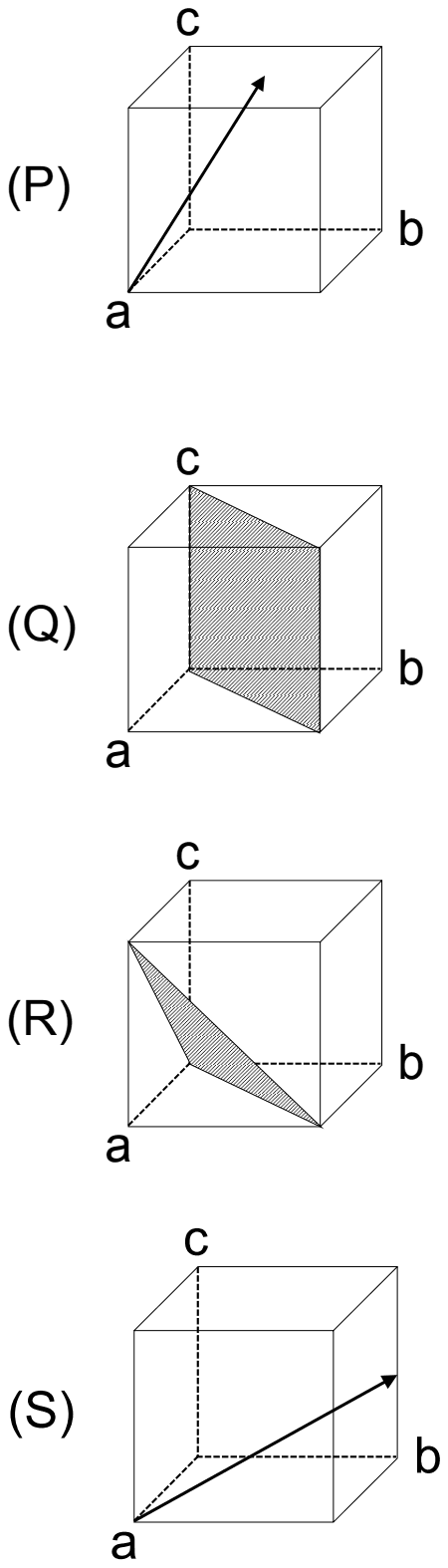
Four unit cubes, axes a, b, c from the back lower left corner. P: arrow from the end of a to the top-face centre. Q: plane through the c axis and the base diagonal. R: triangle through the origin and two corners of the front face. S: arrow from the end of a to the middle of the back right edge

Column II:
1. \((\bar{1}11)\)
2. \([\bar{1}12]\)
3. \([\bar{2}21]\)
4. \((\bar{1}10)\)

Exam Year(s)

GATE XE - 2023,

Answer: A

The correct match is P-2, Q-4, R-1, S-3.

Take the origin at the back lower left corner, where the three dashed axes meet, with \(a\), \(b\), \(c\) along the cube edges. A direction is the difference between its end and start points, cleared to integers; a plane's Miller indices are the reciprocals of its intercepts, or equivalently its normal.

  • P: from (1, 0, 0) to the top-face centre \((\tfrac{1}{2}, \tfrac{1}{2}, 1)\): \((-\tfrac{1}{2}, \tfrac{1}{2}, 1)\), i.e. \([\bar{1}12]\) (2).
  • Q: the plane contains the \(c\) axis and the [110] diagonal of the base, so its normal is \([\bar{1}10]\) and the plane is \((\bar{1}10)\) (4).
  • R: the triangle through (0, 0, 0), (1, 0, 1) and (1, 1, 0) has normal \((1,0,1) \times (1,1,0) = (-1, 1, 1)\): \((\bar{1}11)\) (1).
  • S: from (1, 0, 0) to \((0, 1, \tfrac{1}{2})\): \((-1, 1, \tfrac{1}{2})\), i.e. \([\bar{2}21]\) (3).

A useful first filter: P and S are arrows, so they must take the square-bracket directions 2 and 3, while the shaded Q and R take the round-bracket planes 1 and 4. Only P-2, Q-4, R-1, S-3 and P-3, Q-1, R-4, S-2 respect that, and the working above picks the first. The other two options pair a plane with a direction.

Please log in or register to report this question.
14.

Which one of the following unit cell parameters represents a tetragonal crystal system?

Exam Year(s)

GATE XE - 2024,

Answer: D

The tetragonal system has a = b ≠ c ; α = β = γ = 90.

A tetragonal cell is a cube stretched or squashed along one axis: two equal edges, a third of different length, and all three angles 90 degrees.

a = b = c with all angles equal but not 90 degrees is rhombohedral (trigonal). a ≠ b ≠ c with all angles 90 degrees is orthorhombic. a = b ≠ c with α = β = 90 and γ = 120 degrees is hexagonal.

Please log in or register to report this question.

15.

The Miller indices for the shaded plane shown in the unit cell below is

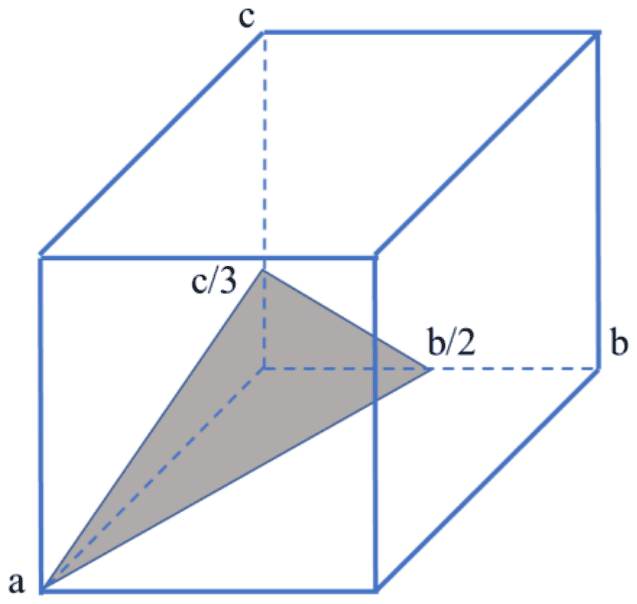
Cubic unit cell with axes a, b, c; the shaded triangular plane meets the a axis at a, the b axis at b/2 and the c axis at c/3

Exam Year(s)

GATE XE - 2024,

Answer: D

The Miller indices are (123).

The plane cuts the three axes at a, b/2 and c/3, that is at fractional intercepts 1, 1/2 and 1/3. The Miller indices are the reciprocals, cleared of fractions:

\(\left(\tfrac{1}{1}, \tfrac{1}{1/2}, \tfrac{1}{1/3}\right) = (1, 2, 3)\)

A plane is written in round brackets, (hkl); square brackets [uvw] denote a direction, so [123] and [632] are the wrong notation. (632) comes from taking the intercepts 1, 1/2, 1/3 and multiplying by 6 instead of inverting them.

Please log in or register to report this question.

16.

The figure below shows a plane PQR in a unit cell. The Miller indices of the plane PQR is

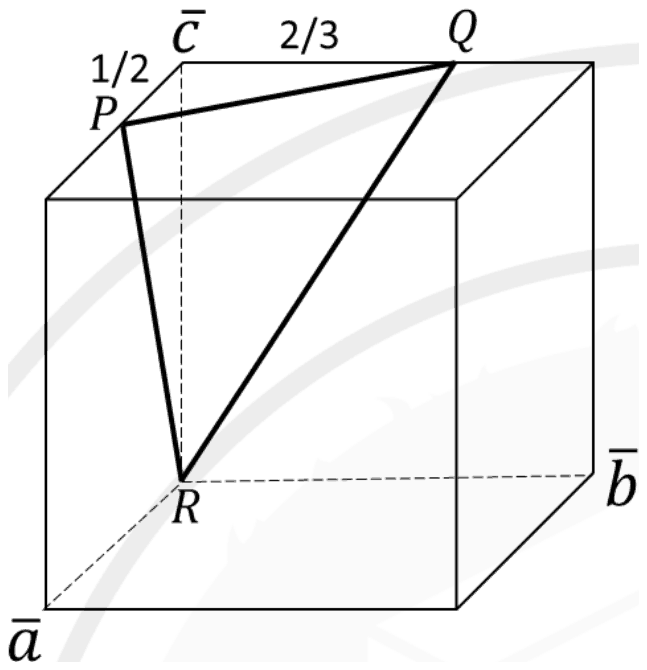
Unit cube with axes a, b, c from the back lower corner R; P lies on the top edge from the c corner toward a at 1/2, Q on the top edge from the c corner toward b at 2/3, and the plane PQR is drawn

Exam Year(s)

GATE XE - 2025,

Answer: B

The Miller indices are \((43\bar{2})\).

Take R, where the three axes meet, as the origin, with \(a\), \(b\) and \(c\) along the axes. Then \(R = (0, 0, 0)\), \(P = (\frac{1}{2}, 0, 1)\) on the top edge along \(a\), and \(Q = (0, \frac{2}{3}, 1)\) on the top edge along \(b\). The plane passes through the origin, so its normal is the cross product of the vectors to P and Q:

\[ \begin{aligned} \vec{n} &= \left(\tfrac{1}{2}, 0, 1\right) \times \left(0, \tfrac{2}{3}, 1\right) \\ &= \left(-\tfrac{2}{3}, -\tfrac{1}{2}, \tfrac{1}{3}\right) \end{aligned} \]

Multiplying by \(-6\) clears the fractions: \((4, 3, -2)\), that is \((43\bar{2})\). Check: the plane \(4x + 3y - 2z = 0\) contains R, P (\(2 - 2 = 0\)) and Q (\(2 - 2 = 0\)).

\((432)\) misses the sign of the \(c\) index, and \((23\bar{4})\) and its negative \((\bar{2}\bar{3}4)\) swap the \(a\) and \(c\) indices: the plane \(2x + 3y - 4z = 0\) misses P, since \(1 - 4 \ne 0\).

Please log in or register to report this question.

17.

In an FCC crystal with lattice parameter \(a\), consider the reaction of two leading partial dislocations, AB and CD, at the line of intersection of their slip planes \((111)\) and \((11\bar{1})\), respectively, as shown in the figure below. Dislocations, AB and CD, have Burgers vectors \(\vec{b}_{1}\) and \(\vec{b}_{2}\), respectively, as given in the figure. Which one of the following options for the slip plane and the Burgers vector of the resulting dislocation is correct?

[The figure shows the two intersecting slip planes, with \(\vec{b}_{1} = \frac{a}{6}[\bar{1}2\bar{1}]\) for AB on \((111)\) and \(\vec{b}_{2} = \frac{a}{6}[2\bar{1}1]\) for CD on \((11\bar{1})\).]

Exam Year(s)

GATE XE - 2025,

Answer: A

The resulting dislocation lies on \((001)\) with Burgers vector \(\frac{a}{6}[110]\).

Add the two Burgers vectors:

\[ \begin{aligned} \vec{b} &= \frac{a}{6}[\bar{1}2\bar{1}] + \frac{a}{6}[2\bar{1}1] \\ &= \frac{a}{6}[110] \end{aligned} \]

The product lies along the intersection of \((111)\) and \((11\bar{1})\), whose direction is \((1,1,1) \times (1,1,-1) = (-2, 2, 0)\), that is \([\bar{1}10]\). Its plane contains both this line and \(\vec{b}\), so its normal is \([\bar{1}10] \times [110] \propto [001]\): the plane is \((001)\). This is the Lomer-Cottrell stair-rod dislocation; \((001)\) is not a slip plane in FCC, so the dislocation is sessile and forms a barrier.

The energy drops from \(\frac{a^{2}}{6} + \frac{a^{2}}{6}\) to \(\frac{a^{2}}{18}\), so the reaction is favourable. \(\frac{a}{2}[110]\) would be the sum of two full dislocations, not two partials, and the planes \((1\bar{1}1)\) and \((\bar{1}11)\) do not contain both the line and \([110]\).

Please log in or register to report this question.

18.

In a cubic crystal, the Burgers vector for a mixed dislocation line is \(\frac{a}{2}[110]\). The dislocation line lies along the [011] direction. The slip plane of the dislocation is

Exam Year(s)

GATE XE - 2026,

Answer: A

The slip plane is \((1\bar{1}1)\).

The slip plane of a dislocation contains both its Burgers vector and its line direction, so its normal is their cross product:

\[ \begin{aligned} [110] \times [011] &= (1\cdot1-0\cdot1,\ 0\cdot0-1\cdot1,\ 1\cdot1-1\cdot0) \\ &= [1\bar{1}1] \end{aligned} \]

In a cubic crystal the plane with normal \([1\bar{1}1]\) is \((1\bar{1}1)\). Check: \(1\cdot1 + 1\cdot(-1) + 0\cdot1 = 0\) and \(0\cdot1 + 1\cdot(-1) + 1\cdot1 = 0\), so both vectors lie in it. (111) contains neither vector, \((0\bar{1}1)\) contains [011] but not [110], and \((1\bar{1}0)\) contains neither.

Please log in or register to report this question.

Answer: A

The correct statement is that Frenkel defects are dominant in those ionic solids where there is a considerable size difference between the cation and anion.

A Frenkel defect moves an ion, usually the smaller cation, from its site into an interstitial position. This is energetically easy only when that ion is much smaller than the other, so it fits into the interstices: AgCl and AgBr are the standard examples.

A Schottky defect is a pair of missing cation and anion, and it dominates when the ions are of similar size, as in NaCl and KCl, where neither ion fits into an interstice. So Schottky defects are not dominant where sizes differ, not dominant in all ionic solids, and the two defect types are not present in similar densities everywhere.

Please log in or register to report this question.

Loading…
Tags: Crystal Structures and Imperfections Questions and Answers || Crystal Structures and Imperfections MCQ Questions and Answers || Crystal Structures and Imperfections GK Questions and Answers || Crystal Structures and Imperfections GK MCQ Questions || Crystal Structures and Imperfections Multiple Choice Questions and Answers || Crystal Structures and Imperfections GK || GK on Crystal Structures and Imperfections || Materials Science Questions and Answers || Materials Science MCQ Questions and Answers || Materials Science GK Questions and Answers || GK on Materials Science