
Machine-translated by Google. Questions are authored in English.
Top

Commodity Thermoplastics Questions and Answers

11.

Match the Product with the most appropriate Processing Technique employed.

ProductProcessing Technique
PRainboots1Blow molding
QDisposable plastic cups2Calendering
RSoft drink bottles3Rotational molding
SFlexible films4Thermoforming

Exam Year(s)

GATE XE - 2025,

Answer: B

The match is P-3; Q-4; R-1; S-2.

  • Rainboots, hollow one-piece products, are made by rotational molding, in which powder tumbles inside a heated rotating mould and coats its walls.
  • Disposable plastic cups are formed from heated sheet drawn into a cup-shaped mould: thermoforming.
  • Soft drink bottles are made by blow molding, inflating a preform against the mould.
  • Flexible films and sheets are produced by calendering, squeezing the melt between heated rolls.

The other options misplace at least one product: blow molding cannot make an open cup, and calendering makes flat film, not bottles or boots.

Please log in or register to report this question.
12.

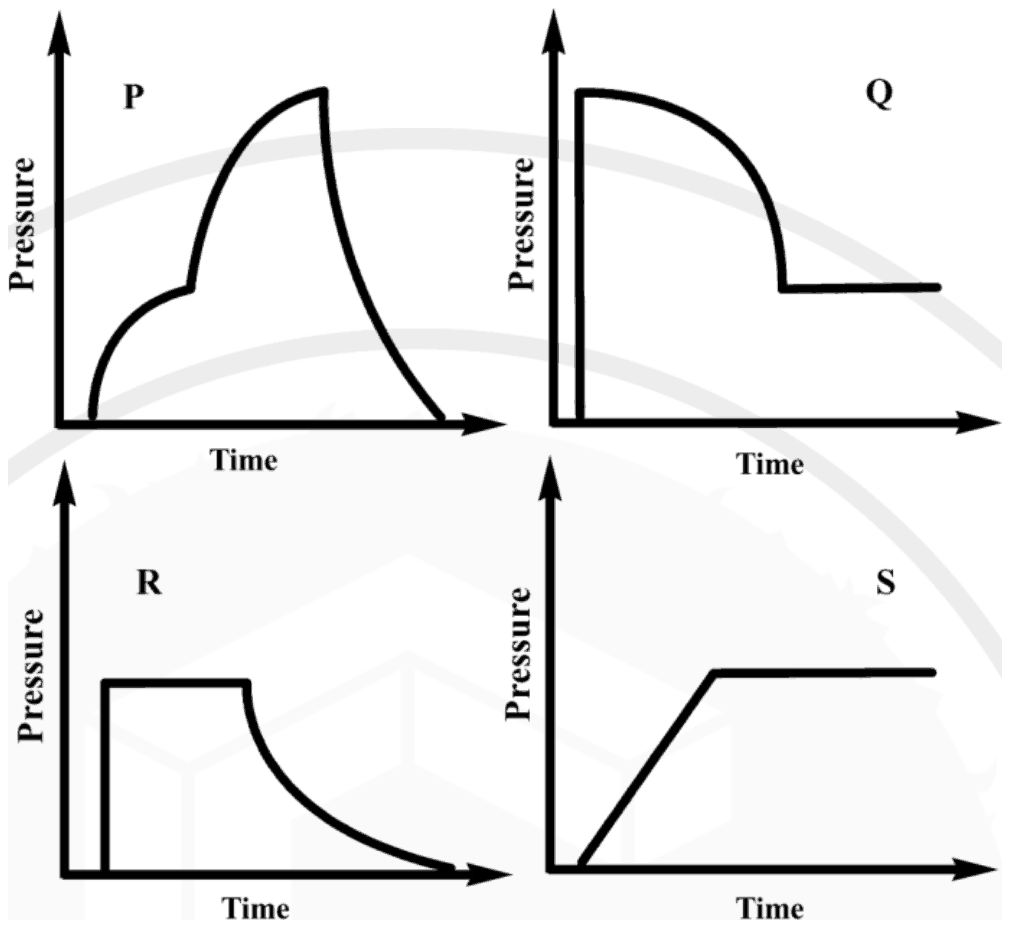
Injection molding is typically used to make plastic parts. If the pressure at the gate is monitored as a function of time during the injection of a thermoplastic polymer, identify the profile that best describes this event.

Four pressure versus time plots: P rises in two stages to a sharp peak then decays to zero; Q jumps to a maximum then falls to a constant level; R jumps to a plateau then decays; S rises linearly then levels off

Exam Year(s)

GATE XE - 2025,

Answer: C

The best description is profile P.

During injection the pressure at the gate goes through three stages:

  1. Filling: as melt flows into the cavity the pressure rises gradually, since the flow length and resistance keep increasing.
  2. Packing: once the cavity is full the melt is compressed and extra material is packed in to make up for shrinkage, so the pressure climbs steeply to its peak.
  3. Holding and cooling: the gate freezes, the part cools and shrinks, and the pressure decays back toward zero.

Profile P shows exactly this: a first rise, a sharper rise to a peak, and then decay to zero. Q and R begin with an instant jump that ignores the filling stage, and S levels off without ever decaying, as if the part never cooled.

Please log in or register to report this question.

13.

Which one of the following polymer processing techniques involves shaping a heated sheet?

Exam Year(s)

GATE XE - 2026,

Answer: A

The technique is thermoforming.

In thermoforming a thermoplastic sheet is heated until it softens and is then drawn against a mould by vacuum, pressure or a plug, and cooled to hold the shape. Cups, trays, blister packs and refrigerator liners are made this way.

Injection moulding forces molten polymer into a closed mould cavity, blow moulding inflates a heated tube (parison) inside a mould to make hollow articles such as bottles, and extrusion pushes molten polymer through a die to make continuous profiles, pipes or sheet. None of these starts from a heated sheet.

Please log in or register to report this question.

14.

Select the correct option to match the Product with the most appropriate Processing technique from the table given below:

ProductProcessing technique
PFibre-reinforced pressure vesselIRotomoulding
QOverhead water tankIIThermoforming
RBlister package for medicineIIIFilament winding
SPlastic carry bagIVBlown film extrusion

Exam Year(s)

GATE XE - 2026,

Answer: D

The correct matching is P-III ; Q-I ; R-II ; S-IV.

  • Fibre-reinforced pressure vessel: filament winding wraps resin-impregnated fibres round a rotating mandrel in a pattern chosen to carry the hoop and axial stresses (III).
  • Overhead water tank: rotomoulding tumbles powder in a heated mould to make large, seamless hollow parts (I).
  • Blister package: thermoforming shapes a heated sheet into the pockets (II).
  • Plastic carry bag: blown film extrusion inflates an extruded tube into thin film (IV).

Option A swaps the tank and the blister pack, and the others assign the pressure vessel to processes that cannot place continuous fibres.

Please log in or register to report this question.

Loading…
Tags: Commodity Thermoplastics Questions and Answers || Commodity Thermoplastics MCQ Questions and Answers || Commodity Thermoplastics GK Questions and Answers || Commodity Thermoplastics GK MCQ Questions || Commodity Thermoplastics Multiple Choice Questions and Answers || Commodity Thermoplastics GK || GK on Commodity Thermoplastics || Polymer Technology Questions and Answers || Polymer Technology MCQ Questions and Answers || Polymer Technology GK Questions and Answers || GK on Polymer Technology