
Machine-translated by Google. Questions are authored in English.
Top

Inventory Control Systems Questions and Answers

1.

Which of the following best describes the EOQ model's main objective?

Exam Year(s)

DSSSB - 2023,

Answer: D

The main objective of the EOQ (economic order quantity) model is to minimise the total inventory costs. It finds the order size at which the sum of the ordering cost and the holding cost is least. The model does not aim at maximising sales, minimising lead time or maximising stock availability, which would raise holding cost.

Please log in or register to report this question.
2.

Which one of the following is NOT a form of inventory?

Exam Year(s)

GATE ME - 2022,

Answer: D

The item that is NOT inventory is CNC milling machines.

Inventory is stock held to be converted into, or sold as, product: raw materials waiting to be processed, work-in-process partly through production, and finished goods awaiting sale. All three appear on the books as current assets.

CNC milling machines are the equipment that does the processing. They are capital goods (fixed assets) used over many years and are not consumed in or sold as the product, so they are not inventory. (A machine-tool maker's unsold machines would be its finished goods, but the question is about the machines as production equipment.)

Please log in or register to report this question.

3.

A local tyre distributor expects to sell approximately 9600 steel belted radial tyres next year. Annual carrying cost is Rs. 16 per tyre and ordering cost is Rs. 75. The economic order quantity of the tyres is

Exam Year(s)

GATE ME - 2018,

Answer: C

The economic order quantity is 300 tyres.

With annual demand D, ordering cost per order \(C_{o}\) and carrying cost per unit per year \(C_{h}\):

\[ \begin{aligned} EOQ &= \sqrt{\frac{2DC_{o}}{C_{h}}} \\ &= \sqrt{\frac{2 \times 9600 \times 75}{16}} \\ &= \sqrt{90000} = 300 \end{aligned} \]

At this quantity the annual ordering cost (32 orders × Rs. 75 = Rs. 2400) equals the annual carrying cost (150 average tyres × Rs. 16 = Rs. 2400), which is the check. 212 is what you get by dropping the factor 2, and 64 comes from inverting the cost ratio; 1200 does not follow from the formula.

Please log in or register to report this question.

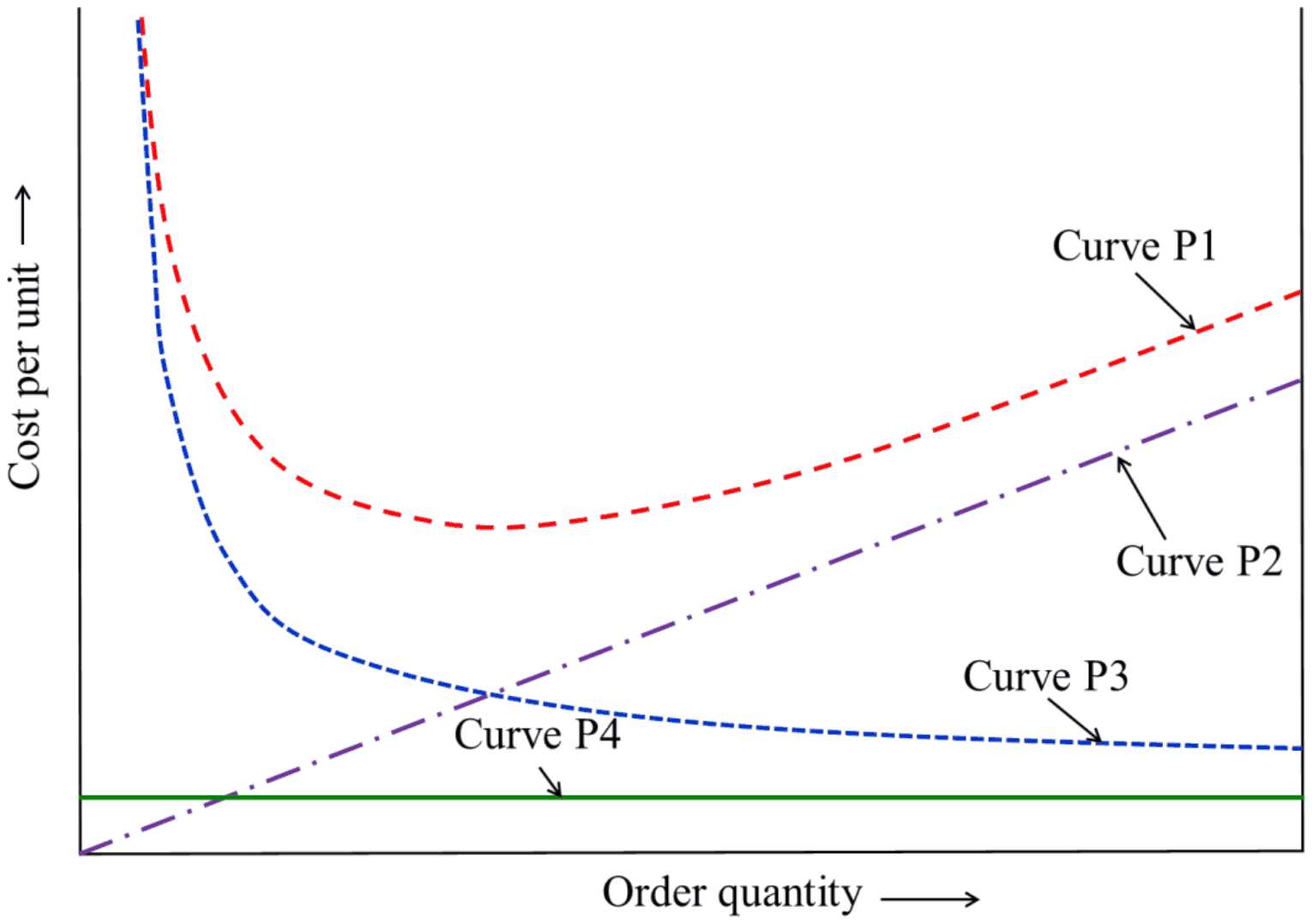
Answer: A

The correct labelling is Curve P1: Total cost, Curve P2: Holding cost, Curve P3: Setup cost, and Curve P4: Production cost.

In the EOQ model, with order quantity Q, annual demand D, setup cost S per order and holding cost H per unit per year:

  • holding cost rises in a straight line with Q, since average stock is Q/2: the dash-dot line P2 through the origin;
  • setup (ordering) cost falls as D/Q, steeply at first and then flattening: the hyperbola-like curve P3;
  • production or purchase cost per unit does not depend on the order quantity: the flat line P4;
  • total cost, the sum of these, is U-shaped with its minimum near where the holding and setup curves cross, at the EOQ: P1.

Every other option gives a straight or flat curve the name of a cost that must curve, or swaps the U-shaped total with a component.

Please log in or register to report this question.

5.

A company orders gears in conditions identical to those considered in the economic order quantity (EOQ) model in inventory control. The annual demand is 8000 gears, the cost per order is 300 rupees, and the holding cost is 12 rupees per month per gear. The company uses an order size that is 25% more than the optimal order quantity determined by the EOQ model. The percentage change in the total cost of ordering and holding inventory from that associated with the optimal order quantity is

Exam Year(s)

GATE ME - 2024,

Answer: A

The total cost rises by 2.5%.

In the EOQ model the total of ordering and holding cost, as a fraction of its minimum, depends only on the ratio of the order size to the optimal size \(Q^{*}\):

\[ \begin{aligned} \frac{TC(Q)}{TC(Q^{*})} &= \frac{1}{2}\left(\frac{Q}{Q^{*}} + \frac{Q^{*}}{Q}\right) \\ &= \frac{1}{2}\left(1.25 + 0.8\right) = 1.025 \end{aligned} \]

so the cost is 2.5% higher. The demand and cost figures fix \(Q^{*}\) (about 183 gears with a holding cost of 144 rupees per gear per year), but the percentage change does not depend on them. The cost curve is flat near its minimum, which is why a 25% error in order size costs only 2.5%; 12.5% is half the 25% change in order size and ignores that flatness, and 0 or 5% do not follow from the formula.

Please log in or register to report this question.

Loading…
Tags: Inventory Control Systems Questions and Answers || Inventory Control Systems MCQ Questions and Answers || Inventory Control Systems GK Questions and Answers || Inventory Control Systems GK MCQ Questions || Inventory Control Systems Multiple Choice Questions and Answers || Inventory Control Systems GK || GK on Inventory Control Systems || Production Planning and Control Questions and Answers || Production Planning and Control MCQ Questions and Answers || Production Planning and Control GK Questions and Answers || GK on Production Planning and Control