
Machine-translated by Google. Questions are authored in English.
Top

Fluid Mechanics Questions and Answers

1.

Two horizontal plates are placed one above the other at a distance of 2 cm, the space between them being filled with an oil of viscosity 15 poises. What is the shear stress in oil if the upper plate is moved with a velocity of 2 m/s?

Exam Year(s)

DSSSB JE - 2023,

Answer: D

For a Newtonian fluid the shear stress is \(\tau = \mu\,\dfrac{du}{dy}\). The viscosity is 15 poise, and 1 poise = 0.1 N s/m\(^2\), so \(\mu = 1.5\) N s/m\(^2\). The gap is 0.02 m and the velocity change across it is 2 m/s:

\[ \tau = 1.5 \times \frac{2}{0.02} = 150\ \text{N/m}^2 \]

The smaller values of 120, 130 and 140 N/m\(^2\) would result from small arithmetic slips in the conversion of the viscosity or the gap, and do not follow from the data.

Please log in or register to report this question.
2.

In the field of fluid dynamics, what describes the tendency of a fluid to resist motion or deformation due to internal friction?

Exam Year(s)

DSSSB - 2023,

Answer: C

Viscosity is the property of a fluid that resists motion or deformation because of internal friction between its layers. Surface tension is the force at the surface of a liquid, elasticity is the tendency to return to the original shape, and density is mass per unit volume, so none of these measures the resistance to flow of the fluid.

Please log in or register to report this question.
3.

In a two-dimensional flow field, the velocities in the x- and y- directions are u and v, respectively. The shear stress for a Newtonian fluid having dynamic viscosity \(\mu\) is given by

Exam Year(s)

GATE XE - 2012,

Answer: D

The shear stress is \(\mu\left(\dfrac{\partial v}{\partial x} + \dfrac{\partial u}{\partial y}\right)\).

For a Newtonian fluid the shear stress is the viscosity times twice the shear strain rate. In two dimensions the rate of angular deformation of a fluid element is the sum of the two cross derivatives, so \(\tau_{xy} = \mu(\partial v/\partial x + \partial u/\partial y)\). For a simple parallel flow this reduces to the familiar \(\mu\,du/dy\).

The difference of the derivatives is the vorticity, which measures rotation, not deformation. \(2\mu\,\partial u/\partial x\) and \(2\mu\,\partial v/\partial y\) are the viscous parts of the normal stresses, not shear stress.

Please log in or register to report this question.
4.

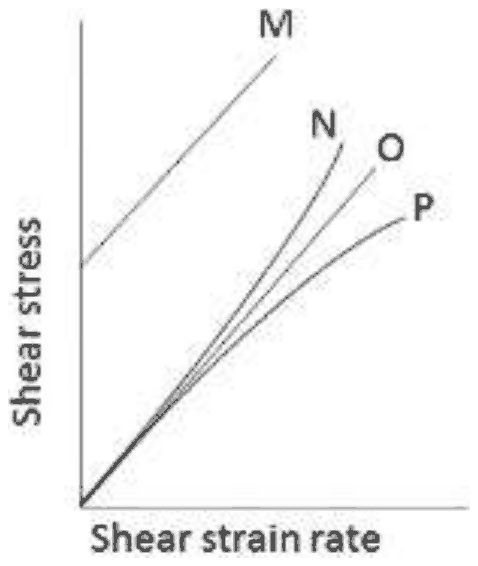
Rheological diagram of different types of fluids is shown in figure. Column I represents the nature of the fluid and column II represents the curve showing the variation of shear stress against shear strain rate.

Column IColumn II
(i) NewtonianM
(ii) Shear thinningN
(iii) Shear thickeningO
(iv) Bingham plasticP

Shear stress against shear strain rate: M is a straight line starting above the origin, O a straight line through the origin, N curves upward and P curves downward from the origin

The most appropriate match between columns I and II is,

Exam Year(s)

GATE XE - 2018,

Answer: B

The match is (i) - O; (ii) - P; (iii) - N; (iv) - M.

  • A Newtonian fluid has shear stress proportional to strain rate: a straight line through the origin, curve O.
  • A shear-thinning fluid's apparent viscosity falls as the rate rises, so the curve bends down towards the rate axis: P.
  • A shear-thickening fluid's viscosity rises with rate, so its curve bends upward: N.
  • A Bingham plastic does not flow until a yield stress is exceeded, then behaves linearly: a straight line starting above the origin, M.

Options pairing Newtonian with P, or Bingham plastic with N, put a curved line where a straight one is needed, and the first option swaps thinning and thickening.

Please log in or register to report this question.
5.

Identify the correct statement related to the viscosity of Newtonian fluids from the following

Exam Year(s)

GATE XE - 2018,

Answer: D

The viscosity of a Newtonian fluid is not influenced by shearing rate.

A Newtonian fluid obeys τ = μ(du/dy), with μ a constant at a given temperature and pressure, so its viscosity is the same at every shear rate. Water, milk and clear juices behave this way.

Viscosity rising with shear rate is dilatant behaviour, and falling with shear rate is pseudoplastic. The viscosity of a Newtonian fluid does depend strongly on temperature (that of liquids falls as they are heated), so 'not influenced by temperature' is wrong.

Please log in or register to report this question.

6.

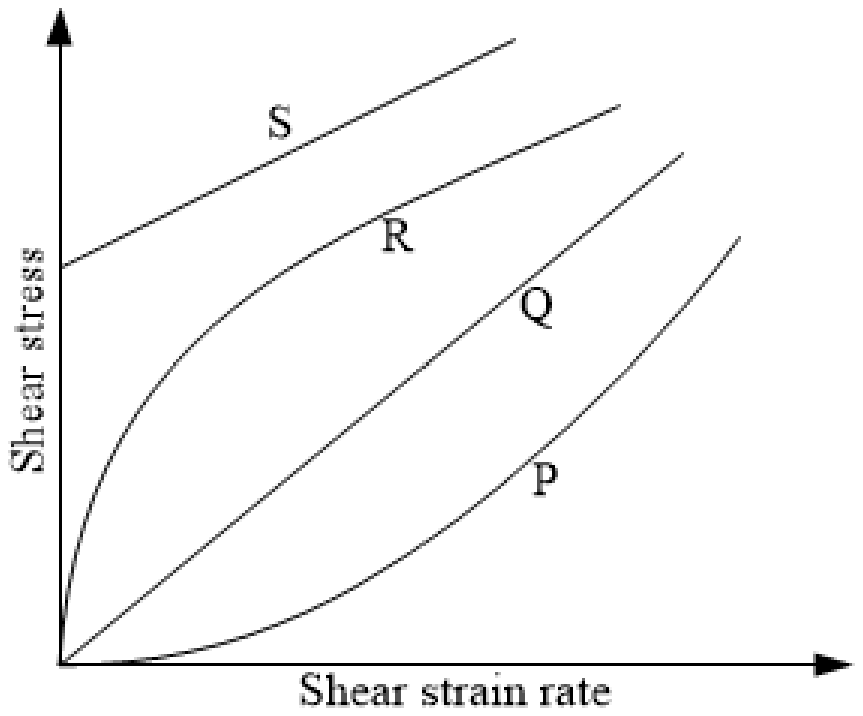
Among the shear stress versus shear strain rate curves shown in the figure, which one corresponds to a shear thinning fluid?

Shear stress against shear strain rate: S a straight line starting above the origin; R a curve from the origin rising steeply and then flattening; Q a straight line through the origin; P a curve from the origin rising slowly and then steepening

Exam Year(s)

GATE XE - 2023,

Answer: C

The shear thinning fluid is R.

A shear thinning (pseudoplastic) fluid has an apparent viscosity, the slope of the stress-strain rate curve, that falls as the strain rate rises. Its curve starts at the origin and bends downwards, concave to the strain-rate axis, as R does.

Q is a straight line through the origin, a Newtonian fluid with constant viscosity. P starts at the origin and steepens, so its apparent viscosity rises: a shear thickening (dilatant) fluid. S is a straight line that starts above the origin, meaning the fluid needs a yield stress before it flows: a Bingham plastic.

Please log in or register to report this question.
7.

A two-dimensional incompressible flow field is defined as,

\[ \vec{V}(x, y) = (Axy)\,\hat{i} + (By^{2})\,\hat{j} \]

where, \(A\) and \(B\) are constants. The dynamic viscosity of the Newtonian fluid is \(\mu\). In the absence of body force, which among the following expressions represents the pressure gradient at the location (5, 0) in the concerned flow field?

Exam Year(s)

GATE XE - 2023,

Answer: C

The pressure gradient is \(\mu A(-\hat{j})\).

Incompressibility fixes \(B\):

\[ \begin{aligned} \frac{\partial u}{\partial x} + \frac{\partial v}{\partial y} &= Ay + 2By = 0 \\ \Rightarrow B &= -\frac{A}{2} \end{aligned} \]

The steady Navier-Stokes equation gives \(\nabla p = -\rho(\vec{V}\cdot\nabla)\vec{V} + \mu\nabla^{2}\vec{V}\). At (5, 0) both velocity components vanish (\(u = 5A \cdot 0 = 0\), \(v = 0\)), so the convective term is zero there. The viscous term:

\[ \begin{aligned} \nabla^{2}u &= \nabla^{2}(Axy) = 0 \\ \nabla^{2}v &= \nabla^{2}(By^{2}) = 2B = -A \end{aligned} \]

So \(\nabla p = \mu(0\,\hat{i} - A\,\hat{j}) = \mu A(-\hat{j})\).

Options with an \(\hat{i}\) component wrongly take \(\nabla^{2}(Axy)\) as non-zero, or keep \(B\) without applying continuity.

Please log in or register to report this question.

8.

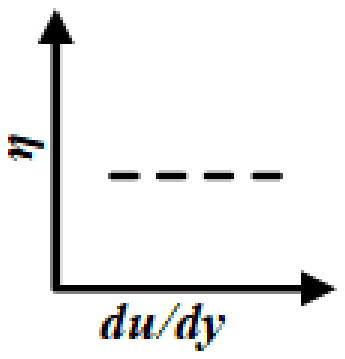
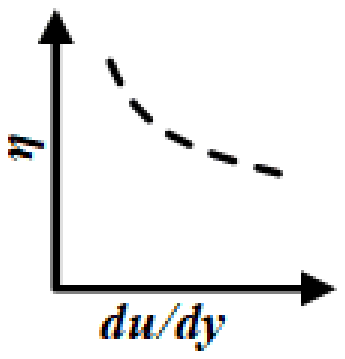
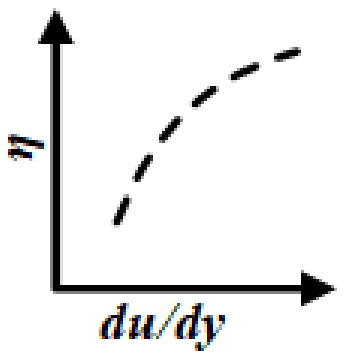
Which one of the following figures shows the CORRECT dependence of apparent viscosity (\(\eta\)) on rate of shear strain (\(du/dy\)) for pseudoplastic fluids?

Exam Year(s)

GATE XE - 2024,

Answer: B

The correct plot is (B), apparent viscosity falling as the shear rate rises.

A pseudoplastic fluid is shear-thinning: in the power-law model \(\tau = K(du/dy)^{n}\) its index is \(n \lt 1\), so the apparent viscosity \(\eta = K(du/dy)^{n-1}\) decreases with increasing shear rate. Polymer solutions, paints and blood behave this way.

Plot (A), a constant viscosity, describes a Newtonian fluid. Plots (C) and (D), viscosity rising with shear rate, describe a dilatant (shear-thickening) fluid with \(n \gt 1\), such as a dense starch suspension.

Please log in or register to report this question.

9.

Group-I indicates different properties of fluid and Group-II defines their basic dimensions in terms of Force (F), Length (L), and Time (T).

Group-IGroup-II
PDynamic viscosity1FL−4T2
QSurface tension2FL−2T
RDensity3FL−1

Which one of the following options identifies the correct match between Group-I and Group-II?

Exam Year(s)

GATE XE - 2025,

Answer: D

The match is P-2, Q-3, R-1.

In the FLT system, mass has dimensions \(FL^{-1}T^{2}\) (from \(F = ma\)).

  • Dynamic viscosity is shear stress divided by velocity gradient: \(FL^{-2} / T^{-1} = FL^{-2}T\), item 2.
  • Surface tension is force per unit length: \(FL^{-1}\), item 3.
  • Density is mass per unit volume: \(FL^{-1}T^{2}/L^{3} = FL^{-4}T^{2}\), item 1.

The other options misplace at least one of these; for instance P-1 gives viscosity the dimensions of density.

Please log in or register to report this question.

10.

Consider the following statements:

Assertion (a)
Surface tension acts along the interface of two fluids.

Reason (r)
The pressure of the fluid inside a bubble is higher than that of the fluid outside the bubble.

Which one of the following options is correct?

Exam Year(s)

GATE XE - 2026,

Answer: B

Both (a) and (r) are true, however (r) is not the correct explanation of (a).

Surface tension is a force per unit length acting tangentially in the interface between two fluids, so the assertion is true.

The reason is also true: across a curved interface surface tension produces a pressure jump, so the pressure inside a bubble exceeds that outside (by \(2\sigma/R\) for a single interface).

But the reason is a consequence of surface tension acting on a curved interface, not an explanation of why surface tension acts along the interface. The assertion is about where the force acts, which follows from the imbalance of molecular attraction at the interface, so (r) does not explain (a).

Please log in or register to report this question.

Loading…
Tags: Fluid Properties Questions and Answers || Fluid Properties MCQ Questions and Answers || Fluid Properties GK Questions and Answers || Fluid Properties GK MCQ Questions || Fluid Properties Multiple Choice Questions and Answers || Fluid Properties GK || GK on Fluid Properties || Fluid Mechanics Questions and Answers || Fluid Mechanics MCQ Questions and Answers || Fluid Mechanics GK Questions and Answers || GK on Fluid Mechanics