Machine-translated by Google. Questions are authored in English.
Top

ER Model and Business Rules Questions and Answers

1.

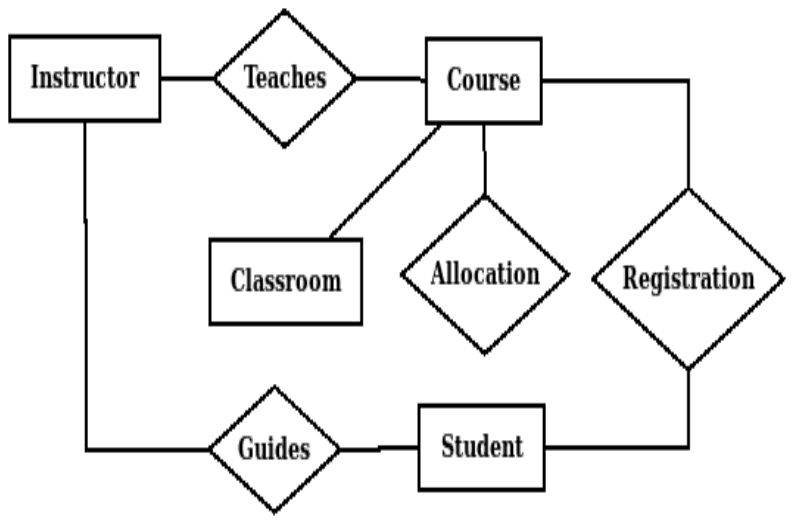
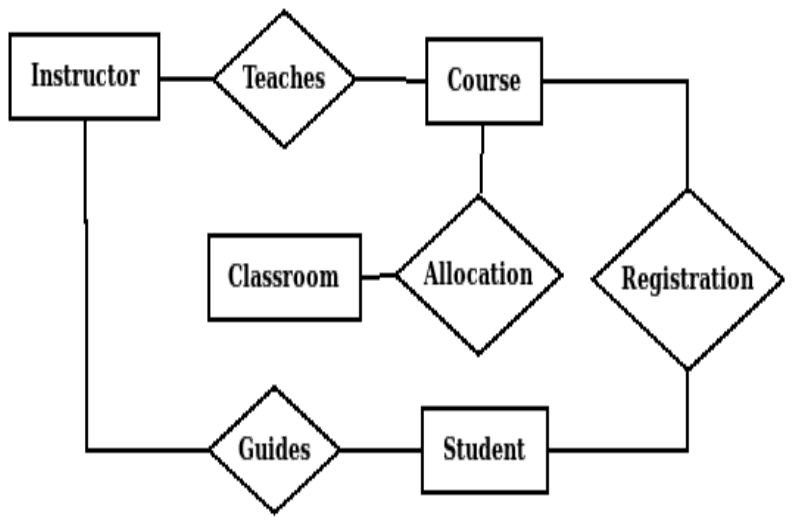
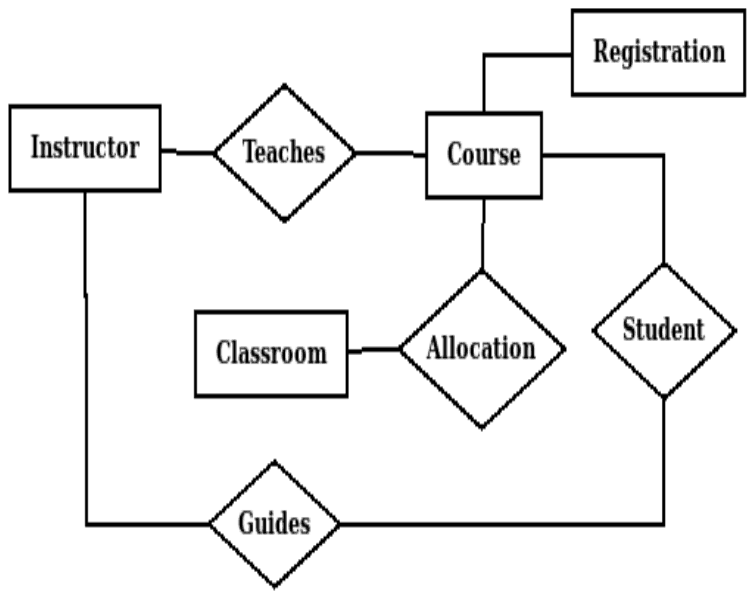
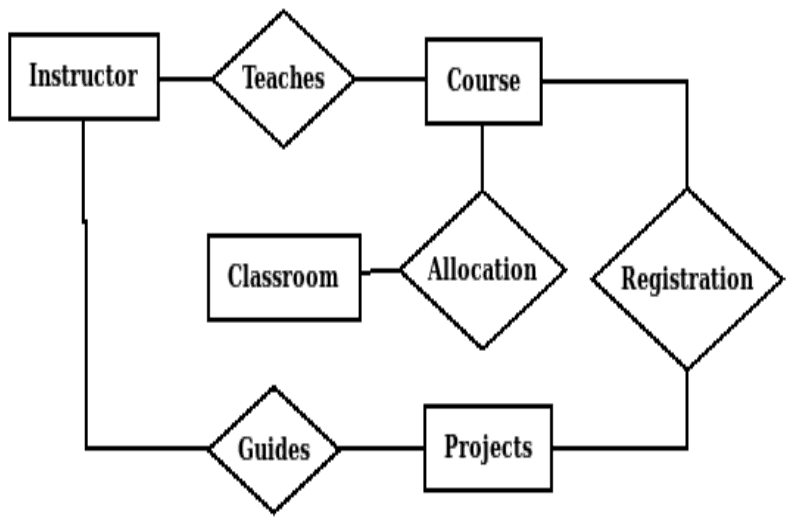
Let S be the specification: "Instructors teach courses. Students register for courses. Courses are allocated classrooms. Instructors guide students." Which one of the following ER diagrams CORRECTLY represents S?
Exam Year(s)

GATE CS - 2024,

Answer: D

The correct ER diagram is (iv).

The specification has four entity sets, Instructor, Course, Classroom and Student, and four relationships: Teaches (Instructor, Course), Registration (Student, Course), Allocation (Course, Classroom) and Guides (Instructor, Student). Diagram (iv) draws exactly these, with entities as rectangles and relationships as diamonds joining the right pairs.

Diagram (i) makes Registration an entity and Student a relationship. Diagram (ii) has no Student entity and has Guides linking Instructor to Projects. Diagram (iii) leaves Allocation unconnected to Classroom and joins Classroom directly to Course.

Please log in or register to report this question.

Answer: A

The true statement is The weak entity set MUST have total participation in the identifying relationship.

A weak entity has no key of its own; it is identified only through its owner, by combining the owner's key with its partial key. So every weak entity must be linked to an owner through the identifying relationship, which is total participation.

The owner need not participate totally: an employee may have no dependents, for example, so not every owner entity has a related weak entity. That rules out the options requiring total participation of the owner, and 'neither' is wrong because the weak side's participation is required.

Please log in or register to report this question.

3.

In an Entity-Relationship (ER) model, suppose \(R\) is a many-to-one relationship from entity set E1 to entity set E2. Assume that E1 and E2 participate totally in \(R\) and that the cardinality of E1 is greater than the cardinality of E2.

Which one of the following is true about \(R\)?

Exam Year(s)

GATE CS - 2018,

Answer: A

The true statement is Every entity in E1 is associated with exactly one entity in E2.

Many-to-one from E1 to E2 means each E1 entity is related to at most one E2 entity. Total participation of E1 means each E1 entity is related to at least one. Together, each E1 entity has exactly one partner in E2.

Some entity in E1 with more than one E2 partner would break the many-to-one rule. On the E2 side, E1 has more entities than E2 and every E1 entity is mapped to some E2 entity, so by the pigeonhole principle some E2 entity is related to two or more E1 entities. That rules out 'exactly one' and 'at most one' for E2.

Please log in or register to report this question.

4.

The approach represented by ER modeling is :

Exam Year(s)

MH SET - 2018, SET Exam - 2018,

Answer: B

ER modelling represents a top down approach.

An entity-relationship design starts from the whole problem: the designer first identifies the main entities and the relationships between them, then refines them by adding attributes, keys and cardinalities, and finally maps the model to tables. Moving from the general picture to the details is the top-down method.

Normalisation is the usual example of the bottom-up approach, starting from individual attributes and grouping them into relations. 'Left right' and 'bottom left' are not design approaches.

Please log in or register to report this question.

5.

In a railway reservation system, the entities are-date, train no, place of departure, destination, type of train, type of seats, seats available.

The primary key will be :

Exam Year(s)

MH SET - 2018, SET Exam - 2018,

Answer: A

The primary key is train no. + date.

A primary key must identify each reservation record uniquely. A given train number runs every day (or on several days), so the train number alone repeats; the combination of train number and date picks out one particular journey, on which seat availability, seat type and the rest depend.

Train number plus destination, or plus place of departure, still repeats from day to day, since the same train serves the same stations daily, and the train number alone is not unique either.

Please log in or register to report this question.

6.

Which of the following statement(s) is/are true for weak entity ?

(i) Weak entity is existence dependent on strong entity
(ii) Weak entity does not have primary key of its own
(iii) Attributes of weak entity are derived from attributes of strong entity

Exam Year(s)

MH SET - 2021, SET Exam - 2021,

Answer: B

Statements (i) and (ii) are true, so the answer is (i) and (ii).

A weak entity set is existence dependent on its identifying (owner) entity set: a dependent cannot exist without the employee it belongs to (i). It has no primary key of its own (ii): it is identified by its discriminator (partial key) combined with the primary key of the owner.

Statement (iii) is false. A weak entity has its own attributes, such as a dependent's name and age; only its identification borrows the owner's key, so its attributes are not derived from the strong entity's attributes.

Please log in or register to report this question.

7.

An ER model of a database consists of entity types P and Q. These are connected by a relationship R, which does not have its own attributes (i.e., no self attributes).

Under which one of the following condition, can the relational table for R be merged with that of P ?

Exam Year(s)

MH SET - 2025, SET Exam - 2025,

Answer: C

R can be merged with P when R is many-to-one and the participation of P in R is total.

If R is many-to-one from P to Q, each P entity is related to at most one Q entity. The relationship can then be stored by adding Q's key as a foreign key column in P's table. If P's participation is total, every P row has a value in that column, so no nulls are introduced.

If R is one-to-many from P, a single P entity can relate to many Q entities, which cannot be stored in one row of P; the table would have to merge with Q instead. With partial participation the merged column would hold nulls for P entities outside the relationship.

Please log in or register to report this question.

8.

Which of the following best explains why a weak entity must always participate in a total participation relationship with its identifying entity ?

Exam Year(s)

Tripura Public Service Commission - 2026,

Answer: C

The reason is that weak entities do not have a primary key of their own.

A weak entity's own attributes (its partial key or discriminator) are not enough to identify it uniquely. It is identified only by combining its partial key with the primary key of its owner (identifying) entity. A weak entity instance cannot therefore exist without an owner to borrow that key from, so every instance must take part in the identifying relationship: total participation. A dependent of an employee, for example, is identified by the employee's ID plus the dependent's name.

Weak entities do have attributes, including the partial key. How they are stored in tables is a consequence of the design, not the reason for it, and taking part in several relationships is neither required nor relevant.

Please log in or register to report this question.

9.

For a weak entity set to be meaningful, it must be associated with another entity set, called the

Exam Year(s)

Tripura Public Service Commission - 2019,

Answer: A

The key gives Identifying set (option A).

A weak entity set has no primary key of its own and must be associated with another entity set, the one that identifies it, through an identifying relationship. The database texts name that set the identifying or owner entity set, so the keyed answer is the standard term.

Option B, Owner set, is the same set under its alternative name, so it is also a correct term; the key chose A. Neighbour set is not a database term. A strong entity set is an entity set that has a primary key, and the owning set is usually one, but the question asks for the name of the role, which is identifying.

Please log in or register to report this question.

10.

Consider the following ER diagram.

ER diagram: entity M (key M1, attributes M2 and M3) in total participation with relationship R1 to entity P (key P1, attribute P2), with an arrow to P; weak entity N (attributes N1 underlined and N2) joined to P by identifying relationship R2 with an arrow to P

Minimum number of tables needed to represent M, N, P, R1, R2 is

Exam Year(s)

Tripura Public Service Commission - 2025,

Answer: B

The minimum number of tables is 3.

  • R1 is many-to-one from M to P, and M takes part totally, so R1 can be merged into M's table by adding P1 as a foreign key: M(M1, M2, M3, P1).
  • P needs its own table: P(P1, P2).
  • N is a weak entity identified through R2, so the identifying relationship is merged into N's table, whose key is P1 plus the partial key N1: N(P1, N1, N2).

That is three tables. Five would give R1 and R2 tables of their own, which the cardinalities make unnecessary, and two would lose either P or the weak entity N.

Please log in or register to report this question.

Loading…

Other Subjects

Tags: ER Model and Business Rules Questions and Answers || ER Model and Business Rules MCQ Questions and Answers || ER Model and Business Rules GK Questions and Answers || ER Model and Business Rules GK MCQ Questions || ER Model and Business Rules Multiple Choice Questions and Answers || ER Model and Business Rules GK || GK on ER Model and Business Rules || Database Questions and Answers || Database MCQ Questions and Answers || Database GK Questions and Answers || GK on Database