
Machine-translated by Google. Questions are authored in English.
Top

Particle in a Box Questions and Answers

1.

Consider a particle in three different boxes of width \(L\). The potential inside the boxes vary as shown in figures (i), (ii) and (iii) with \(V_{0} \ll \frac{\hbar^{2}\pi^{2}}{2mL^{2}}\). The corresponding ground-state energies of the particle are \(E_{1}\), \(E_{2}\) and \(E_{3}\), respectively. Then
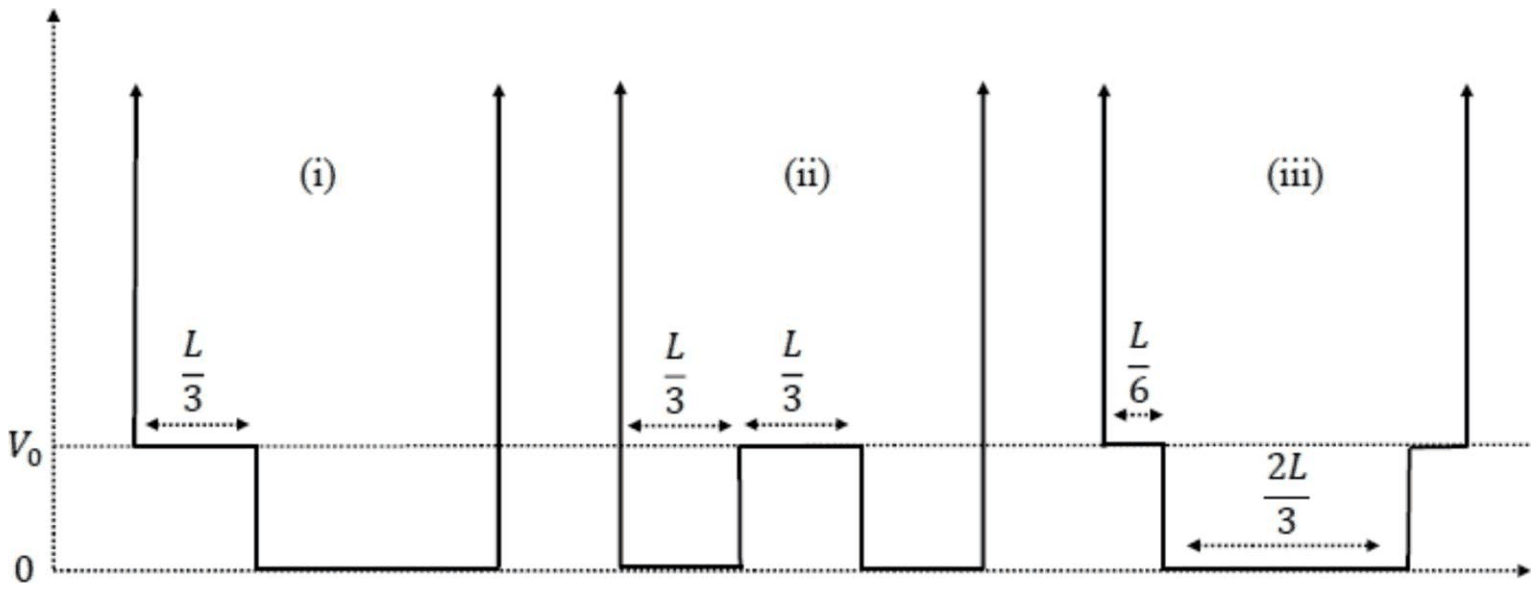
Three infinite wells of width L with a step of height V0: (i) over the left third, (ii) over the middle third, (iii) over the outer sixth at each end, leaving the central 2L/3 at zero

Exam Year(s)

GATE Physics - 2022,

Answer: A

The order is \(E_{2} \gt E_{1} \gt E_{3}\).

Because \(V_{0}\) is small compared with the ground-state energy, first-order perturbation theory applies: each energy rises by \(V_{0}\) times the probability of finding the particle in the raised region. The ground state \(\psi = \sqrt{2/L}\sin(\pi x/L)\) is largest at the centre of the well and small near the walls.

  • Box (ii) raises the middle third, where the particle is most likely to be: probability about 0.61.
  • Box (i) raises one outer third: \(\frac{1}{3} - \frac{\sin(2\pi/3)}{2\pi} \approx 0.20\).
  • Box (iii) raises the outer sixth at each end, where the wavefunction is smallest: \(2\left(\frac{1}{6} - \frac{\sin(\pi/3)}{2\pi}\right) \approx 0.06\).

So \(E_{2} \gt E_{1} \gt E_{3}\). Boxes (i) and (iii) raise the same total width, \(L/3\), so a reading that ignores where the step sits would make \(E_{1} = E_{3}\); the other orders get the position dependence backwards.

Please log in or register to report this question.

2.

Consider a particle in a two dimensional infinite square well potential of side \(L\), with \(0 \le x \le L\) and \(0 \le y \le L\). The wavefunction of the particle is zero only along the line \(y = \frac{L}{2}\), apart from the boundaries of the well. If the energy of the particle in this state is \(E\), what is the energy of the ground state?

Exam Year(s)

GATE Physics - 2023,

Answer: B

The ground-state energy is \(\frac{2}{5}E\).

In a square well of side \(L\), \(\psi = \sin\frac{n_{x}\pi x}{L}\sin\frac{n_{y}\pi y}{L}\) and \(E = E_{0}(n_{x}^{2} + n_{y}^{2})\) with \(E_{0} = \pi^{2}\hbar^{2}/2mL^{2}\). A node only along \(y = L/2\), and none along any line of constant \(x\), means \(n_{x} = 1\) and \(n_{y} = 2\):

\[ \begin{aligned} E &= E_{0}(1 + 4) = 5E_{0} \\ E_{ground} &= E_{0}(1 + 1) = 2E_{0} = \frac{2}{5}E \end{aligned} \]

1/4 comes from comparing only the \(y\) parts (1 against 4), and 1/2 and 3/8 match no pair of states.

Please log in or register to report this question.

3.

The wavefunction of a particle in an infinite one-dimensional potential well at time \(t\) is

\[ \begin{aligned} \Psi(x,t) &= \sqrt{\tfrac{2}{3}}\,e^{-iE_{1}t/\hbar}\psi_{1}(x) \\ &+ \tfrac{1}{\sqrt{6}}\,e^{i\pi/6}e^{-iE_{2}t/\hbar}\psi_{2}(x) \\ &+ \tfrac{1}{\sqrt{6}}\,e^{i\pi/4}e^{-iE_{3}t/\hbar}\psi_{3}(x) \end{aligned} \]

where \(\psi_{1}\), \(\psi_{2}\) and \(\psi_{3}\) are the normalized ground state, the normalized first excited state and the normalized second excited state, respectively. \(E_{1}\), \(E_{2}\) and \(E_{3}\) are the eigen-energies corresponding to \(\psi_{1}\), \(\psi_{2}\) and \(\psi_{3}\), respectively. The expectation value of energy of the particle in state \(\Psi(x,t)\) is

Exam Year(s)

GATE Physics - 2024,

Answer: A

The expectation value of energy is \(\dfrac{17}{6}E_{1}\).

For a stationary-state expansion, ⟨E⟩ = Σ |cn|2En; the phase factors drop out of the squared moduli. For an infinite well En = n2E1, so E2 = 4E1 and E3 = 9E1:

\[ \begin{aligned} \langle E \rangle &= \tfrac{2}{3}E_{1} + \tfrac{1}{6}(4E_{1}) + \tfrac{1}{6}(9E_{1}) \\ &= \tfrac{4 + 4 + 9}{6}E_{1} = \tfrac{17}{6}E_{1} \end{aligned} \]

The probabilities 2/3 + 1/6 + 1/6 add to 1, so the state is normalized. 2/3 E1 keeps only the ground-state term, 3/2 E1 treats the levels as En = nE1, and 14E1 adds the energies without weighting them.

Please log in or register to report this question.

4.

A particle of mass m is in a one dimensional potential

\[ V(x) = \begin{cases} 0, & 0 \lt x \lt L \\ \infty, & \text{otherwise} \end{cases} \]

At some instant its wave function is given by

\[ \begin{aligned} \psi(x) &= \frac{1}{\sqrt{3}}\psi_{1}(x) \\ &\quad + i\sqrt{\frac{2}{3}}\psi_{2}(x), \end{aligned} \]

where \(\psi_{1}(x)\) and \(\psi_{2}(x)\) are the ground and the first excited states, respectively. Identify the correct statement.

Exam Year(s)

IIT JAM - 2018,

Answer: A

The answer is \(\langle x \rangle = \frac{L}{2}\); \(\langle E \rangle = \frac{\hbar^{2}}{2m}\frac{3\pi^{2}}{L^{2}}\).

Energy: the states have \(E_{n} = \frac{n^{2}\pi^{2}\hbar^{2}}{2mL^{2}}\), and the probabilities are \(\frac{1}{3}\) and \(\frac{2}{3}\):

\[ \begin{aligned} \langle E \rangle &= \tfrac{1}{3}E_{1} + \tfrac{2}{3}(4E_{1}) = 3E_{1} \\ &= \frac{\hbar^{2}}{2m}\frac{3\pi^{2}}{L^{2}} \end{aligned} \]

Position: each stationary state alone has \(\langle x \rangle = L/2\). The cross term is proportional to \(2\,\text{Re}(c_{1}^{*}c_{2})\int \psi_{1}x\psi_{2}\,dx\), and since \(c_{1}^{*}c_{2} = i\sqrt{2}/3\) is purely imaginary, it vanishes at this instant. So \(\langle x \rangle = L/2\).

The \(\frac{2L}{3}\) options mistake the probability weights for positions, and \(8\pi^{2}\) is \(2E_{2}\), double counting the excited state.

Please log in or register to report this question.

5.

The fourth excited state wave function of a one-dimensional infinite square well has.........nodes.

Exam Year(s)

MH SET - 2018, SET Exam - 2018,

Answer: B

The fourth excited state has four nodes.

In an infinite square well the states are \( \psi_{n} = \sqrt{2/L}\,\sin(n\pi x/L) \), with \( n = 1 \) the ground state. The \( n \)th state has \( n - 1 \) nodes inside the well, not counting the walls where every state vanishes.

The fourth excited state is \( n = 5 \), so it has \( 5 - 1 = 4 \) nodes. Three nodes belong to the third excited state (\( n = 4 \)), and five or six would count the walls or skip a level.

Please log in or register to report this question.

6.

A particle in one-dimension is moving under the potential described by :

\[ V(x) = \begin{cases} \infty & \text{for } x \lt 0 \\ -V_{0} & \text{for } 0 \le x \le a,\ V_{0} \gt 0 \\ 0 & \text{for } x \gt a \end{cases} \]

The minimum depth of the potential for at least one bound state is :

Exam Year(s)

MH SET - 2020, SET Exam - 2020,

Answer: B

The minimum depth is \(\frac{\hbar^{2}\pi^{2}}{8ma^{2}}\).

The infinite wall at \(x = 0\) forces \(\psi(0) = 0\), so inside the well \(\psi = A\sin kx\) with \(k = \sqrt{2m(V_{0} + E)}/\hbar\), and outside it decays as \(e^{-\kappa x}\). A bound state just appears when E reaches zero from below and the inside wave has turned through a quarter wavelength by \(x = a\), so that it can join a flat exterior solution:

\[ \begin{aligned} ka &= \frac{\pi}{2},\quad k^{2} = \frac{2mV_{0}}{\hbar^{2}} \\ V_{0} &= \frac{\pi^{2}\hbar^{2}}{8ma^{2}} \end{aligned} \]

This is the odd-parity condition of a finite well of width 2a, so unlike a symmetric well it needs a minimum depth. \(\frac{\hbar^{2}\pi^{2}}{2ma^{2}}\) is the ground-state energy of an infinite well of width a, a different quantity.

Please log in or register to report this question.

Loading…

Other Subjects

Tags: Particle in a Box Questions and Answers || Particle in a Box MCQ Questions and Answers || Particle in a Box GK Questions and Answers || Particle in a Box GK MCQ Questions || Particle in a Box Multiple Choice Questions and Answers || Particle in a Box GK || GK on Particle in a Box || Quantum Mechanics Questions and Answers || Quantum Mechanics MCQ Questions and Answers || Quantum Mechanics GK Questions and Answers || GK on Quantum Mechanics