
Machine-translated by Google. Questions are authored in English.
Top

Magnetic Forces and Materials Questions and Answers

81.

An infinitely long cylinder of radius \(R\) carries a frozen-in magnetization \(\vec{M} = ke^{-s}\hat{z}\), where \(k\) is a constant and \(s\) is the distance from the axis of cylinder. The magnetic permeability of free space is \(\mu_{0}\). There is no free current present anywhere. The magnetic flux density \((\vec{B})\) inside the cylinder is

Exam Year(s)

GATE Physics - 2024,

Answer: C

The flux density inside is \(\mu_{0}ke^{-s}\hat{z}\).

With no free current, ∮ H · dl = 0. Take a rectangular loop with one side inside the cylinder parallel to the axis and the other far outside. For an infinitely long cylinder with axial magnetization, H outside is zero and H inside is parallel to the axis, so H must be zero inside as well. Then

\[ \begin{aligned} \vec{B} &= \mu_{0}(\vec{H} + \vec{M}) \\ &= \mu_{0}\vec{M} = \mu_{0}ke^{-s}\hat{z} \end{aligned} \]

Zero would ignore the magnetization entirely. μ0ke-R uses the value of M at the surface everywhere, and the extra factor R/s has no source in this geometry: B simply follows M point by point.

Please log in or register to report this question.
82.

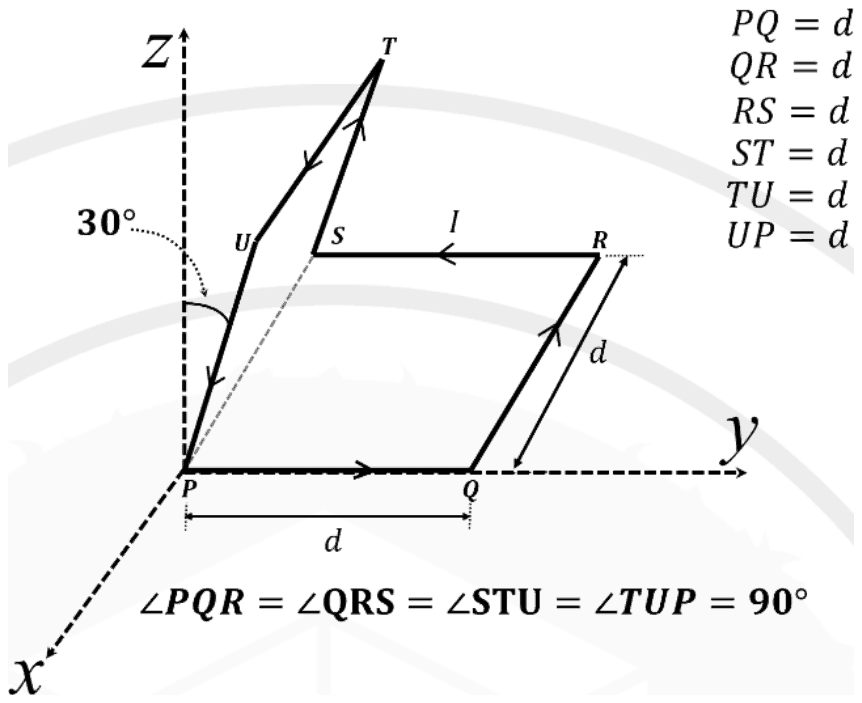
The wire loop shown in the figure carries a steady current \(I\). Each straight section of the loop has length \(d\). A part of the loop lies in \(xy\) plane and the other part is tilted at 30° with respect to the \(xz\) plane. The magnitude of the magnetic dipole moment of the loop (in appropriate units) is

Loop PQRSTUP of six sides of length d: square PQRS in the xy plane with P at the origin and PQ along y, and square PSTU hinged on PS and tilted 30 degrees from the xz plane

Exam Year(s)

GATE Physics - 2025,

Answer: D

The magnitude of the dipole moment is \(Id^{2}\).

Add and subtract the side PS (from S to P): the loop P-Q-R-S-T-U-P is then the sum of two square loops, PQRS in the \(xy\) plane and PSTU in the tilted plane, each of area \(d^{2}\), with the shared side cancelling.

PQRS, traversed P to Q (along \(+y\)) then Q to R (along \(-x\)), has moment \(Id^{2}\hat{z}\). PSTU contains PS (along \(-x\)) and PU, which leans 30° from the \(z\)-axis towards \(+y\); its moment is perpendicular to its plane:

\[ \begin{aligned} \vec{m}_{2} &= Id^{2}(\cos 30^{\circ}\hat{y} - \sin 30^{\circ}\hat{z}) \\ \vec{m} &= Id^{2}\left(\tfrac{\sqrt{3}}{2}\hat{y} + \tfrac{1}{2}\hat{z}\right) \\ |\vec{m}| &= Id^{2} \end{aligned} \]

Adding the two squares' moments as if they were perpendicular gives \(\sqrt{2}Id^{2}\), and as if parallel \(2Id^{2}\); they are in fact 120° apart, so the resultant has the magnitude of either one.

Please log in or register to report this question.

83.

Given below are two statements : one is labelled as Assertion (A) and the other is labelled as Reason (R).

Assertion (A) : A material for which \(X_{m} \gt 0\) and \(\mu_{r} \ge 1\) is said to be paramagnetic.
(Here \(X_{m}\) is magnetic susceptibility and \(\mu_{r}\) is relative permeability)
Reason (R) : A material for which \(X_{m} \gg 0,\ \mu_{r} \gg 1\) is said to be ferromagnetic.

In the light of the above statements, choose the most appropriate answer from the options given below.

Exam Year(s)

RSMSSB JE - 2025, RSMSSB - 2025,

Answer: C

(A) is false but (R) is true.

(R) is true. A ferromagnetic material has a very large positive susceptibility and a very large relative permeability, so \(X_{m} \gg 0\) and \(\mu_{r} \gg 1\) is the usual description of one.

(A) is false. A paramagnetic material has a small positive susceptibility, of the order of \(10^{-5}\) to \(10^{-3}\), so that \(\mu_{r} = 1 + X_{m}\) is only just above 1. The condition given in the Assertion, \(X_{m} \gt 0\) and \(\mu_{r} \ge 1\), has no upper limit and is met by ferromagnetic materials as well, so it does not define a paramagnetic one. A diamagnetic material, by contrast, has \(X_{m} \lt 0\) and \(\mu_{r} \lt 1\).

So option B (A true, R false) and options A and D (A true) fail on the Assertion, and the Board keyed option C. A student who reads (A) loosely, as the textbook line that paramagnets have positive susceptibility, is led to option A or D; the missing size limit is what makes the Assertion wrong.

Please log in or register to report this question.

84.

A point charge ‘q’ having mass ‘m’ follows a circular trajectory of radius ‘R’ under the action of magnetic field \(\vec{B}\). The magnitude of the angular momentum of the particle is :

Exam Year(s)

MH SET - 2018, SET Exam - 2018,

Answer: D

The angular momentum is \(BqR^{2}\).

The magnetic force provides the centripetal force for circular motion:

\[ \begin{aligned} qvB &= \frac{mv^{2}}{R} \\ mv &= qBR \end{aligned} \]

The angular momentum about the centre of the circle is

\[ L = mvR = qBR \cdot R = BqR^{2} \]

It is not zero, because the particle moves in a circle about that centre. The options with \(q^{2}\) or with an extra m have the wrong dimensions; the mass cancels when mv is replaced by qBR.

Please log in or register to report this question.

85.

A unit charge q moving with initial velocity \((\overline{v} = v_{x}\hat{i})\) is subjected to external electric field \((\overline{E} = E_{y}\hat{j})\). The number of degrees of freedom is :

Exam Year(s)

MH SET - 2019, SET Exam - 2019,

Answer: B

The motion has 2 degrees of freedom.

The charge starts with velocity along \(\hat{i}\) and the only force, \(q\overline{E}\), acts along \(\hat{j}\). Nothing ever gives it a velocity component along \(\hat{k}\), so the motion stays in the x-y plane: it moves uniformly in x and accelerates in y, tracing a parabola.

Two independent coordinates, x and y, are needed to describe it, so the number of degrees of freedom is 2. A free particle in space would have 3, motion along a line 1, and zero would mean no motion at all.

Please log in or register to report this question.

86.

There is a space region where \(\overline{E} = E_{0}\hat{z}\) and \(\overline{B} = B_{0}\hat{x}\) are both present. A charged particle with velocity \(\left(\frac{E_{0}}{B_{0}}\right)\hat{y}\) enters this region. The trajectory of the particle in this region is a :

Exam Year(s)

MH SET - 2019, SET Exam - 2019,

Answer: A

The trajectory is a Straight line.

The Lorentz force on the particle is \(q(\overline{E} + \overline{v} \times \overline{B})\). With \(\overline{v} = (E_{0}/B_{0})\hat{y}\) and \(\overline{B} = B_{0}\hat{x}\):

\[ \begin{aligned} \overline{v} \times \overline{B} &= \frac{E_{0}}{B_{0}}B_{0}(\hat{y} \times \hat{x}) \\ &= -E_{0}\hat{z} \end{aligned} \]

This exactly cancels \(\overline{E} = E_{0}\hat{z}\), so the net force is zero and the particle moves undeflected in a straight line. This is the principle of the velocity selector. A particle with any other speed would follow a cycloid-type path; circles and helices need a magnetic field alone.

Please log in or register to report this question.

87.

A charged particle is released from rest in a region where both uniform constant electric field and uniform constant magnetic field are present. If these fields are perpendicular to each other, then the trajectory of the particle is a ........ .

Exam Year(s)

MH SET - 2020, SET Exam - 2020,

Answer: C

The trajectory is a cycloid.

The electric field starts the particle moving from rest, and the magnetic force \(q\bar{v} \times \bar{B}\) then bends its path. The motion is the sum of a uniform drift with velocity \(\bar{v}_{d} = \frac{\bar{E} \times \bar{B}}{B^{2}}\) and a circular motion at the cyclotron frequency. Because the particle starts at rest, the circular speed equals the drift speed, so the path is that of a point on the rim of a rolling wheel: a cycloid, which momentarily stops at each cusp.

A straight line would need no magnetic force, a circle would need no electric field, and a helix needs an initial velocity component along B.

Please log in or register to report this question.

88.

The SI unit of magnetic dipole moment is ........ .

Exam Year(s)

MH SET - 2020, SET Exam - 2020,

Answer: D

The SI unit is C m\(^{2}\)/s.

The magnetic dipole moment of a current loop is \(m = IA\), current times area, so its unit is the ampere square metre. Since one ampere is one coulomb per second:

\[ \begin{aligned} \text{A m}^{2} &= \frac{\text{C}}{\text{s}}\,\text{m}^{2} \\ &= \text{C m}^{2}/\text{s} \end{aligned} \]

The coulomb metre (C m) is the unit of the electric dipole moment, a common confusion. C m\(^{2}\) and C m/s lack the correct combination of area and time.

Please log in or register to report this question.

Loading…
Tags: Magnetic Forces and Materials Questions and Answers || Magnetic Forces and Materials MCQ Questions and Answers || Magnetic Forces and Materials GK Questions and Answers || Magnetic Forces and Materials GK MCQ Questions || Magnetic Forces and Materials Multiple Choice Questions and Answers || Magnetic Forces and Materials GK || GK on Magnetic Forces and Materials || Electromagnetic Field Theory Questions and Answers || Electromagnetic Field Theory MCQ Questions and Answers || Electromagnetic Field Theory GK Questions and Answers || GK on Electromagnetic Field Theory