
Machine-translated by Google. Questions are authored in English.
Top

Power System Stability Questions and Answers

1.

Identify whether the given statements related to power swings in a power system are true or false.

1. The presence of a power swing does not necessarily mean that the system is unstable.

2. The relay must distinguish between a fault and a power swing and respond correctly.

Exam Year(s)

DSSSB AE - 2023,

Answer: A

Both statements are true. A power swing is an oscillation of the machine rotor angles after a disturbance, such as a line switching or fault clearing, and a stable system rides through it and settles down, so a swing does not necessarily mean that the system is unstable. Because a swing can look to a distance relay like a fault (the impedance moves into the relay's zone), the relay must tell the two apart, which is done by power swing blocking, so that it trips for a fault but not for a stable swing.


Hence true and true is the right pair, option A.

Please log in or register to report this question.
2.

For accurate power system dynamics, detailed models of synchronous machine are developed using ______.

Exam Year(s)

DSSSB AE - 2023,

Answer: A

Detailed models of the synchronous machine for stability and dynamic studies are developed with Park's transformation (the dq0 transformation), which converts the stator quantities from the a, b, c frame to a frame rotating with the rotor. In that frame the inductances, which vary with rotor position in the abc frame, become constants and the equations become much simpler.


Maxwell's equations and Gauss's equations describe the electromagnetic field in general and are not used to build machine models in this way, and Kirchhoff's laws are only the circuit laws applied after the model is set up. The answer is option A.

Please log in or register to report this question.

3.

Which of the following is NOT a correct technique to improve transient stability in power systems?

Exam Year(s)

DSSSB AE - 2023,

Answer: C

Transient stability is improved by fast fault clearing, auto reclosing of breakers (the fault is often temporary), high speed excitation systems, increasing the system voltage (which raises the power that the lines can transfer), reducing the transfer reactance, and so on. These are the correct techniques.


The key gives decreasing the X/R ratio as the one that is not a correct technique. Lowering X/R by adding resistance does not raise the power limit of the line and wastes power, so it is not a way of improving stability; the usual aim is a low reactance. The answer is option C.

Please log in or register to report this question.

4.

Identify whether the given statements are true or false.

1. Equal area criterion is used for transient stability.

2. Swing equation is used for steady state stability.

Exam Year(s)

DSSSB AE - 2023,

Answer: A

The key marks both statements true. The equal area criterion is a graphical method of testing the transient stability of a single machine connected to an infinite bus, so statement 1 is true. The swing equation, \(\dfrac{2H}{\omega_s}\dfrac{d^2\delta}{dt^2} = P_m - P_e\), is the basic equation of rotor motion; it is solved step by step for transient stability, and when it is linearised for a small disturbance it gives the criterion for steady state (small signal) stability, so it is used in both studies and statement 2 is accepted as true.


So the pair true and true, option A, is the key. The statement 2 is only loosely worded, since the swing equation is more often linked with transient stability.

Please log in or register to report this question.

5.

A 50 Hz, four pole turbo generator rated 100 MVA, 11 kV has an inertia constant of 8.0 MJ/MVA. What is the energy stored in the rotor at synchronous speed?

Exam Year(s)

DSSSB AE - 2023,

Answer: C

The inertia constant \(H\) is the kinetic energy stored in the rotor at synchronous speed per MVA of machine rating, so the stored energy is the product of \(H\) and the rating.


\[ \begin{aligned} W = H \times S \\ &= 8.0\ \text{MJ/MVA} \times 100\ \text{MVA} \\ &= 800\ \text{MJ} \end{aligned} \]


The frequency, number of poles and voltage are not needed. The values 8 MJ and 80 MJ would be for 1 MVA and 10 MVA, and 8000 MJ for 1000 MVA. The answer is 800 MJ, option C.

Please log in or register to report this question.

6.

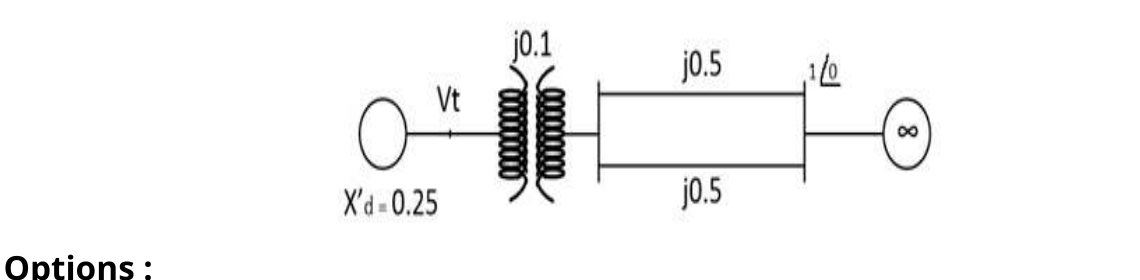
In the given figure, the generator is delivering 1.0 pu power to infinite bus (V = 1 pu), with the generator terminal voltage Vt = 1 pu. What is the power angle?

Single line diagram: generator with X'd = 0.25 pu and terminal voltage Vt, a transformer j0.1, two parallel lines j0.5 each, and an infinite bus of voltage 1 angle 0

Exam Year(s)

DSSSB AE - 2023,

Answer: D

The power angle asked for is the angle of the generator terminal voltage \(V_t\) ahead of the infinite bus. The reactance between them is the transformer in series with the two parallel lines of j0.5 each.


\[ X = 0.1 + \frac{0.5}{2} = 0.35\ \text{pu} \]


\[ \begin{aligned} P = \frac{V_tV}{X}\sin\delta \\ &= \frac{1 \times 1}{0.35}\sin\delta \\ &= 1 \Rightarrow \sin\delta = 0.35 \end{aligned} \]


\[ \delta = 20.5^\circ \]


The generator reactance of 0.25 pu would only be used for the angle of the internal voltage behind it, so it is not needed here. The answer is option D.

Please log in or register to report this question.

7.

A generator operating at 50 Hz delivers 1 pu power to an infinite bus through a transmission circuit in which resistance is ignored. A fault takes place reducing the maximum power transferable to 0.5 pu, whereas before the fault, this power was 2 pu.

What is the initial load angle?

Exam Year(s)

DSSSB AE - 2023,

Answer: A

The power transferred is \(P_e = P_{max}\sin\delta\). Before the fault \(P_{max} = 2\) pu and the load is 1 pu.


\[ \begin{aligned} \sin\delta_0 = \frac{1}{2} \Rightarrow \delta_0 \\ &= 30^\circ = \frac{\pi}{6} = 0.5236\ \text{rad} \end{aligned} \]


The fault reduces the limit to 0.5 pu, which is what sets the swing afterwards, but the initial angle only depends on the pre fault values. The other options are larger angles of 36, 42 and 48 degrees. The answer is 0.523 rad, option A.

Please log in or register to report this question.

8.

A 20 MVA, 50 Hz generator delivers 18 MW over a double circuit line to an infinite bus. The generator has kinetic energy of 2.52 MJ/MVA at rated speed. What is the value of inertia constant?

Exam Year(s)

DSSSB AE - 2023,

Answer: A

The inertia constant \(M\) in seconds squared per electrical degree is related to the stored energy per MVA, \(H\), by


\[ M = \frac{GH}{180 f} \]


Taking the stored energy of 2.52 MJ/MVA as H on a per MVA basis (G = 1):


\[ \begin{aligned} M = \frac{2.52}{180 \times 50} \\ &= 2.8 \times 10^{-4}\ \text{s}^2/\text{elec degree} \end{aligned} \]


This is the key, option A. If the 20 MVA rating were put in as G, the value would be 20 times larger (5.6e-3), which is not offered, so the item is read per unit MVA. The load of 18 MW is not needed.

Please log in or register to report this question.

Loading…
Tags: Power System Stability Questions and Answers || Power System Stability MCQ Questions and Answers || Power System Stability GK Questions and Answers || Power System Stability GK MCQ Questions || Power System Stability Multiple Choice Questions and Answers || Power System Stability GK || GK on Power System Stability || Power Systems Questions and Answers || Power Systems MCQ Questions and Answers || Power Systems GK Questions and Answers || GK on Power Systems