Machine-translated by Google. Questions are authored in English.
Top

Hamiltonian Formulation Questions and Answers

1.

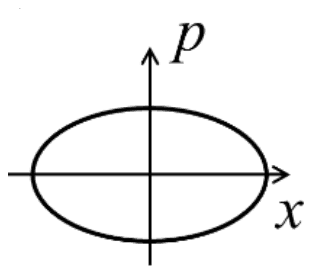
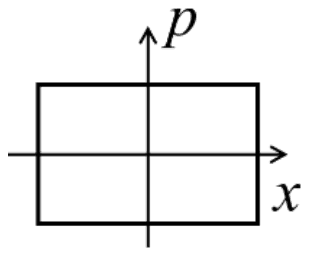
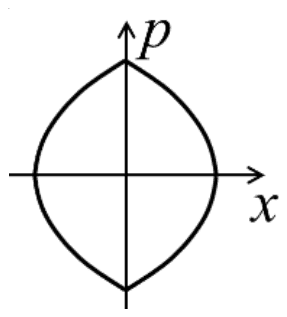
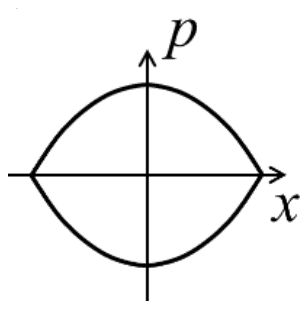
A particle moves in one dimension under a potential \(V(x) = \alpha|x|\) with some non-zero total energy. Which one of the following best describes the particle trajectory in the phase space?
Exam Year(s)

GATE Physics - 2018,

Answer: A

The phase-space trajectory is sketch (A): smooth where it crosses the \(x\) axis and pointed where it crosses the \(p\) axis.

Energy conservation gives \(E = p^{2}/2m + \alpha|x|\), so

\[ |x| = \frac{1}{\alpha}\left(E - \frac{p^{2}}{2m}\right) \]

For \(x \gt 0\) and for \(x \lt 0\) the curve is a parabola in \(p\), opening toward the origin with its vertex on the \(x\) axis at \(x = \pm E/\alpha\), where it is smooth. The two parabolic arcs meet on the \(p\) axis at \(p = \pm\sqrt{2mE}\) at an angle, making corners there; this is because the force \(-\alpha\,\text{sgn}(x)\) jumps at \(x = 0\).

Sketch (B) has the corners on the \(x\) axis instead. The ellipse (C) is the harmonic oscillator, \(V \propto x^{2}\), and the rectangle (D) is a particle bouncing in an infinite square well, where \(|p|\) is constant.

Please log in or register to report this question.

2.

A particle of mass \(m\) is free to move on a frictionless horizontal two dimensional \((r, \theta)\) plane, and is acted upon by a force \(\vec{F} = -\frac{k}{2r^{3}}\hat{r}\) with \(k\) being a positive constant. If \(p_{r}\) and \(p_{\theta}\) are the generalised momenta corresponding to \(r\) and \(\theta\) respectively, then what is the value of \(\frac{dp_{r}}{dt}\)?

Exam Year(s)

GATE Physics - 2023,

Answer: D

The result is \(\frac{dp_{r}}{dt} = \frac{2p_{\theta}^{2} - mk}{2mr^{3}}\).

The force \(-\frac{k}{2r^{3}}\hat{r}\) comes from the potential \(V = -\frac{k}{4r^{2}}\). The Lagrangian in polar coordinates is \(\mathcal{L} = \frac{m}{2}(\dot{r}^{2} + r^{2}\dot{\theta}^{2}) - V\), with \(p_{\theta} = mr^{2}\dot{\theta}\). Lagrange's equation for \(r\) gives

\[ \begin{aligned} \frac{dp_{r}}{dt} &= \frac{\partial \mathcal{L}}{\partial r} = mr\dot{\theta}^{2} - \frac{k}{2r^{3}} \\ &= \frac{p_{\theta}^{2}}{mr^{3}} - \frac{k}{2r^{3}} = \frac{2p_{\theta}^{2} - mk}{2mr^{3}} \end{aligned} \]

The first term is the centrifugal term and the second is the applied force. The options with \(p_{\theta}^{2} - 2mk\) double the force term, and \(\frac{2p_{\theta}^{2} - mk}{mr^{3}}\) doubles both terms.

Please log in or register to report this question.

Answer: C

The canonical equations are ẋ = py/m, ṗx = -mω02y, ẏ = px/m, ṗy = -mω02x.

The Lagrangian couples the velocities crosswise, so each momentum involves the other velocity:

\[ \begin{aligned} p_{x} &= \frac{\partial L}{\partial \dot{x}} = m\dot{y}, \qquad p_{y} = \frac{\partial L}{\partial \dot{y}} = m\dot{x} \\ H &= p_{x}\dot{x} + p_{y}\dot{y} - L = \frac{p_{x}p_{y}}{m} + m\omega_{0}^{2}xy \end{aligned} \]

Hamilton's equations: \(\dot{x} = \partial H/\partial p_{x} = p_{y}/m\), \(\dot{y} = p_{x}/m\), \(\dot{p}_{x} = -\partial H/\partial x = -m\omega_{0}^{2}y\), \(\dot{p}_{y} = -m\omega_{0}^{2}x\).

The first two options pair ẋ with px, as for an ordinary kinetic term, which this Lagrangian does not have. The last option has the right pairing but the wrong sign in the force terms.

Please log in or register to report this question.

4.

A bead is constrained to move along a long, massless, frictionless horizontal rod parallel to the \(x\) axis. The rod itself is moving vertically upward along the \(z\) direction against gravity with a constant speed, starting from \(z = 0\) at \(t = 0\), and remains horizontal. The conjugate momenta are denoted by \(p_{x}, p_{y}, p_{z}\) and the Hamiltonian by \(H\). Which of the following option(s) is/are correct?

Exam Year(s)

GATE Physics - 2025,

Answer: D

The correct statement is \(H\) is not the total energy of the system and is not conserved.

The bead's height is fixed by the rod, \(z = vt\), a time-dependent (rheonomic) constraint; only \(x\) is free. The Lagrangian and Hamiltonian are

\[ \begin{aligned} L &= \tfrac{1}{2}m(\dot{x}^{2} + v^{2}) - mgvt \\ H &= p_{x}\dot{x} - L = \frac{p_{x}^{2}}{2m} - \tfrac{1}{2}mv^{2} + mgvt \end{aligned} \]

The total energy would be \(\frac{p_{x}^{2}}{2m} + \frac{1}{2}mv^{2} + mgvt\), so \(H\) differs from it by \(mv^{2}\): with a moving constraint the Hamiltonian is not the energy. And \(H\) depends explicitly on time through \(mgvt\), so \(\frac{dH}{dt} = \frac{\partial H}{\partial t} = mgv \ne 0\): it is not conserved (the rod does work on the bead).

(This is a multiple-select question; the key accepts this option alone.)

Please log in or register to report this question.

5.

If Lagrangian of a system is :

\[ \begin{aligned} L(\theta, \dot{\theta}) &= \tfrac{1}{2}m(l^{2}\dot{\theta}^{2} \\ &\quad - gl\theta^{2}), \end{aligned} \]

where \(g\), \(l\) are constants. Then the Hamiltonian of the system is :

Exam Year(s)

MH SET - 2018, SET Exam - 2018,

Answer: B

The Hamiltonian is \(\dfrac{P_{\theta}^{2}}{2ml^{2}} + \dfrac{1}{2}mgl\theta^{2}\).

The generalised momentum is \(P_{\theta} = \partial L/\partial \dot{\theta} = ml^{2}\dot{\theta}\), so \(\dot{\theta} = P_{\theta}/(ml^{2})\). Then

\[ \begin{aligned} H &= P_{\theta}\dot{\theta} - L \\ &= \frac{P_{\theta}^{2}}{ml^{2}} - \frac{P_{\theta}^{2}}{2ml^{2}} + \frac{1}{2}mgl\theta^{2} \\ &= \frac{P_{\theta}^{2}}{2ml^{2}} + \frac{1}{2}mgl\theta^{2} \end{aligned} \]

As expected for a natural system, H is the total energy, kinetic plus potential, so the potential enters with a plus sign (option A has a minus) and keeps its factor 1/2 (options C and D drop it).

Please log in or register to report this question.

6.

If the Hamiltonian of the dynamical system is given by \(H = pq\), then as \(t \to \infty\).

Exam Year(s)

MH SET - 2019, SET Exam - 2019,

Answer: A

As \(t \to \infty\), \(q \to \infty\) and \(p \to 0\).

Hamilton's equations for \(H = pq\):

\[ \begin{aligned} \dot{q} &= \frac{\partial H}{\partial p} = q \\ \dot{p} &= -\frac{\partial H}{\partial q} = -p \end{aligned} \]

So \(q = q_{0}e^{t}\) and \(p = p_{0}e^{-t}\). For a non-zero starting \(q_{0}\) (positive, as the option assumes), \(q\) grows without bound, while \(p\) decays to 0. The product \(pq = H\) stays constant, as energy conservation requires.

Both tending to 0 or both to \(\infty\) would change \(pq\), and the last option reverses the two equations.

Please log in or register to report this question.

7.

Let the Hamiltonian of a system be \(H = \dfrac{p^{2}}{2} + \dfrac{k^{2}q^{2}}{2}\). If \(C_{1}, C_{2}\) denote arbitrary constants the general solution of \(q\) is :

Exam Year(s)

MH SET - 2020, SET Exam - 2020,

Answer: A

The general solution is \(q(t) = C_{1}\cos kt + C_{2}\sin kt\).

Hamilton's equations give

\[ \begin{aligned} \dot{q} &= \frac{\partial H}{\partial p} = p \\ \dot{p} &= -\frac{\partial H}{\partial q} = -k^{2}q \end{aligned} \]

so \(\ddot{q} = -k^{2}q\), simple harmonic motion with angular frequency \(k\). Its general solution is \(C_{1}\cos kt + C_{2}\sin kt\).

Exponentials \(e^{\pm kt}\) would solve \(\ddot{q} = +k^{2}q\), the sign of an inverted oscillator. Frequency \(k^{2}\) mistakes \(k^{2}\) in the Hamiltonian for the frequency, and \(kt + C_{1}\) is free motion.

Please log in or register to report this question.

8.

Suppose a system has holonomic and conservative part, and also some part of forces acting on the system are not conservative. Let the typical non-conservative force acting on jth particle is denoted as \(Q_{i}\). The Hamilton's equations of motion modify to :

Exam Year(s)

MH SET - 2020, SET Exam - 2020,

Answer: B

The modified equations are \(\dot{q}_{i} = \frac{\partial H}{\partial p_{i}}\), \(\dot{p}_{i} = -\frac{\partial H}{\partial q_{i}} + Q_{i}\).

The conservative forces are contained in H. A non-conservative generalized force \(Q_{i}\) adds to the rate of change of momentum, as in Lagrange's equation, where \(\frac{d}{dt}\frac{\partial L}{\partial \dot{q}_{i}}\) minus \(\frac{\partial L}{\partial q_{i}}\) equals \(Q_{i}\). Since \(p_{i} = \partial L/\partial \dot{q}_{i}\) and \(\partial L/\partial q_{i} = -\partial H/\partial q_{i}\), this gives \(\dot{p}_{i} = -\partial H/\partial q_{i} + Q_{i}\), while the first equation, which only defines the velocity, is unchanged.

Options A and C give \(\dot{p}_{i}\) the wrong sign of \(\partial H/\partial q_{i}\), and options C and D subtract the applied force instead of adding it.

Please log in or register to report this question.

9.

If the Hamiltonian of the dynamical system is

\[ \begin{aligned} &H(q_{1}, q_{2}, p_{1}, p_{2}) \\ &= p_{1}^{2} + p_{2}^{2} - k\, q_{1}^{2}, \end{aligned} \]

then the Lagrangian is given by :

Exam Year(s)

MH SET - 2021, SET Exam - 2021,

Answer: C

The Lagrangian is \(L = \dfrac{\dot{q}_{1}^{2}}{4} + \dfrac{\dot{q}_{2}^{2}}{4} + kq_{1}^{2}\).

Hamilton's equation \(\dot{q}_{i} = \partial H / \partial p_{i} = 2p_{i}\) gives \(p_{i} = \dot{q}_{i}/2\). Then the Legendre transform \(L = \sum p_{i}\dot{q}_{i} - H\) gives

\[ \begin{aligned} L &= \frac{\dot{q}_{1}^{2} + \dot{q}_{2}^{2}}{2} - \frac{\dot{q}_{1}^{2} + \dot{q}_{2}^{2}}{4} + kq_{1}^{2} \\ &= \frac{\dot{q}_{1}^{2}}{4} + \frac{\dot{q}_{2}^{2}}{4} + kq_{1}^{2} \end{aligned} \]

The sign of \(kq_{1}^{2}\) flips because it enters H as part of the potential (\(H = T + V\), \(L = T - V\) with \(V = -kq_{1}^{2}\)). Options with \(-kq_{1}^{2}\) miss that, and those with denominators 2 or 1 use the wrong relation between \(p\) and \(\dot{q}\).

Please log in or register to report this question.

10.

For a conservative dynamical system, the area enclosed by the phase space :

Exam Year(s)

MH SET - 2023, SET Exam - 2023,

Answer: B

The area enclosed in phase space remains constant with time.

This is Liouville's theorem. For a Hamiltonian system the flow in phase space is incompressible: the divergence of the phase-space velocity vanishes,

\[ \begin{aligned} &\sum_{i}\left(\frac{\partial\dot{q}_{i}}{\partial q_{i}} + \frac{\partial\dot{p}_{i}}{\partial p_{i}}\right) \\ &= \sum_{i}\left(\frac{\partial^{2}H}{\partial q_{i}\partial p_{i}} - \frac{\partial^{2}H}{\partial p_{i}\partial q_{i}}\right) \\ &= 0 \end{aligned} \]

so a region of phase points may change shape as it moves but keeps its area (volume). Shrinking area belongs to dissipative systems, where trajectories crowd onto attractors, and growing or oscillating area does not occur in Hamiltonian flow.

Please log in or register to report this question.

Loading…
Tags: Hamiltonian Formulation Questions and Answers