
Machine-translated by Google. Questions are authored in English.
Top

Special Theory of Relativity Questions and Answers

1.

A rod \(PQ\) of proper length \(L\) lies along the \(x\)-axis and moves towards the positive \(x\) direction with speed \(v = \frac{3c}{5}\) with respect to the ground (see figure), where \(c\) is the speed of light in vacuum. An observer on the ground measures the positions of \(P\) and \(Q\) at different times \(t_{P}\) and \(t_{Q}\) respectively in the ground frame, and finds the difference betwen them to be \(\frac{9L}{10}\). What is the value of \(t_{Q} - t_{P}\)?

(The figure shows the rod on the \(x\)-axis with \(P\) at its rear end and \(Q\) at its front end, moving with velocity \(v\) away from the origin \(O\).)

Exam Year(s)

GATE Physics - 2023,

Answer: C

The time difference is \(t_{Q} - t_{P} = \frac{L}{6c}\).

In the ground frame the rod is contracted to \(L/\gamma\), with \(\gamma = 1/\sqrt{1 - 9/25} = 5/4\), so its length there is \(4L/5\). Q is the front end. If P's position is read at \(t_{P}\) and Q's at the later time \(t_{Q}\), Q has moved on by \(v(t_{Q} - t_{P})\) in the meantime:

\[ \begin{aligned} \frac{4L}{5} + \frac{3c}{5}(t_{Q} - t_{P}) &= \frac{9L}{10} \\ t_{Q} - t_{P} &= \frac{L/10}{3c/5} = \frac{L}{6c} \end{aligned} \]

The other values do not satisfy this relation: \(L/3c\), for example, would put the ends \(L\) apart, and \(2L/3c\) even further.

Please log in or register to report this question.
2.

An inertial observer sees two spacecrafts S and T flying away from each other along \(x\)-axis with individual speed \(0.5c\), where \(c\) is the speed of light. The speed of T with respect to S is

Exam Year(s)

GATE Physics - 2024,

Answer: A

The speed of T relative to S is \(\dfrac{4}{5}c\).

Velocities do not simply add in special relativity. In the observer's frame S moves at -0.5c and T at +0.5c. Using the relativistic subtraction formula:

\[ \begin{aligned} v_{TS} &= \frac{u - v}{1 - uv/c^{2}} = \frac{0.5c + 0.5c}{1 + 0.25} \\ &= \frac{c}{1.25} = 0.8c \end{aligned} \]

c is the Galilean sum 0.5c + 0.5c, and 4/3 c exceeds the speed of light, which no relative speed of material bodies can. 2/3 c comes from dividing by 1.5 instead of 1.25.

Please log in or register to report this question.
3.

\((\vec{E}, \vec{B})\) are the electric and magnetic fields in a rest frame. \((\vec{E}', \vec{B}')\) represent the corresponding quantities in a reference frame moving with a constant velocity \(\vec{v}_{0}\). Using the invariance of Lorentz force \(\vec{F} = q\,\vec{E} + q\,\vec{v} \times \vec{B}\) under Galilean transformations, identify the correct relation.

Exam Year(s)

IIT JAM - 2026,

Answer: B

The correct relation is \(\vec{E}' = \vec{E} + \vec{v}_0 \times \vec{B}\) and \(\vec{B}' = \vec{B}\).

Under a Galilean transformation a charge with velocity \(\vec{v}\) in the rest frame has velocity \(\vec{v} - \vec{v}_0\) in the moving frame, and the force on it is the same in both frames:

\[ \begin{aligned} & q(\vec{E} + \vec{v} \times \vec{B}) \\ &= q(\vec{E}' + (\vec{v} - \vec{v}_0) \times \vec{B}') \end{aligned} \]

This must hold for every \(\vec{v}\). Matching the terms that depend on \(\vec{v}\) gives \(\vec{B}' = \vec{B}\); the remaining terms then give \(\vec{E} = \vec{E}' - \vec{v}_0 \times \vec{B}\), that is, \(\vec{E}' = \vec{E} + \vec{v}_0 \times \vec{B}\).

Leaving both fields unchanged ignores the change of velocity. The other two options either mix the electric field into the magnetic term or have \(\vec{B}'\) depend on the particle's own velocity, which a field cannot do.

Please log in or register to report this question.
4.

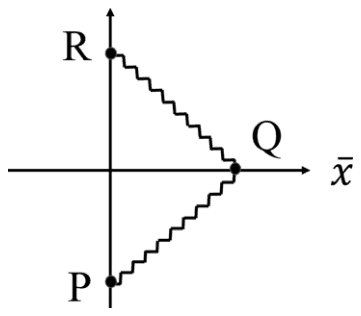
An observer \(\bar{O}(\bar{t}, \bar{x})\) moves with a constant velocity in the positive \(x\)-direction relative to an observer \(O(t, x)\) at rest. In the frame of reference of \(\bar{O}(\bar{t}, \bar{x})\), a light-ray emitted at a point P at some time reaches the \(\bar{x}\)-axis at the point Q. Then, on reflection it arrives at point R, as shown in the figure.

Diagram in the barred frame: P on the t-bar axis below the origin, Q on the x-bar axis, R on the t-bar axis above, joined by a zigzag light path

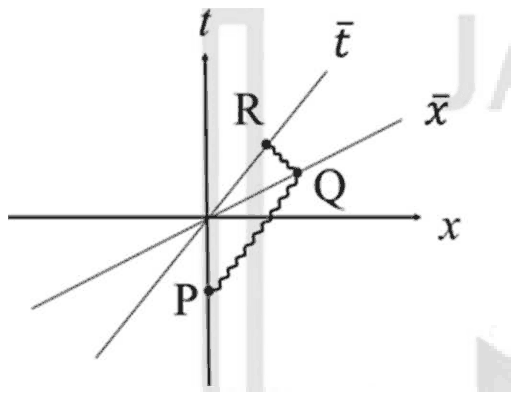
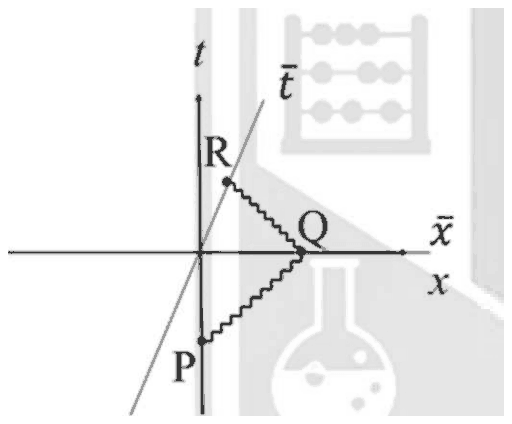
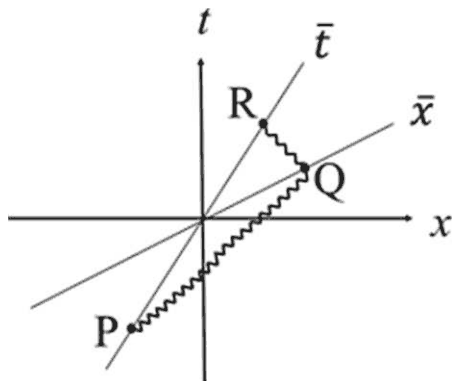
Which of the following options represents these events as observed by \(O(t, x)\)?

Exam Year(s)

IIT JAM - 2026,

Answer: D

The correct diagram is (D).

In the frame of \(\bar{O}\), P and R lie on the \(\bar{t}\) axis (\(\bar{x} = 0\)), before and after the reflection, and Q lies on the \(\bar{x}\) axis (\(\bar{t} = 0\)) at positive \(\bar{x}\). These facts hold in every frame, because they describe which events share a position or a time for \(\bar{O}\).

Since \(\bar{O}\) moves along \(+x\), its worldline, the \(\bar{t}\) axis, tilts towards \(+x\) in the diagram of \(O\), and its \(\bar{x}\) axis tilts upwards by the same angle, as a mirror image about the light line. So P and R must sit on the tilted \(\bar{t}\) line and Q on the tilted \(\bar{x}\) line, with Q on the right.

(A) puts P on the vertical \(t\) axis, not on the \(\bar{t}\) axis. (B) draws the \(\bar{x}\) axis on top of the \(x\) axis, which is the Galilean picture and ignores the relativity of simultaneity. (C) places Q on the negative side, which would need \(\bar{O}\) to move the other way. Only (D) has P, R on \(\bar{t}\), Q on \(\bar{x}\) and Q to the right.

Please log in or register to report this question.

5.

The events are represented by coordinates \((ct, x, y, z)\) in some frame of reference. Which of the following statements is/are correct?

[\(c\) is the speed of light]

Exam Year(s)

IIT JAM - 2026,

Answer: D

The correct statement is that events \((9, -1, 1, -1)\) and \((-10, 1, 0, -1)\) are time-like separated.

The invariant interval is \(\Delta s^2 = (c\Delta t)^2 - \Delta x^2 - \Delta y^2 - \Delta z^2\): positive for time-like, zero for light-like and negative for space-like separation. The differences for each pair are:

\[ \begin{aligned} \text{A:}\ (-2, 1, 1, 0) &\Rightarrow 4 - 1 - 1 = 2 \\ \text{B:}\ (2, 1, -1, 0) &\Rightarrow 4 - 1 - 1 = 2 \\ \text{C:}\ (1, 1, -2, 0) &\Rightarrow 1 - 1 - 4 = -4 \\ \text{D:}\ (-19, 2, -1, 0) &\Rightarrow 361 - 4 - 1 = 356 \end{aligned} \]

Pair D has a positive interval, so it is time-like, as stated. Pairs A and B are also time-like, not space-like, and pair C is space-like, not light-like. So only D is correct.

Please log in or register to report this question.
6.

Time-order of two events can be changed by making a Lorentz transformation only if they occur in :

Exam Year(s)

MH SET - 2018, SET Exam - 2018,

Answer: B

The time order can change only for events in the space-like region.

The invariant interval between two events is \(s^{2} = c^{2}\Delta t^{2} - \Delta x^{2}\). If the separation is time-like (\(s^{2} \gt 0\)), one event lies inside the other's light cone; a signal could connect them, and every inertial observer agrees on which came first. If it is light-like (\(s^{2} = 0\)), the events can be joined by a light ray, and again the order is fixed.

Only when the separation is space-like (\(s^{2} \lt 0\)) can a Lorentz boost with speed below c make \(\Delta t\) change sign. Such events cannot be causally connected, so no paradox arises. Exceeding the speed of light is not possible, which rules out the last option.

Please log in or register to report this question.

7.

Electron and positron annihilate and produce a single photon only when :

Exam Year(s)

MH SET - 2018, SET Exam - 2018,

Answer: D

A single photon can be produced only when at least one particle is in a bound state.

For a free electron and positron, energy and momentum cannot both be conserved if only one photon is emitted. In the centre-of-momentum frame the total momentum is zero but the energy is at least \(2m_{e}c^{2}\); a single photon with that energy would carry momentum \(E/c \neq 0\). So free-pair annihilation gives at least two photons.

If one of the particles is bound, for example an electron bound in an atom, the nucleus or the rest of the atom can take up the recoil momentum, and one-photon annihilation becomes possible. Having one or both particles at rest does not help, since the centre-of-momentum argument still applies.

Please log in or register to report this question.

8.

A space ship is moving away from earth with velocity 0.4 c. It fires a rocket (away from earth) whose velocity is 0.5 c with respect to the space ship. The velocity of the rocket as observed from the earth is :

Exam Year(s)

MH SET - 2019, SET Exam - 2019,

Answer: A

The rocket's velocity is 0.75 c.

Velocities must be combined with the relativistic addition formula, not simply added:

\[ \begin{aligned} u &= \frac{v + u'}{1 + vu'/c^{2}} = \frac{0.4c + 0.5c}{1 + 0.2} \\ &= \frac{0.9c}{1.2} = 0.75c \end{aligned} \]

The option 0.90 c is the Galilean sum, which ignores the denominator. The other options do not follow from either rule.

Please log in or register to report this question.

9.

A particle as observed in certain frame of reference has a total energy of 13 GeV and a momentum of 5 GeV/c. Its rest mass is :

Exam Year(s)

MH SET - 2020, SET Exam - 2020,

Answer: A

The rest mass is 12 GeV/c\(^{2}\).

The relativistic energy-momentum relation gives

\[ \begin{aligned} (mc^{2})^{2} &= E^{2} - (pc)^{2} \\ &= 13^{2} - 5^{2} = 144\ \text{GeV}^{2} \\ mc^{2} &= 12\ \text{GeV} \end{aligned} \]

The numbers form the 5-12-13 right triangle. The MeV options are a thousand times too small, and 1.2 GeV/c\(^{2}\) misplaces the decimal point; the rest energy must be of the same order as the 13 GeV total energy because the momentum is comparatively small.

Please log in or register to report this question.

10.

Consider two persons A and B of same age, 20 years. Person A remains rest at origin, whereas person B takes a roundtrip space voyage to a star with velocity v = 0.99c relative to person A (where c is the speed of light). The round trip distance travelled by the person B is 20 light years. When B meets A after completion of the space voyage, their ages are :

Exam Year(s)

MH SET - 2023, SET Exam - 2023,

Answer: B

A is 40.2 years old and B is 22.8 years old.

In A's frame the trip takes

\[ t_{A} = \frac{20\ \text{ly}}{0.99c} = 20.2\ \text{years} \]

so A ages to 40.2 years. B's clock runs slow by the factor \(\sqrt{1 - v^{2}/c^{2}}\):

\[ \begin{aligned} \sqrt{1 - 0.99^{2}} &= \sqrt{0.0199} = 0.141 \\ t_{B} &= 20.2 \times 0.141 = 2.85\ \text{years} \end{aligned} \]

so B is about 22.8 years old. This is the twin paradox: B, who accelerates and turns round, is the younger. Equal ages ignore time dilation, and the other options give the dilation to the wrong twin or not at all.

Please log in or register to report this question.

Loading…
Tags: Special Theory of Relativity Questions and Answers