
Machine-translated by Google. Questions are authored in English.
Top

Non-inertial Frames Questions and Answers

1.

Two frames \(S\) (solid lines) and \(S'\) (dashed lines) with common origin are shown in the figure below. Frame \(S\) is inertial while \(S'\) is rotating about the common \(z\)-axis. There is a point mass fixed at \(P\) on the \(x\)-axis of the \(S\) frame. The magnitude of the centrifugal force and the Coriolis force experienced by the mass in the \(S'\) frame is \(F_{cen}\) and \(F_{cor}\), respectively. Which of the following options is correct for these forces?
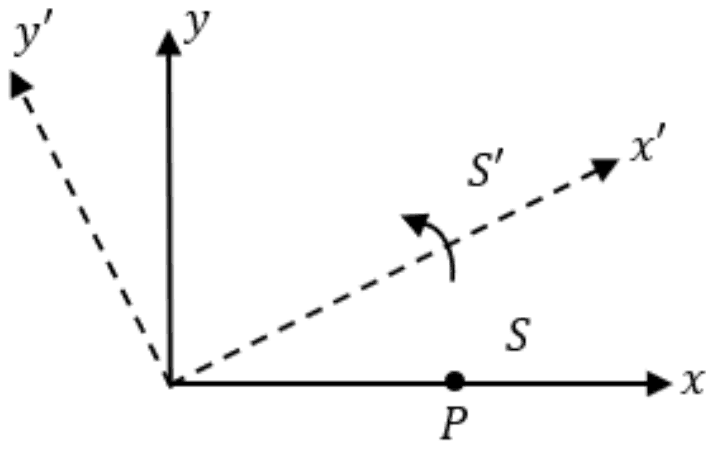
Solid x and y axes of frame S with point P on the x axis, and dashed x-prime and y-prime axes of frame S-prime rotated anticlockwise about the common origin

Exam Year(s)

GATE Physics - 2026,

Answer: B

Both forces are non-zero, with \(F_{cen} = F_{cor}/2\).

In the rotating frame S' the mass, fixed in S at distance r from the axis, appears to move in a circle at speed \(v' = \omega r\), opposite to the frame's rotation. The fictitious forces are:

\[ \begin{aligned} F_{cen} &= m\omega^{2}r\ \text{(outward)} \\ F_{cor} &= 2m\omega v' = 2m\omega^{2}r\ \text{(inward)} \end{aligned} \]

Their sum is \(m\omega^{2}r\) inward, exactly the centripetal force needed for the circular motion seen in S', with no real force acting. The forces are not zero, because S' is rotating, and the Coriolis force is twice, not half or equal to, the centrifugal force, which rules out the remaining options.

Please log in or register to report this question.

2.

The period of oscillation of the plane of Foucault's pendulum is :

(\(\phi\) is the latitude)

Exam Year(s)

MH SET - 2019, SET Exam - 2019,

Answer: B

The period is inversely proportional to sin \(\phi\).

The plane of a Foucault pendulum turns at the angular rate \(\Omega\sin\phi\), where \(\Omega\) is the earth's rotation rate, because only the vertical component of the earth's rotation turns the plane. The time for one complete turn is:

\[ \begin{aligned} T &= \frac{2\pi}{\Omega\sin\phi} \\ &= \frac{24\ \text{h}}{\sin\phi} \end{aligned} \]

At the poles (\(\phi = 90\)°) the plane turns once a day, and at the equator it does not turn at all. The period is not proportional to the latitude itself, nor to \(\cos\phi\).

Please log in or register to report this question.

3.

A frame of reference S′ is rotating with constant angular velocity \(\omega\) with respect to a stationary frame of reference S. Both the frames of reference have common origin. The time derivative of vector \(\bar{A}\) in S′ is :

Exam Year(s)

MH SET - 2020, SET Exam - 2020,

Answer: C

The derivative in the rotating frame is \(\frac{d'\bar{A}}{dt} = -\bar{\omega} \times \bar{A} + \frac{d\bar{A}}{dt}\).

The standard operator relation between a fixed frame S and a frame S′ rotating with angular velocity \(\bar{\omega}\) is

\[ \begin{aligned} \left(\frac{d\bar{A}}{dt}\right)_{S} &= \left(\frac{d\bar{A}}{dt}\right)_{S'} \\ &\quad + \bar{\omega} \times \bar{A} \end{aligned} \]

Solving for the rotating-frame derivative gives option C. Option B has the wrong sign of the rotation term, option A drops the fixed-frame rate of change, and option D would hold only if \(\omega = 0\). A vector fixed in S, for example, appears in S′ to rotate backwards at \(-\bar{\omega} \times \bar{A}\).

Please log in or register to report this question.

Loading…
Tags: Non-inertial Frames Questions and Answers