
Machine-translated by Google. Questions are authored in English.
Top

Network Theorems Questions and Answers

1.

If the given circuit is converted into Thevenin's equivalent with respect to terminals \(a - b\), then find \(V_{TH}\).

Circuit: 18 V source and two 6 ohm resistors in series, a 3 A current source in parallel across the line, a 4 ohm resistor in parallel, then a 1 ohm resistor carrying current I, with terminals a and b across the 4 ohm resistor

Exam Year(s)

DSSSB AE - 2023,

Answer: D

Remove the 1 ohm load (the terminals a and b are across the 4 ohm resistor) and find the open circuit voltage. Let \(V_1\) be the voltage at the node where the 3 A source is connected and \(V_a\) the voltage across the 4 ohm resistor.


\[ \begin{aligned} \frac{18 - V_1}{6} + 3 \\ &= \frac{V_1 - V_a}{6},\qquad \frac{V_a}{4} \\ &= \frac{V_1 - V_a}{6} \end{aligned} \]


The second equation gives \(V_a = 0.4 V_1\). The first gives \(36 = 1.6 V_1\), so \(V_1 = 22.5\) V and


\[ V_{TH} = V_a = 0.4 \times 22.5 = 9\ \text{V} \]


The answer is 9 V, option D.

Please log in or register to report this question.

2.

If the given circuit is converted into Norton's equivalent with respect to terminals \(a - b\), then find \(I_N\) and \(R_N\).

Circuit: 180 V source with a 20 ohm resistor in series, then a 3 A current source in parallel with a 40 ohm resistor, then a 12 ohm resistor across terminals a and b

Exam Year(s)

DSSSB AE - 2023,

Answer: D

The Norton resistance is found with the sources set to zero: the voltage source is shorted and the current source opened, so looking into a-b the 12 ohm resistor is in parallel with the series path of 20 ohms and 40 ohms.


\[ \begin{aligned} R_N = 12 \parallel (20 + 40) \\ &= \frac{12 \times 60}{72} = 10\ \Omega \end{aligned} \]


For the Norton current, short a-b. With node voltage \(V\) at the left end of the 40 ohm and current source block, taking the 3 A source as acting from a to this node:


\[ \begin{aligned} \frac{180 - V}{20} \\ &= \frac{V}{40} - 3 \Rightarrow V \\ &= 160\ \text{V},\quad I_N = \frac{180 - 160}{20} \\ &= 1\ \text{A} \end{aligned} \]


So \(I_N = 1\) A and \(R_N = 10\ \Omega\), option D.

Please log in or register to report this question.
3.

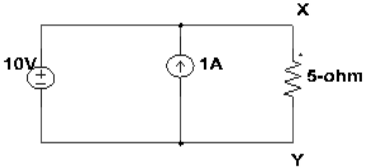
In the given circuit, find the current through \(5\ \Omega\) resistor using the superposition principle.

Circuit: a 10 V source, a 1 A current source and a 5 ohm resistor all connected in parallel between the top and bottom wires, with terminals X at the top and Y at the bottom of the resistor

Exam Year(s)

DSSSB AE - 2023,

Answer: A

Superposition: take each source alone.


With only the 10 V source acting, the current source is replaced by an open circuit and the 5 ohm resistor is across the 10 V source.


\[ I_1 = \frac{10}{5} = 2\ \text{A} \]


With only the 1 A source acting, the voltage source is replaced by a short circuit, which is directly across the 5 ohm resistor, so the whole of the 1 A flows in the short and the current in the resistor is \(I_2 = 0\).


\[ I = I_1 + I_2 = 2 + 0 = 2\ \text{A} \]


The answer is 2 A, option A. Because the voltage source is in parallel with the resistor, the resistor voltage is fixed at 10 V whatever the current source does.

Please log in or register to report this question.
4.

What percentage of maximum power is delivered to a load if a load resistance is 10 times greater than the Thevenin resistance of the source to which it is connected ?

Exam Year(s)

RSMSSB JE - 2025, RSMSSB - 2025,

Answer: A

The load receives 33.06% of the maximum power.

A source of Thevenin voltage V and resistance \(R_{th}\) delivers to a load \(R_{L}\) the power below, and the maximum, reached when \(R_{L} = R_{th}\), is \(V^{2}/4R_{th}\).

\[ \begin{aligned} P_{L} &= \frac{V^{2}R_{L}}{(R_{th}+R_{L})^{2}} \\ \frac{P_{L}}{P_{max}} &= \frac{4R_{th}R_{L}}{(R_{th}+R_{L})^{2}} \end{aligned} \]

With \(R_{L} = 10R_{th}\):

\[ \begin{aligned} \frac{P_{L}}{P_{max}} &= \frac{4 \times 10}{(1+10)^{2}} = \frac{40}{121} \\ &= 0.3306 = 33.06\% \end{aligned} \]

40% is what you get by leaving \(R_{th}\) out of the denominator (40/100). A tenfold mismatch costs about two thirds of the available power, which is why 25% and 35% do not fit either.

Please log in or register to report this question.

5.

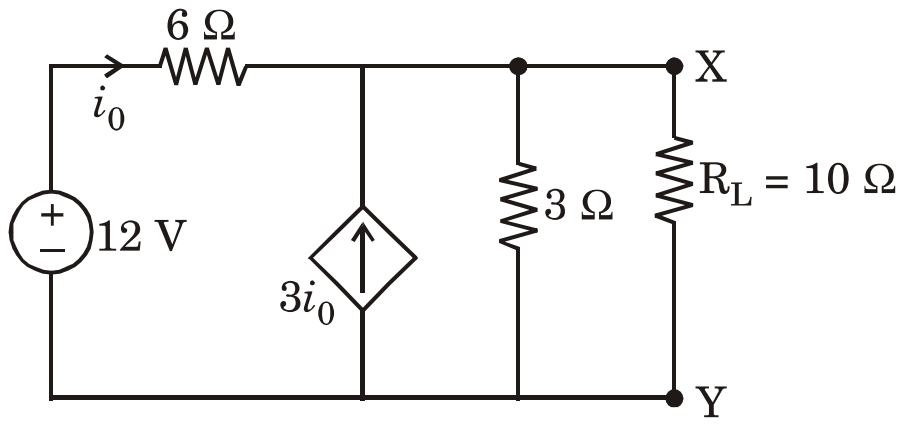
Find the short circuit current (IS.C.) of the following circuit using Norton's theorem :

Circuit: a 12 V source in series with a 6 ohm resistor carrying current i0 feeds a node; from that node to the bottom wire are a current source of 3 i0 pointing up, a 3 ohm resistor and, between terminals X and Y, a load resistor R_L of 10 ohm

Exam Year(s)

MH SET - 2019, SET Exam - 2019,

Answer: C

The short circuit current is 8 A.

Short the terminals X and Y. That puts the 3 Ω resistor and the 10 Ω load in parallel with a short, so neither carries current, and the top node sits at 0 V. The 12 V source then drives the 6 Ω resistor directly:

\[ i_0 = \dfrac{12}{6} = 2\ \text{A} \]

The dependent current source pushes 3i0 upward into the top node:

\[ 3 i_0 = 6\ \text{A} \]

Both currents flow through the short from X to Y, so by KCL at the top node:

\[ I_{S.C.} = i_0 + 3 i_0 = 2 + 6 = 8\ \text{A} \]

The 6 A of option D is only the dependent source's own current, left without the 2 A from the 6 Ω branch. Norton's current is the current through the short, and a dependent source cannot be set to zero when it is found.

Please log in or register to report this question.

6.

A superposition theorem is valid for which of the following ?

Exam Year(s)

MH SET - 2019, SET Exam - 2019,

Answer: A

The superposition theorem is valid for resistors with voltage sources.

Superposition says that in a linear network with several independent sources, the response anywhere is the sum of the responses to each source acting alone, with the others replaced by their internal resistances. It depends on linearity: doubling a cause must double its effect.

Resistors with voltage sources form a linear network, so the theorem applies. Diodes, transistors and zener diodes are non-linear devices whose current is not proportional to voltage, so superposition does not hold in circuits containing them, except over small-signal linearised models.

Please log in or register to report this question.

7.

Superposition theorem is essentially based on the concept of :

Exam Year(s)

MH SET - 2020, SET Exam - 2020,

Answer: B

The superposition theorem is based on linearity.

The theorem says that in a network with several independent sources, the response anywhere is the sum of the responses to each source acting alone (with the others replaced by their internal impedances). That holds only when the network obeys additivity and homogeneity, which together define linearity.

Duality is a correspondence between pairs of networks (series and parallel, voltage and current). Reciprocity concerns interchanging excitation and response. In a non-linear network, such as one containing a diode, superposition fails.

Please log in or register to report this question.

8.

A source of angular frequency 1 radian/second has a source impedance consisting of 1 Ω resistance in series with 1 H inductance. The load that will obtain the max power transfer is :

Exam Year(s)

MH SET - 2020, SET Exam - 2020,

Answer: C

The load is 1 Ω resistance in series with a 1 F capacitor.

Maximum power is transferred when the load impedance is the complex conjugate of the source impedance.

\[ \begin{aligned} Z_{s} &= R + j\omega L = 1 + j(1)(1) = 1 + j1 \\ Z_{L} &= Z_{s}^{*} = 1 - j1 \end{aligned} \]

A reactance of \(-j1\ \Omega\) at \(\omega = 1\) rad/s is a capacitor with \(1/(\omega C) = 1\), so C = 1 F, in series with 1 Ω.

A pure 1 Ω load ignores the source reactance. The parallel combinations give different impedances: 1 Ω in parallel with 1 F, for instance, is \(0.5 - j0.5\ \Omega\), not \(1 - j1\).

Please log in or register to report this question.

9.

In the circuit shown in the figure, the power dissipated in 30 Ω resistor will be maximum, if the value of R is :

A source V in series with a 30 ohm resistor and a variable resistor R connected in parallel with a 16 ohm resistor

Exam Year(s)

MH SET - 2021, SET Exam - 2021,

Answer: D

The power in the 30 Ω resistor is maximum when R is zero.

The 30 Ω resistor is fixed, so its power \(P = I^{2} \times 30\) depends only on the current through it. That current is

\[ I = \frac{V}{30 + (R \parallel 16)} \]

which is largest when the parallel combination R ∥ 16 is smallest. With R = 0 the variable resistor shorts the 16 Ω resistor, the parallel combination becomes 0, and I = V/30, the maximum possible.

The maximum power transfer idea, matching R to the load, does not apply here: it maximises power for a fixed source resistance feeding a variable load, whereas here the load is fixed and R is in the source path.

Please log in or register to report this question.

10.

Using superposition theorem, find the current through the 5 Ω resistor in the network shown below :

A 16 V source in series with a 3 ohm resistor feeds a node joined to a 5 ohm resistor and a 5 A current source, both returning to the common line

Exam Year(s)

MH SET - 2021, SET Exam - 2021,

Answer: A

The current through the 5 Ω resistor is 3.875 A.

Take each source alone. With only the 16 V source (current source open), the 3 Ω and 5 Ω resistors are in series. With only the 5 A source (voltage source shorted), the current divides between the 5 Ω resistor and the 3 Ω resistor:

\[ \begin{aligned} I_{1} &= \frac{16}{3 + 5} = 2\ \text{A} \\ I_{2} &= 5 \times \frac{3}{3 + 5} = 1.875\ \text{A} \\ I &= I_{1} + I_{2} = 3.875\ \text{A} \end{aligned} \]

Both contributions flow down through the 5 Ω resistor, so they add. 2.00 A is the voltage-source part alone, and the other values come from wrong current-divider ratios.

Please log in or register to report this question.

Loading…

Other Subjects

Tags: Network Theorems Questions and Answers || Network Theorems MCQ Questions and Answers || Network Theorems GK Questions and Answers || Network Theorems GK MCQ Questions || Network Theorems Multiple Choice Questions and Answers || Network Theorems GK || GK on Network Theorems || Network Analysis Questions and Answers || Network Analysis MCQ Questions and Answers || Network Analysis GK Questions and Answers || GK on Network Analysis