
Machine-translated by Google. Questions are authored in English.
Top

Laplace Transform in System Analysis Questions and Answers

Direction for [ Question No: 1 To 1 ] :

Directions : In the following questions, match List - I and List - II and select the correct answer using the codes given below the lists :

1.

List - IList - II
a. Stabilityi. transient analysis
b. Y-parametersii. discrete time domain analysis
c. Laplace transformiii. hybrid \(\pi\) model
d. Z-transformiv. location of poles

Codes : a b c d

Exam Year(s)

UGC NET - 2012,

Answer: A

The matching is: a stability with the location of poles (iv), b Y-parameters with the hybrid \(\pi\) model (iii), c Laplace transform with transient analysis (i), d Z-transform with discrete time domain analysis (ii), the code iv iii i ii (option A).

Stability is judged from the position of the poles, the hybrid-\(\pi\) model uses admittance parameters, the Laplace transform is used for transients, and the Z-transform for sampled systems. Options B, C and D swap Laplace and Z or place stability elsewhere.

Please log in or register to report this question.
Direction for [ Question No: 2 To 2 ] :

Directions : The following items consist of two statements, one labelled the "Assertion (A)" and the other labelled the "Reason (R)". You are to examine these two statements carefully and decide if the Assertion (A) and the Reason (R) are individually true and if so, whether the Reason is a correct explanation of the Assertion. Select your answers to these items using the codes given below and mark your answer accordingly.

2.

Assertion (A) : The roots of the denominator of a network function decide its stability.

Reason (R) : The poles on real axis determine the damping factor of the system.

Exam Year(s)

UGC NET - 2012,

Answer: A

Both statements are true and the reason explains the assertion (option A). The poles of a network function are the roots of its denominator, and a system is stable when they all have negative real parts, so the roots decide stability.

The real part of the poles is the damping factor of the response, and a pole on the real axis gives a purely decaying exponential term, so the position of the poles also fixes the damping. Options B, C and D deny one of these links.

Please log in or register to report this question.

3.

Find the Laplace transform of \(H(t) = e^{-t} + 2te^{-t}\).

Exam Year(s)

DSSSB AE - 2023,

Answer: C

Use the standard transforms \(\mathcal{L}\{e^{-t}\} = \dfrac{1}{s + 1}\) and \(\mathcal{L}\{te^{-t}\} = \dfrac{1}{(s + 1)^2}\).


\[ \begin{aligned} H(s) = \frac{1}{s + 1} + \frac{2}{(s + 1)^2} \\ &= \frac{(s + 1) + 2}{(s + 1)^2} \\ &= \frac{s + 3}{s^2 + 2s + 1} \end{aligned} \]


That is the third option. The denominator \(1 + 2s + s^2\) is \((s + 1)^2\), so the options with \(2 + s + s^2\) are wrong, and the last option, with numerator 3, lacks the \(s\) from the first term. The answer is option C.

Please log in or register to report this question.

4.

The Laplace transform of \(\sin 3t\) is ______.

Exam Year(s)

DSSSB AE - 2023,

Answer: A

The Laplace transform of \(\sin at\) is \(\dfrac{a}{s^2 + a^2}\). With \(a = 3\):


\[ \mathcal{L}\{\sin 3t\} = \frac{3}{s^2 + 9} \]


The option with \(s^2 + 3\) uses \(a\) where \(a^2\) is needed, the one with numerator 9 is \(a^2\) in place of \(a\), and the last option would be \(\dfrac{3}{3(s^2 + 3)}\), which does not equal the transform. The answer is option A.

Please log in or register to report this question.

5.

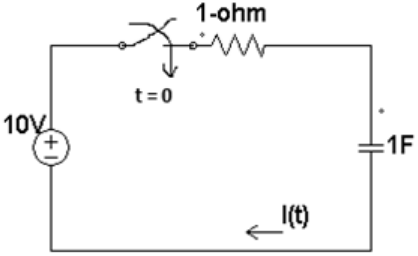
For the given circuit, determine I(t) in Laplace domain i.e. I(s).

Circuit: a 10 V source in series with a switch closing at t = 0, a 1 ohm resistor and a 1 F capacitor in a single loop, with the current I(t) marked

Exam Year(s)

DSSSB AE - 2023,

Answer: A

When the switch closes at \(t = 0\), a 10 V step is applied to the series combination of the 1 ohm resistor and the 1 F capacitor, with no initial charge. In the Laplace domain the source is \(10/s\) and the impedance is \(R + 1/(sC) = 1 + 1/s\).


\[ \begin{aligned} I(s) = \frac{10/s}{1 + 1/s} \\ &= \frac{10/s}{(s+1)/s} = \frac{10}{s + 1} \end{aligned} \]


In the time domain this is \(i(t) = 10e^{-t}\), the current of the charging capacitor, which starts at 10 A and falls to zero. The option \(10/s\) would be the current in a purely inductive path, and \(10/(s-1)\) would grow without limit. The answer is option A.

Please log in or register to report this question.

6.

Laplace transform of \(\delta(t - T)\) is :

Exam Year(s)

MH SET - 2018, SET Exam - 2018,

Answer: C

The Laplace transform of \(\delta(t - T)\) is \(e^{-sT}\).

Using the sifting property of the impulse, for \(T \gt 0\):

\[ \int_{0}^{\infty} \delta(t - T) e^{-st}\, dt = e^{-sT} \]

This is also the time-shift theorem applied to \(\mathcal{L}\{\delta(t)\} = 1\): delaying by T multiplies the transform by \(e^{-sT}\).

'Constant' is the transform of the undelayed impulse \(\delta(t)\). \(1/e^{-sT} = e^{sT}\) would be an advance, not a delay, and \(s e^{-sT}\) is the transform of the derivative of a delayed impulse.

Please log in or register to report this question.

7.

The Laplace transform of a unit step function is :

Exam Year(s)

MH SET - 2023, SET Exam - 2023,

Answer: A

The Laplace transform of a unit step is \(\dfrac{1}{s}\).

\[ \begin{aligned} \mathcal{L}\{u(t)\} &= \int_{0}^{\infty} e^{-st}\,dt \\ &= \frac{1}{s} \end{aligned} \]

The integral converges for Re(s) > 0.

The other options belong to other signals: 1 is the transform of the unit impulse \(\delta(t)\), \(1/s^{2}\) is the transform of the unit ramp \(t\,u(t)\), and \(1/(s+a)\) is the transform of the decaying exponential \(e^{-at}u(t)\).

Please log in or register to report this question.

8.

The Laplace transform of a unit impulse function is :

Exam Year(s)

MH SET - 2025, SET Exam - 2025,

Answer: D

The Laplace transform of a unit impulse is 1.

By the definition of the transform and the sifting property of the impulse:

\[ \begin{aligned} \mathcal{L}\{\delta(t)\} &= \int_{0^-}^{\infty} \delta(t)e^{-st}\,dt \\ &= e^{-s \cdot 0} = 1 \end{aligned} \]

1/s is the transform of the unit step, not the impulse. \(e^{-st}\) is the kernel of the transform, and \(e^{-sT}\) would be the transform of an impulse delayed by T. \(\delta(t)\) is the impulse function itself in the time domain, not its transform.

Please log in or register to report this question.

9.

The final value of \(2S + 1 / S^{4} + 8S^{3} + 16S^{2} + S\) is

Exam Year(s)

UGC NET - 2012,

Answer: C

The final value is 1, option (C). By the final value theorem, \(\lim_{t\to\infty} f(t) = \lim_{s\to 0} sF(s)\), provided that all the poles of \(sF(s)\) lie in the left half plane.

\[ sF(s) = \frac{s(2s+1)}{s\,(s^{3}+8s^{2}+16s+1)} \]

\[ = \frac{2s+1}{s^{3}+8s^{2}+16s+1} \]

\[ \lim_{s\to0} sF(s) = \frac{1}{1} = 1 \]

The cubic in the denominator is stable, since all its coefficients are positive and \(8\times16 > 1\), so the theorem applies. The answers 0, \(\infty\) and 2 in options (A), (B) and (D) do not follow from this limit.

Please log in or register to report this question.

Loading…

Other Subjects

Tags: Laplace Transform in System Analysis Questions and Answers || Laplace Transform in System Analysis MCQ Questions and Answers || Laplace Transform in System Analysis GK Questions and Answers || Laplace Transform in System Analysis GK MCQ Questions || Laplace Transform in System Analysis Multiple Choice Questions and Answers || Laplace Transform in System Analysis GK || GK on Laplace Transform in System Analysis || Signals and Systems Questions and Answers || Signals and Systems MCQ Questions and Answers || Signals and Systems GK Questions and Answers || GK on Signals and Systems