
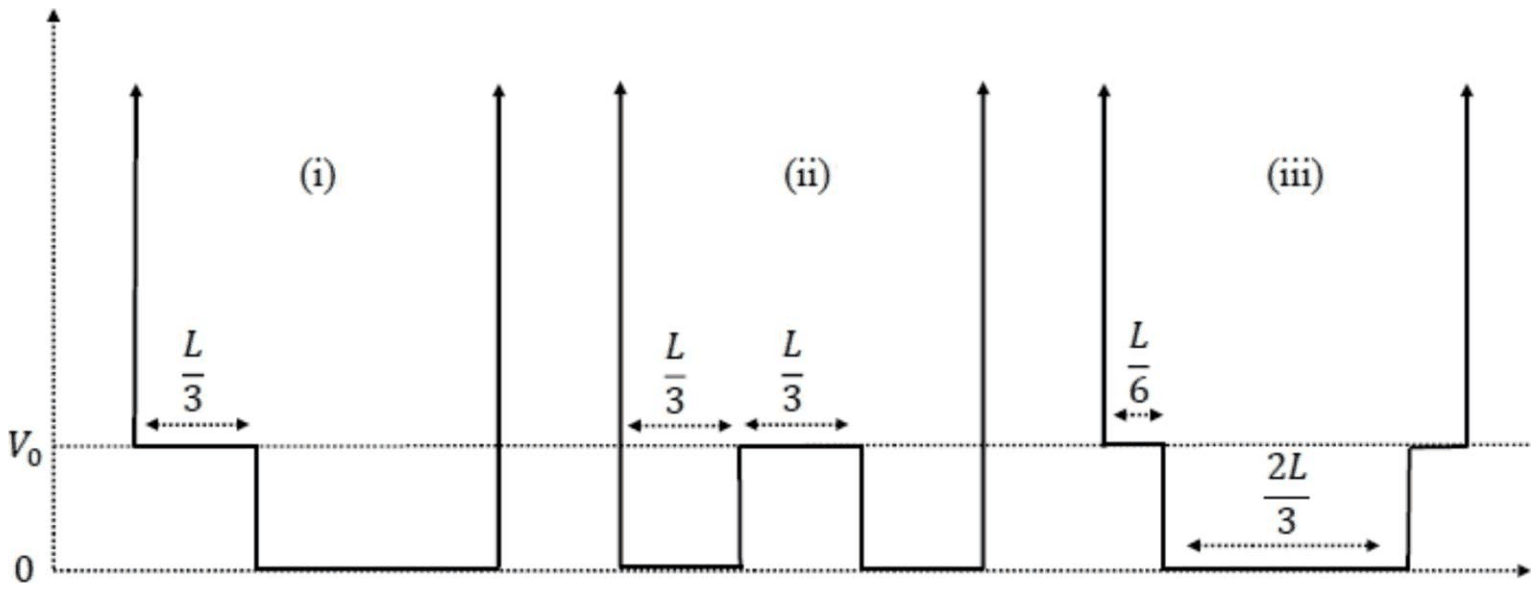
Consider a particle in three different boxes of width \(L\). The potential inside the boxes vary as shown in figures (i), (ii) and (iii) with \(V_{0} \ll \frac{\hbar^{2}\pi^{2}}{2mL^{2}}\). The corresponding ground-state energies of the particle are \(E_{1}\), \(E_{2}\) and \(E_{3}\), respectively. Then
GATE Physics - 2022,
Answer: A
The order is \(E_{2} \gt E_{1} \gt E_{3}\).
Because \(V_{0}\) is small compared with the ground-state energy, first-order perturbation theory applies: each energy rises by \(V_{0}\) times the probability of finding the particle in the raised region. The ground state \(\psi = \sqrt{2/L}\sin(\pi x/L)\) is largest at the centre of the well and small near the walls.
- Box (ii) raises the middle third, where the particle is most likely to be: probability about 0.61.
- Box (i) raises one outer third: \(\frac{1}{3} - \frac{\sin(2\pi/3)}{2\pi} \approx 0.20\).
- Box (iii) raises the outer sixth at each end, where the wavefunction is smallest: \(2\left(\frac{1}{6} - \frac{\sin(\pi/3)}{2\pi}\right) \approx 0.06\).
So \(E_{2} \gt E_{1} \gt E_{3}\). Boxes (i) and (iii) raise the same total width, \(L/3\), so a reading that ignores where the step sits would make \(E_{1} = E_{3}\); the other orders get the position dependence backwards.
Please log in or register to report this question.