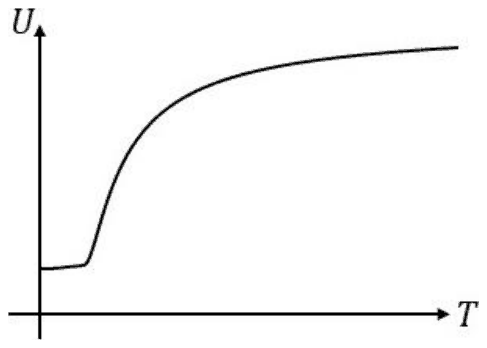
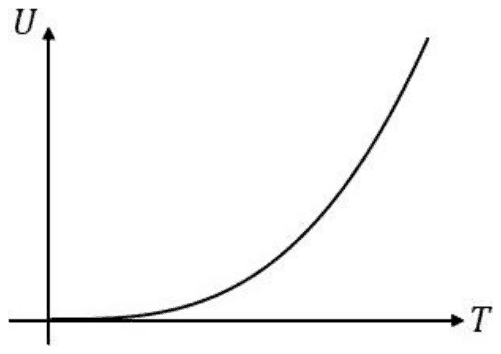
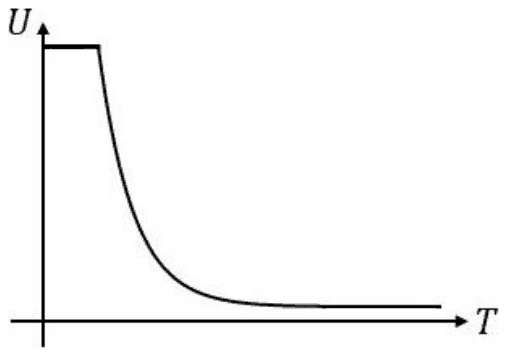
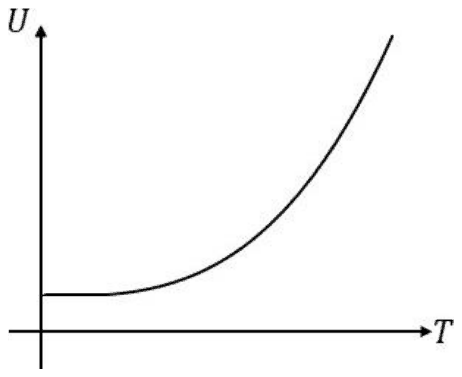
Consider a non-interacting gas of spin 1 particles, each with magnetic moment \(\mu\), placed in a weak magnetic field \(B\), such that \(\frac{\mu B}{k_{B}T} \ll 1\). The average magnetic moment of a particle is
GATE Physics - 2022,
Answer: A
The average moment is \(\frac{2\mu}{3}\left(\frac{\mu B}{k_{B}T}\right)\).
A spin-1 particle has three orientations, \(m = +1, 0, -1\), with energies \(-\mu B\), 0 and \(+\mu B\). Writing \(x = \mu B/k_{B}T\), the Boltzmann average is
\[ \begin{aligned} \langle \mu_{z} \rangle &= \mu\frac{e^{x} - e^{-x}}{1 + e^{x} + e^{-x}} \\ &= \mu\frac{2\sinh x}{1 + 2\cosh x} \end{aligned} \]
For \(x \ll 1\), \(\sinh x \approx x\) and \(\cosh x \approx 1\), so \(\langle \mu_{z} \rangle \approx \mu\frac{2x}{3}\). The factor 2/3 is the Curie-law factor \(J(J+1)/3\) for \(J = 1\). The other coefficients, \(\frac{1}{2}\), \(\frac{1}{3}\) and \(\frac{3}{4}\), do not come from the three-level sum; a spin-1/2 particle, for comparison, would give \(\mu x\).
Please log in or register to report this question.