
Machine-translated by Google. Questions are authored in English.
Top

IP Routing Questions and Answers

1.

A packet with the destination IP address 145.36.109.70 arrives at a router whose routing table is shown. Which interface will the packet be forwarded to?

Subnet AddressSubnet Mask (in CIDR notation)Interface
145.36.0.0/16E1
145.36.128.0/17E2
145.36.64.0/18E3
145.36.255.0/24E4
Default--E5

Exam Year(s)

GATE CS - 2025,

Answer: A

The packet is forwarded to E3.

A router uses longest prefix match. The destination's third octet is 109 = 01101101 in binary. Check each entry:

  • 145.36.0.0/16 matches, since the first two octets agree.
  • 145.36.128.0/17 needs the first bit of the third octet to be 1 (128 to 255); 109 starts with 0, so no match.
  • 145.36.64.0/18 needs the first two bits of the third octet to be 01 (64 to 127); 109 starts 01, so it matches.
  • 145.36.255.0/24 needs the third octet to be 255; no match.

Of the matching entries, /18 is longer than /16, so the packet goes out on E3. E1 is what a router would choose if it ignored the longest match, E2's range 128 to 255 does not contain 109, and the default route E5 is used only when nothing else matches.

Please log in or register to report this question.
2.

Consider the routing protocols given in List I and the names given in List II:

List IList II
(i) Distance vector routing(a) Bellman-Ford
(ii) Link state routing(b) Dijkstra

For matching of items in List I with those in List II, which ONE of the following options is CORRECT?

Exam Year(s)

GATE CS - 2025,

Answer: A

The correct matching is (i) - (a) and (ii) - (b).

In distance vector routing (as in RIP), each router keeps a vector of distances and repeatedly updates it from its neighbours' vectors. That is the distributed Bellman-Ford algorithm.

In link state routing (as in OSPF), each router floods its link states, so every router learns the whole topology and then computes shortest paths from itself with Dijkstra's algorithm.

The options pairing both protocols with the same algorithm, or swapping them, mix up the local, iterative update of distance vector routing with the global, single-source computation of link state routing.

Please log in or register to report this question.

3.

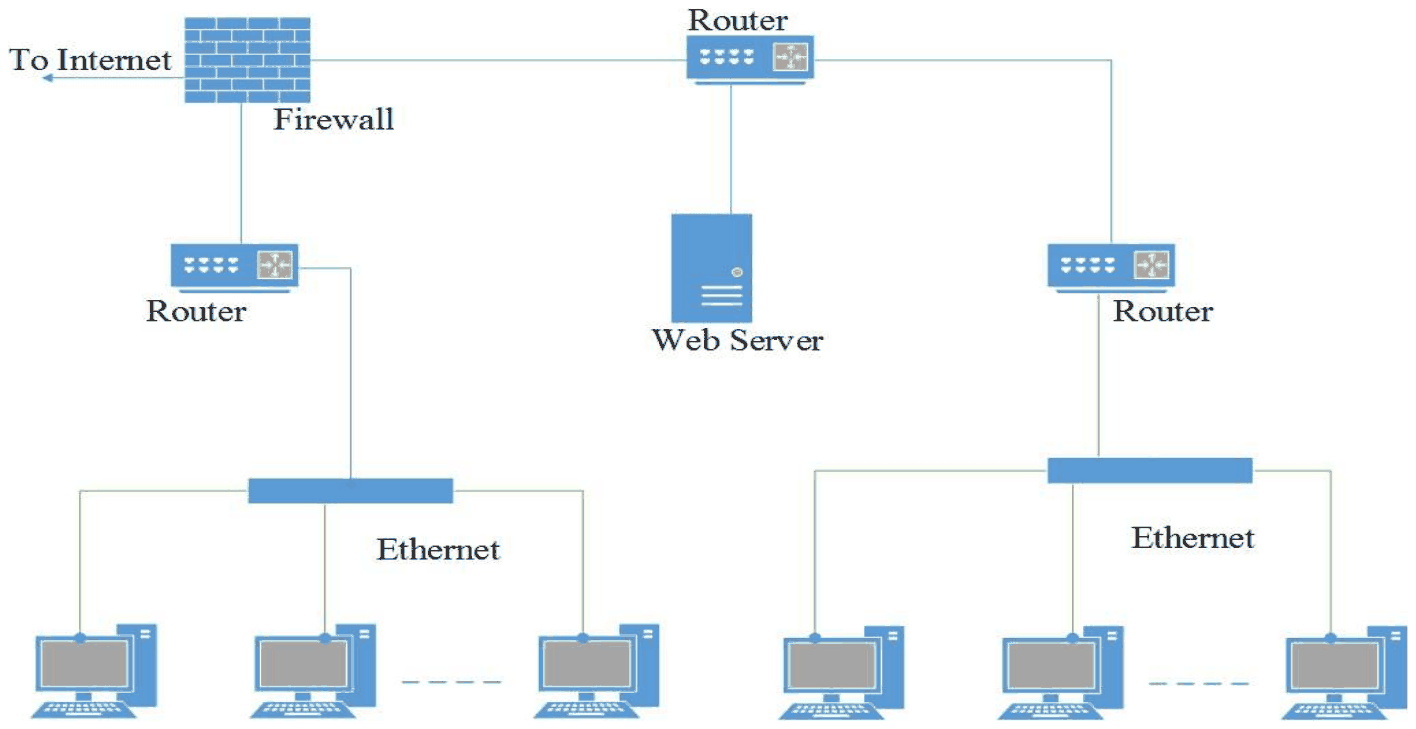
Consider an enterprise network with two Ethernet segments, a web server and a firewall, connected via three routers as shown below.

A firewall links to the Internet, to a router below it and to a top router; the top router links to a web server and to a third router; the lower-left and right routers each serve an Ethernet segment of computers

What is the number of subnets inside the enterprise network?

Exam Year(s)

GATE CS - 2022,

Answer: C

There are 6 subnets.

Each router or firewall interface sits on its own subnet, so every separate link or segment between these devices is one subnet. Counting them in the figure:

  1. firewall to the lower-left router;
  2. firewall to the top router;
  3. top router to the web server;
  4. top router to the right router;
  5. the lower-left router's Ethernet segment;
  6. the right router's Ethernet segment.

The firewall's link to the Internet is outside the enterprise network, so it is not counted. 3 counts only the routers, 8 and 12 count interfaces or hosts rather than shared links.

Please log in or register to report this question.

Answer: D

Another way to avoid problems caused by inconsistent updates and to stop network loops is route poisoning. When a network goes down, the distance-vector routing protocol initiates route poisoning by advertising the network with a metric of 16, or unreachable (sometimes referred to as infinite).

Please log in or register to report this question.

5.

What does RIPv2 use to prevent routing loops?

1.CIDR

2.Split horizon

3.Authentication

4.Classless masking

5.Holddown timers

Answer: C

RIPv2 uses the same timers and loop-avoidance schemes as RIPv1. Split horizon is used to stop an update from being sent out the same interface it was received on. Holddown timers allow time for a network to become stable in the case of a flapping link.

Please log in or register to report this question.

6.

Which two of the following are true regarding the distance-vector and link-state routing protocols?

1.Link state sends its complete routing table out all active interfaces on periodic time intervals.

2.Distance vector sends its complete routing table out all active interfaces on periodic time intervals.

3.Link state sends updates containing the state of its own links to all routers in the internetwork.

4.Distance vector sends updates containing the state of its own links to all routers in the internetwork.

Answer: C

The distance-vector routing protocol sends its complete routing table out all active interfaces at periodic time intervals. Link-state routing protocols send updates containing the state of its own links to all routers in the internetwork.

Please log in or register to report this question.

7.

You have the following routing table. Which of the following networks will not be placed in the neighbor routing table?

R    192.168.30.0/24 [120/1] via 192.168.40.1, 00:00:12, Serial0
C    192.168.40.0/24 is directly connected, Serial0
     172.16.0.0/24 is subnetted, 1 subnets
C    172.16.30.0 is directly connected, Loopback0
R    192.168.20.0/24 [120/1] via 192.168.40.1, 00:00:12, Serial0
R    10.0.0.0/8 [120/15] via 192.168.40.1, 00:00:07, Serial0
C    192.168.50.0/24 is directly connected, Ethernet0

Answer: C

Correct answer: 10.0.0.0

The 10.0.0.0/8 route already has a metric of 15, and RIP adds one hop when advertising it onward, giving 16 - which RIP defines as infinity, meaning unreachable. The neighbour therefore discards it. The other entries have metrics of 0 or 1 and will be advertised and installed normally.

Please log in or register to report this question.

8.

Which statement is true regarding classless routing protocols?

1.The use of discontiguous networks is not allowed.

2.The use of variable length subnet masks is permitted.

3.RIPv1 is a classless routing protocol.

4.IGRP supports classless routing within the same autonomous system.

5.RIPv2 supports classless routing.

Answer: C

Correct answer: 2 and 5

A classless protocol carries the subnet mask in its updates, which is what permits variable length subnet masks and discontiguous networks - so statement 2 is correct and statement 1 states the opposite. RIPv2 is classless, so statement 5 is correct. RIPv1 and IGRP are both classful and send no mask, which disposes of statements 3 and 4.

Please log in or register to report this question.

9.

The Corporate router receives an IP packet with a source IP address of 192.168.214.20 and a destination address of 192.168.22.3. Looking at the output from the Corporate router, what will the router do with this packet?

Corp#sh ip route
[output cut]
R    192.168.215.0 [120/2] via 192.168.20.2, 00:00:23, Serial0/0
R    192.168.115.0 [120/1] via 192.168.20.2, 00:00:23, Serial0/0
R    192.168.30.0 [120/1] via 192.168.20.2, 00:00:23, Serial0/0
C    192.168.20.0 is directly connected, Serial0/0
C    192.168.214.0 is directly connected, FastEthernet0/0

Answer: A

Since the routing table shows no route to the 192.168.22.0 network, the router will discard the packet and send an ICMP destination unreachable message out interface FastEthernet 0/0, which is the source LAN where the packet originated from.

Please log in or register to report this question.

10.

Which command displays RIP routing updates?

Answer: B

Correct answer: debug ip rip

debug ip rip shows the updates as they are sent and received, with the networks and metrics in each. show ip route displays the result of those updates rather than the updates themselves, and there is no debug ip route command. As always with debug, it should be enabled briefly on a production router.

Please log in or register to report this question.

Loading…

Other Subjects

Tags: IP Routing Questions and Answers || IP Routing MCQ Questions and Answers || IP Routing GK Questions and Answers || IP Routing GK MCQ Questions || IP Routing Multiple Choice Questions and Answers || IP Routing GK || GK on IP Routing || Computer Networking Questions and Answers || Computer Networking MCQ Questions and Answers || Computer Networking GK Questions and Answers || GK on Computer Networking