
Machine-translated by Google. Questions are authored in English.
Top

Plant Physiology and Biochemistry Questions and Answers

Answer: B

Free oxygen stays low because of binding of oxygen to leghemoglobin.

Nitrogenase is irreversibly inactivated by oxygen, yet the bacteroids in the nodule need oxygen for respiration to supply the ATP that nitrogen fixation demands. Leghemoglobin, a plant haemoglobin made in large amounts in infected nodule cells (giving them their pink colour), binds oxygen tightly and delivers it to the respiring bacteroids while keeping the free oxygen concentration very low.

Rhizobia are aerobic, not anaerobic, so that option is wrong. Neither the reductase nor the nitrogenase component of the nitrogenase complex removes oxygen; both are themselves damaged by it.

Please log in or register to report this question.
2.

Which one of the following performs normal C3 photosynthesis when water is available, but switches to crassulacean acid metabolism (CAM) during salt or drought stress?

Exam Year(s)

GATE Life Sciences - 2012,

Answer: A

The plant is Mesembryanthemum crystallinum, the common ice plant.

The ice plant is the classic facultative CAM species. Well watered, it fixes carbon by the ordinary C3 pathway; under salt or drought stress it induces PEP carboxylase and the other CAM enzymes and switches to opening its stomata at night, which saves a great deal of water.

Cynodon dactylon (Bermuda grass) and Eleusine coracana (finger millet, spelt Eleucine in the paper) are C4 grasses, and Hordeum vulgare (barley) is a C3 plant; none of them switches to CAM.

Please log in or register to report this question.
3.

Which of the following statements are TRUE for plant growth regulators?

P. The release of cellulase and polygalacturonase into the cell wall is promoted by abscissic acid
Q. The early biosynthetic steps of gibberellic acid, up to the formation of ent-kaurene take place in the plastid
R. The naturally occurring zeatin belongs to the aromatic group of cytokinins
S. Induction of protease inhibitors as a result of wounding and pathogen attack is activated by jasmonic acid

Exam Year(s)

GATE Life Sciences - 2012,

Answer: B

The true statements are Q, S.

Q is true: gibberellin synthesis begins in the plastid, where geranylgeranyl diphosphate is cyclised to ent-kaurene; the later steps take place in the endoplasmic reticulum and cytosol. S is true: wounding and herbivore attack trigger jasmonic acid signalling, which switches on genes for proteinase inhibitors.

P is false: the release of cellulase and polygalacturonase that dissolves the cell walls in abscission zones is promoted by ethylene, not abscisic acid, despite the latter's name. R is false: zeatin is an isoprenoid (adenine-type) cytokinin; the aromatic cytokinins are a separate group such as benzyladenine. So the pairs with P or R are wrong.

Please log in or register to report this question.
4.

Identify the CORRECT statements in plant secondary metabolism.

P. Tropane alkaloids in Atropa belladonna are synthesized from tyrosine
Q. Antioxidative food ingredient rosmarinic acid is obtained from cell suspension cultures of Coleus blumei
R. Thiophenes are produced from hairy root cultures of Tagetes patula
S. Cyanidin, the principal anthocyanin responsible for red color in Rosa hybrida is produced from cinnamaldehyde

Exam Year(s)

GATE Life Sciences - 2012,

Answer: D

The correct statements are Q, R.

Q is correct: cell suspension cultures of Coleus blumei accumulate rosmarinic acid in high yield and are a well-known example of producing this antioxidant in culture. R is correct: hairy root cultures of Tagetes patula (French marigold), produced by Agrobacterium rhizogenes, synthesise nematicidal thiophenes.

P is false: the tropane alkaloids of Atropa belladonna, such as hyoscyamine, derive from ornithine (or arginine) through putrescine, not from tyrosine. S is false: cyanidin is made via the phenylpropanoid and flavonoid pathway from phenylalanine, through p-coumaroyl CoA and chalcone, not from cinnamaldehyde. So pairs with P or S are excluded.

Please log in or register to report this question.
5.

Which of the following statements are TRUE for respiration?

P. The conversion of one molecule of pyruvate to three molecules of CO2 generates four molecules of NADH
Q. Fructose 6-phospate is the principal substrate for glycolysis
R. The oxidation of glucose 6-phosphate to 6-phosphogluconate is the first step in the oxidative pentose phosphate pathway
S. The mitochondrial 'alternative oxidase' provides an alternative pathway for transfer of electrons from ubiquinone to oxygen utilizing proton pumping complex of the respiratory chain

Exam Year(s)

GATE Life Sciences - 2012,

Answer: A

The true statements are P, R.

P is true. Pyruvate dehydrogenase releases one CO2 and makes one NADH; one turn of the citric acid cycle releases two more CO2 and makes three NADH (plus one FADH2 and one ATP or GTP). That is three CO2 and four NADH per pyruvate. R is true: glucose 6-phosphate dehydrogenase oxidises glucose 6-phosphate (to 6-phosphogluconolactone, hydrolysed to 6-phosphogluconate), the committed first step of the oxidative pentose phosphate pathway.

Q is false: glycolysis starts from glucose (or, in plants, sucrose and starch), and fructose 6-phosphate is an intermediate. S is false: the alternative oxidase takes electrons from ubiquinol straight to oxygen, bypassing the proton-pumping complexes III and IV, which is why it releases energy as heat.

Please log in or register to report this question.
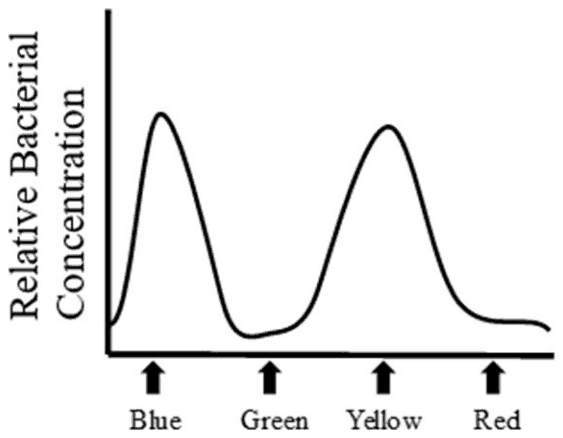
6.

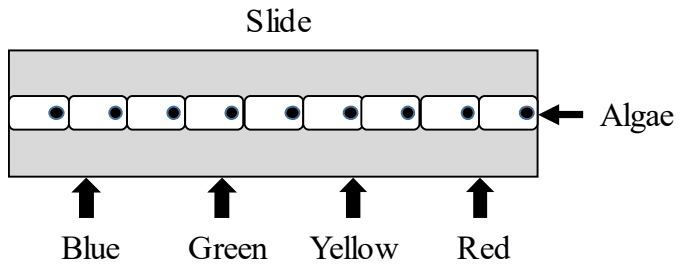
Filamentous photosynthetic algae were placed on a microscopic slide and illuminated with light of different colors as illustrated.

Algal filament lit at Blue, Green, Yellow, Red

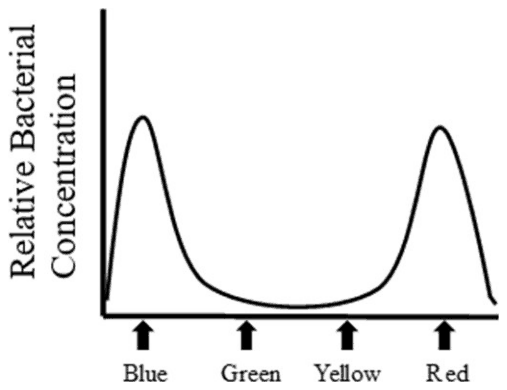
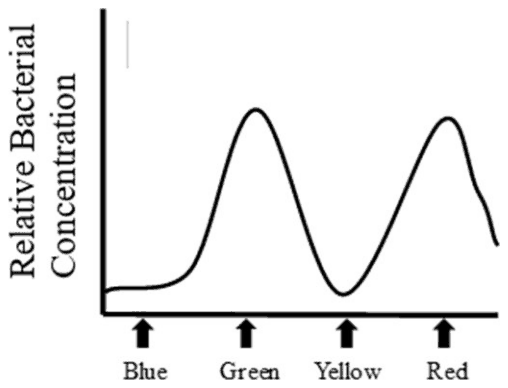
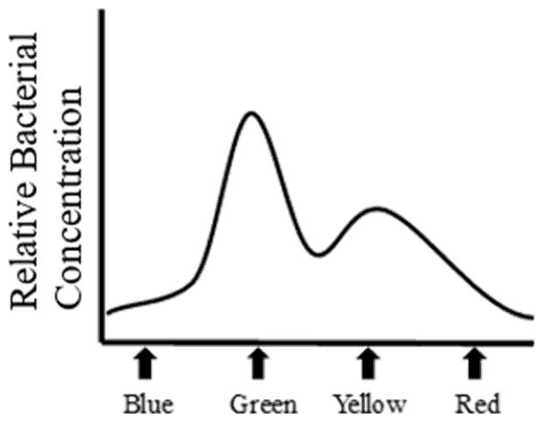
The bacteria that are known to migrate towards the region of high O2 were also added uniformly on the slide. Which one of the following options illustrates the distribution of bacteria along the length of the microscopic slide after illumination?

Exam Year(s)

GATE Life Sciences - 2022,

Answer: A

The bacteria gather in the blue and red regions, as in option (A).

This is Engelmann's experiment. The algae photosynthesise and release O2 fastest where they absorb light best, and chlorophyll absorbs most strongly in the blue and red parts of the spectrum. Aerotactic bacteria swim toward high oxygen, so they pile up under the blue and red lights and stay sparse under green and yellow light, which chlorophyll largely transmits or reflects.

Option (B) puts a peak at green, the region chlorophyll absorbs least. Options (C) and (D) place peaks at green or yellow and miss the red peak, which would require photosynthesis to be driven mainly by poorly absorbed wavelengths.

Please log in or register to report this question.

7.

Match the secondary metabolites in Group-I with types of secondary metabolites in Group-II in CORRECT order.

Group-IGroup-II
P. MyrceneI. Sesquiterpene
Q. β-FarneseneII. Cyanogenic glycoside
R. AmygdalinIII. Flavone
S. NicotineIV. Alkaloid
T. LuteolinV. Monoterpene

Exam Year(s)

GATE Life Sciences - 2022,

Answer: D

The correct order is P-V, Q-I, R-II, S-IV, T-III.

  • Myrcene is a C10 acyclic monoterpene, made of two isoprene units (V).
  • β-Farnesene is a C15 sesquiterpene, three isoprene units, known as an aphid alarm pheromone (I).
  • Amygdalin, from bitter almond and apricot kernels, is a cyanogenic glycoside that releases HCN on hydrolysis (II).
  • Nicotine, from tobacco, is a pyridine alkaloid (IV).
  • Luteolin is a flavone (III).

Option A swaps the two terpenes, and options B and C misplace amygdalin and nicotine as well.

Please log in or register to report this question.

8.

Match Group-I (enzyme), Group-II (reaction catalyzed by the enzyme), and Group-III (subcellular localization of the enzyme and the associated metabolic process) in CORRECT combination.

Group-IGroup-IIGroup-III
P. PEP CarboxylaseI. 2 Glycolate + 2 O2 = 2 Glyoxylate + 2 H2O2a. Cytosol - C4 cycle
Q. RubiscoII. Pyruvate + NAD+ + CoA = Acetyl-CoA + CO2 + NADHb. Peroxisome - C2 cycle
R. Glycolate oxidaseIII. Phosphoenolpyruvate + HCO3− = Oxaloacetate + Pic. Mitochondria - aerobic respiration
S. Pyruvate dehydrogenaseIV. 3 (Ribulose 1,5-bisphosphate) + 3 CO2 + 3 H2O = 6 (3-phosphoglycerate) + 6 H+d. Chloroplast - C3 cycle

Exam Year(s)

GATE Life Sciences - 2022,

Answer: A

The correct combination is P-III-a, Q-IV-d, R-I-b, S-II-c.

  • PEP carboxylase fixes HCO3- onto phosphoenolpyruvate to give oxaloacetate (III), in the mesophyll cytosol, the first step of the C4 cycle (a).
  • Rubisco carboxylates ribulose 1,5-bisphosphate to two molecules of 3-phosphoglycerate (IV), in the chloroplast stroma, in the C3 (Calvin) cycle (d).
  • Glycolate oxidase oxidises glycolate to glyoxylate with O2, producing H2O2 (I), in the peroxisome, as part of photorespiration, the C2 cycle (b).
  • Pyruvate dehydrogenase converts pyruvate, NAD+ and CoA to acetyl-CoA, CO2 and NADH (II), in the mitochondrial matrix, linking glycolysis to aerobic respiration (c).

Options B, C and D attach the wrong reaction to PEP carboxylase, Rubisco or pyruvate dehydrogenase.

Please log in or register to report this question.

9.

A suspension of photosynthetic green algae was illuminated in the presence of 14CO2 for few seconds. The first metabolite in the Calvin cycle to be radiolabeled will be

Exam Year(s)

GATE Life Sciences - 2023,

Answer: C

The first labelled metabolite is 3-phosphoglycerate.

In the carboxylation step of the Calvin cycle, rubisco adds \(CO_{2}\) to ribulose 1,5-bisphosphate, and the unstable six-carbon intermediate splits at once into two molecules of 3-phosphoglycerate, one of which carries the new carbon. Calvin's short-exposure experiments with algae found the label in 3-phosphoglycerate within seconds.

1,3-bisphosphoglycerate and glyceraldehyde 3-phosphate are formed from 3-phosphoglycerate afterwards, in the reduction steps. Ribulose 1,5-bisphosphate is labelled only later, when the cycle regenerates it.

Please log in or register to report this question.

10.

Identify the CORRECT combination(s) between the enzymes in Group 1 and the reactions in Group 2 they catalyze.

Group 1Group 2
(P) Cinnamate-4-hydroxylase(i) L-phenylalanine → Cinnamic acid
(Q) Glycerate kinase(ii) Glyceraldehyde 3-phosphate → dihydroxyacetone phosphate
(R) PEP carboxylase(iii) Glycolate + O2 → Glyoxylate + H2O2
(S) Nitrate reductase(iv) NO3- + NAD(P)H + H+ → NO2- + NAD(P)+ + H2O

Exam Year(s)

GATE Life Sciences - 2024,

Answer: A

The correct combination is S-iv.

Nitrate reductase reduces nitrate to nitrite using NAD(P)H, the first step of nitrate assimilation in plants:

\[ \begin{aligned} &\mathrm{NO_3^- + NAD(P)H + H^+} \\ &\rightarrow \mathrm{NO_2^- + NAD(P)^+ + H_2O} \end{aligned} \]

The other pairs are wrong. Phenylalanine to cinnamic acid is catalysed by phenylalanine ammonia-lyase; cinnamate-4-hydroxylase converts cinnamate to p-coumarate. Glyceraldehyde 3-phosphate to dihydroxyacetone phosphate is triose phosphate isomerase, not glycerate kinase. Glycolate oxidation to glyoxylate and H2O2 is glycolate oxidase in photorespiration, not PEP carboxylase. Only one pair is correct, the whole key of this multiple-select question.

Please log in or register to report this question.

Loading…

Other Subjects

Tags: Plant Physiology and Biochemistry Questions and Answers