Machine-translated by Google. Questions are authored in English.
Top

Miscellaneous Logical Puzzles Questions and Answers

Important Instructions
11.

Consider an art gallery whose walkways are shown as lines in the diagram. A black dot represents a junction of two walkways. A guard may be placed at a junction to watch over the walkways that join at that junction. The minimum number of guards needed to watch all the walkways is ________.

[The diagram shows five walkways forming a single closed loop shaped like a house outline (a pentagon), with a black dot at each of its five corners.]

Exam Year(s)

GATE AG - 2026,

Answer: B

The minimum number of guards is 3.

The walkways form one closed loop of five walkways joining five junctions in a ring. A guard at a junction covers exactly the two walkways meeting there, so two guards can cover at most four walkways. Five walkways therefore need at least three guards.

Three are enough. Number the junctions 1 to 5 round the loop and place guards at 1, 3 and 4: walkway 1-2 is watched from 1, walkways 2-3 and 3-4 from 3, walkway 4-5 from 4, and walkway 5-1 from 1. Any choice of three junctions that leaves no walkway with both ends unguarded works.

So 2 is too few, and 4 or 5 guards would work but are not the minimum.

Please log in or register to report this question.
12.

A coin with heads facing up is shown as H and a coin with tails facing up is shown as T.

Six coins are placed in the Starting Arrangement, as shown in the figure below. A “step” is defined as interchanging a pair of adjacent coins without flipping them. The minimum number of steps needed to go from the Starting Arrangement to the Final Arrangement, as shown in the figure, is ________.

Starting ArrangementH H H T T T
Final ArrangementT T T H H H

Exam Year(s)

GATE Mathematics - 2026, GATE AG - 2026,

Answer: C

The minimum number of steps is 9.

Each step swaps two neighbouring coins, so it changes the relative order of exactly one pair of coins. In the starting arrangement H H H T T T every H stands to the left of every T; in the final arrangement T T T H H H every T stands to the left of every H. Each of the 3 × 3 = 9 head-tail pairs has to change its order, and one step can reverse only one pair, so at least 9 steps are needed.

Nine steps are also enough: move the first T leftwards past three H coins (3 steps), then the second T past the three H coins (3 steps), then the third (3 steps).

3 and 6 are too few because they reverse only some of the nine pairs, and 12 is more than the minimum.

Please log in or register to report this question.
13.

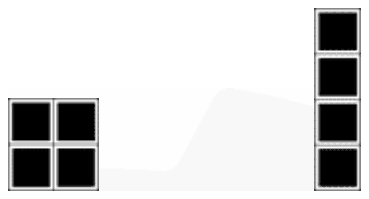
The figure shows two 4-tile patterns.

Two 4-tile patterns: a 2 by 2 square of tiles, and a straight line of 4 tiles

Either one or both of the patterns can be used any number of times and in any orientation to construct a new pattern. Which one of the options below cannot be constructed by using only these two 4-tile patterns assuming there are no overlaps among them?

Exam Year(s)

GATE CS - 2026,

Answer: C

The pattern that cannot be built is (C), the 3 by 5 rectangle.

Both building blocks contain exactly 4 tiles, and pieces may not overlap, so any pattern made only from them must contain a multiple of 4 tiles. Count the tiles in each option:

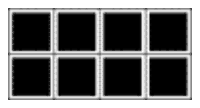
  • (A) 2 × 4 = 8 tiles: two 2 × 2 squares side by side, or two lines of 4 stacked.
  • (B) 3 × 4 = 12 tiles: three horizontal lines of 4.
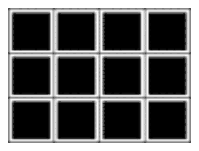
  • (C) 3 × 5 = 15 tiles: not a multiple of 4.
  • (D) 4 × 5 = 20 tiles: five vertical lines of 4.

Since 15 is not divisible by 4, no combination of the two patterns can cover the 3 by 5 rectangle exactly, while each of the others is built as shown.

Please log in or register to report this question.
14.

A cube is to be cut into 8 pieces of equal size and shape. Here, each cut should be straight and it should not stop till it reaches the other end of the cube.

The minimum number of such cuts required is

Exam Year(s)

GATE Life Sciences - 2024, GATE CS - 2024, GATE XE - 2024,

Answer: A

The minimum is 3 cuts.

Make one straight cut through the middle parallel to each pair of opposite faces: the first halves the cube, the second (at right angles) gives four quarters, and the third (perpendicular to both) gives eight equal smaller cubes.

Fewer cuts cannot work, because each full cut through the solid at most doubles the number of pieces, so two cuts give at most 4 pieces. Four, seven or eight cuts would produce more pieces than 8 or are more cuts than necessary.

Please log in or register to report this question.
15.

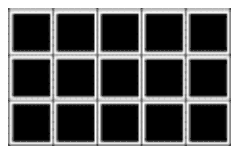
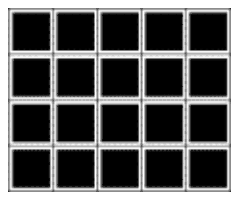
In the 4 × 4 array shown below, each cell of the first three rows has either a cross (X) or a number.

1X43
X554
3X6X
    

The number in a cell represents the count of the immediate neighboring cells (left, right, top, bottom, diagonals) NOT having a cross (X). Given that the last row has no crosses (X), the sum of the four numbers to be filled in the last row is

Exam Year(s)

GATE CS - 2024, GATE XE - 2024,

Answer: A

The four numbers in the last row add up to 11.

The last row has no crosses, so each of its cells counts its non-cross neighbours in the third row (3, X, 6, X) and beside it in the fourth row.

  1. First cell: 3 above, X diagonally, its right neighbour: 2.
  2. Second cell: 3 and 6 diagonally, X above, its two row neighbours: 4.
  3. Third cell: 6 above, two X's diagonally, its two row neighbours: 3.
  4. Fourth cell: 6 diagonally, X above, its left neighbour: 2.

So the sum is \(2 + 4 + 3 + 2 = 11\). Answers of 9, 10 or 12 come from counting a cross as a free cell or missing a diagonal neighbour.

Please log in or register to report this question.
16.

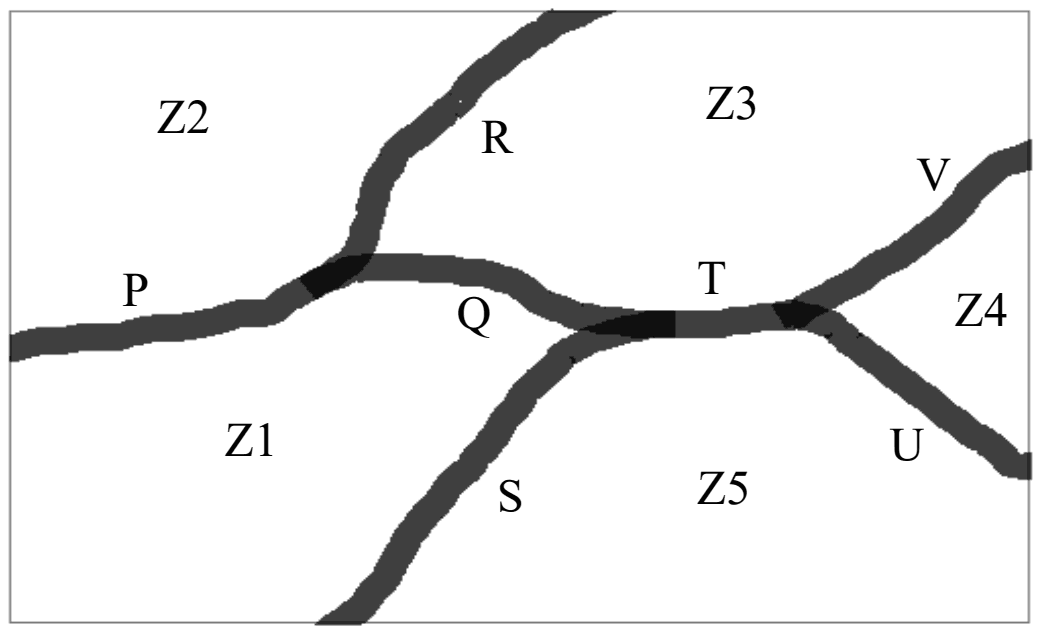
The diagram below shows a river system consisting of 7 segments, marked P, Q, R, S, T, U, and V. It splits the land into 5 zones, marked Z1, Z2, Z3, Z4, and Z5. We need to connect these zones using the least number of bridges. Out of the following options, which one is correct?

Note: The figure shown is representative.

River map: segment P separates Z2 from Z1, R separates Z2 from Z3, Q separates Z3 from Z1, S separates Z1 from Z5, T separates Z3 from Z5, V separates Z3 from Z4 and U separates Z4 from Z5

Exam Year(s)

GATE CS - 2025,

Answer: C

The correct choice is bridges on Q, R, T, and V.

Each river segment separates two zones, so a bridge on it joins those two zones:

  • P: Z1-Z2; R: Z2-Z3; Q: Z1-Z3; S: Z1-Z5;
  • T: Z3-Z5; V: Z3-Z4; U: Z4-Z5.

Connecting 5 zones needs at least 4 bridges, the edges of a spanning tree. Q, R, T and V join Z1, Z2, Z5 and Z4 each directly to Z3, so all five zones are connected with 4 bridges.

Three bridges (P, Q, T) cannot connect five zones. P, Q, S and T connect Z1, Z2, Z3 and Z5 but leave Z4 cut off, because neither U nor V is bridged. P, Q, S, U and V connects everything but uses 5 bridges, one more than needed.

Please log in or register to report this question.
17.

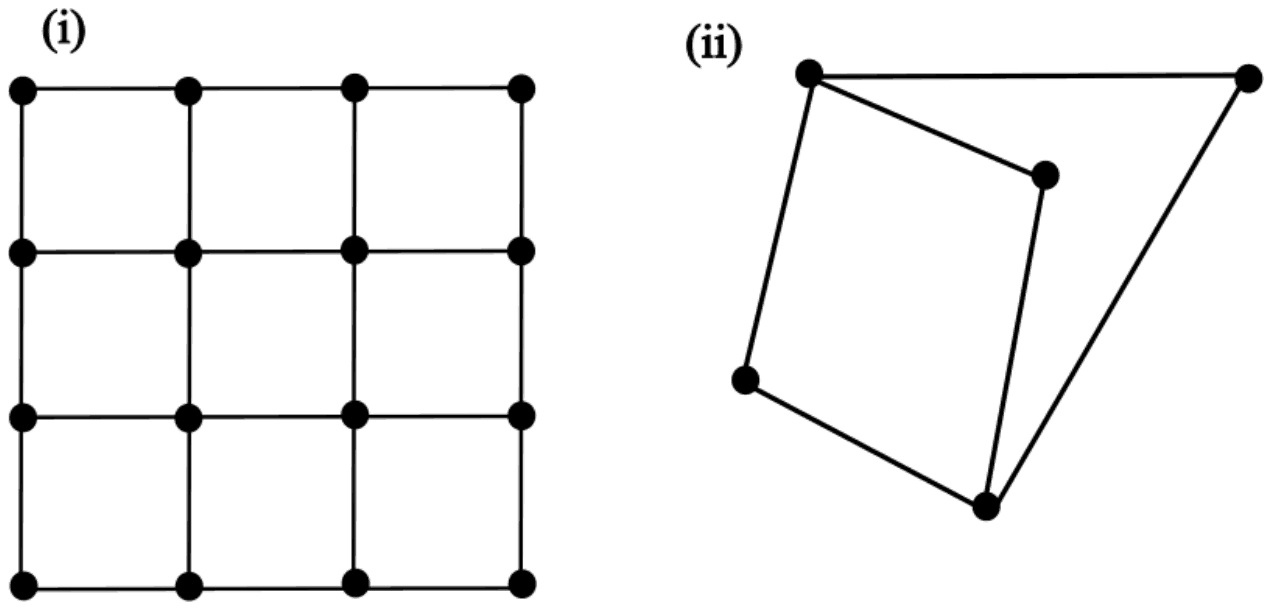
Figures (i) and (ii) represent intercity highway systems. The black dots represent cities and the line segments between them represent intercity highways.
A salesperson needs to make a trip. She needs to start from a city, visit each of the remaining cities exactly once, and finally return to the same city from which she started.

Which one of the following options is then true?

Figure (i): 16 cities in a 4 by 4 square grid, each joined to its horizontal and vertical neighbours. Figure (ii): 5 cities; the top-left city is joined to three others, the bottom city to three others, and the remaining three cities have two highways each

Exam Year(s)

GATE CS - 2026,

Answer: A

Such a trip is possible for (i), but not for (ii).

The trip is a Hamiltonian cycle: a closed route through every city exactly once.

In (i), a 4 by 4 grid of 16 cities, such a cycle exists. Number rows 1 to 4 from the top and columns 1 to 4 from the left. One route: along row 1 from column 1 to column 4; down to row 2 and left to column 2; down to row 3 and right to column 4; down to row 4 and left to column 1; then up column 1 through rows 3 and 2 back to the start. It passes through all 16 cities once.

In (ii) there are five cities. Three of them have only two highways each, and a cycle through a city of degree two must use both of its highways. Those forced highways already include three edges at the top-left city (to the top-right city, the middle city and the left city). A cycle can use only two edges at any city, so no Hamiltonian cycle exists. That rules out the options claiming a trip for (ii) and the one denying it for (i).

Please log in or register to report this question.
18.

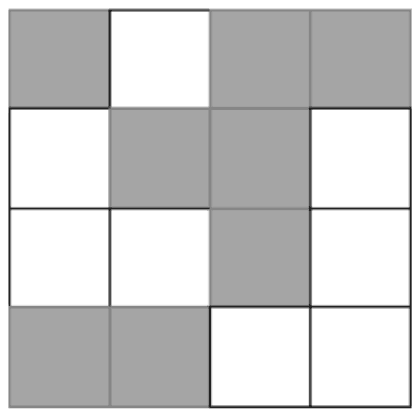
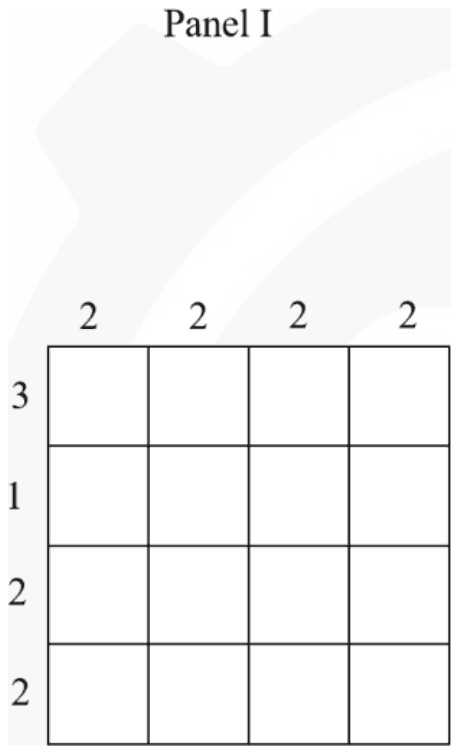
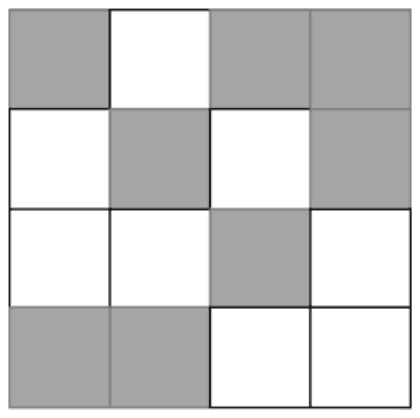
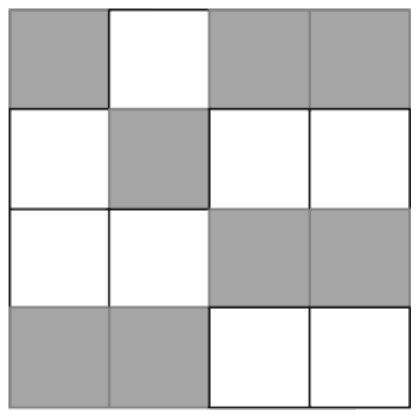
The figure in Panel I below is a grid of cells with four rows and four columns. The numbers on the top and on the left represent the number of cells that are to be shaded in that column and row, respectively. Which one of the options shown in Panel II below represents the grid shaded correctly?

An empty 4 by 4 grid with column totals 2, 2, 2, 2 on top and row totals 3, 1, 2, 2 on the left

Exam Year(s)

GATE CS - 2026,

Answer: B

The correct grid is (ii).

The rows must contain 3, 1, 2 and 2 shaded cells from top to bottom, and every column exactly 2. Reading grid (ii) row by row (1 = shaded): 1011, 0100, 0011, 1100. The row counts are 3, 1, 2, 2 and the column counts are 2, 2, 2, 2, as required.

The others fail somewhere:

  • (i): 1011, 0101, 0010, 1100. The second row has 2 shaded cells and the third only 1.
  • (iii): 1011, 0110, 0010, 1100. The second row has 2, and the third column has 3.
  • (iv): 1011, 0100, 0010, 1101. The third row has 1 and the bottom row 3.

Please log in or register to report this question.
19.

A palindrome is a word that reads the same forwards and backwards. In a game of words, a player has the following two plates painted with letters.

Two square plates, one painted with the letter A and one with the letter D

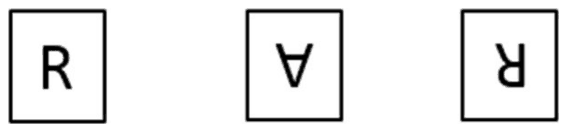
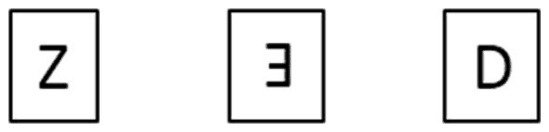
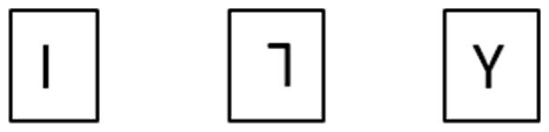
From the additional plates given in the options, which one of the combinations of additional plates would allow the player to construct a five-letter palindrome. The player should use all the five plates exactly once. The plates can be rotated in their plane.

Exam Year(s)

GATE CS - 2022,

Answer: B

The plates in option (B), R, A and R, complete the palindrome RADAR.

With the given A and D, option (B) supplies an R, an upside-down A and an upside-down R. Since plates may be rotated in their plane, turning the last two through 180 degrees gives a normal A and R, and the five letters R, A, D, A, R read the same both ways.

A five-letter palindrome needs two matching pairs and one middle letter. Option (A) gives A, D, D, D, J, with both A and J unpaired. Option (C) gives A, D, Z, E, D, leaving A, Z and E unpaired. Option (D) gives A, D, I, L, Y, five different letters. None of these can be arranged into a palindrome.

Please log in or register to report this question.
20.

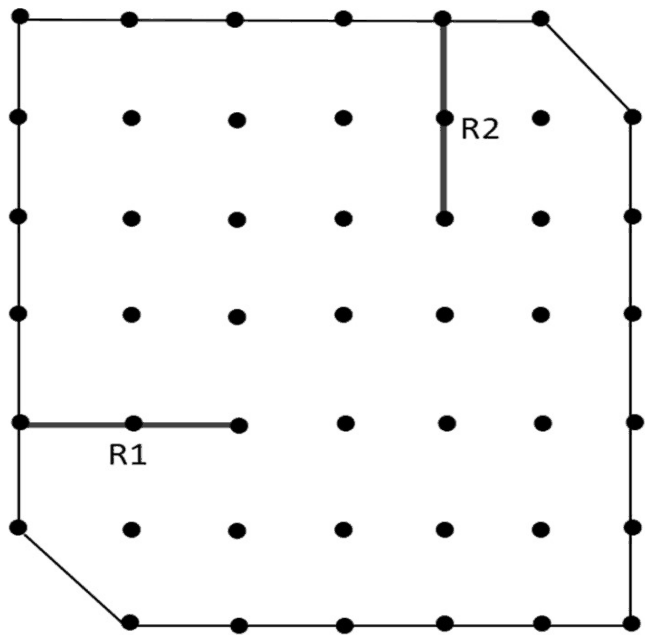
A plot of land must be divided between four families. They want their individual plots to be similar in shape, not necessarily equal in area. The land has equally spaced poles, marked as dots in the below figure. Two ropes, R1 and R2, are already present and cannot be moved.

What is the least number of additional straight ropes needed to create the desired plots? A single rope can pass through three poles that are aligned in a straight line.

A 7 by 7 grid of poles fenced as a square with the top-right and bottom-left corners cut off diagonally; rope R1 runs in from the left side and rope R2 hangs down from the top side

Exam Year(s)

GATE CS - 2022,

Answer: D

The least number of additional ropes is 3.

Number the poles from (0, 0) at the bottom left to (6, 6) at the top right. The land is a 6 by 6 square with two opposite corners cut off; R1 runs from (0, 2) to (2, 2) and R2 from (4, 6) down to (4, 4). Three ropes complete four similar plots:

  1. from (2, 2) down to (2, 0), through three poles;
  2. from (4, 4) right to (6, 4), through three poles;
  3. the diagonal from (2, 2) to (4, 4), through (3, 3).

Each plot is then a square with one corner cut off along a line joining the mid-points of the two sides at that corner: two small ones of side 2 at the bottom left and top right, and two large ones of side 4 at the top left and bottom right. All four have the same shape at two scales, so they are similar, and the areas add up to the 35 square units of the land. Both fixed ropes end up as sides of plots, so nothing is wasted, and 3 is the official least number; the options 4 and 5 use more ropes than this construction needs.

Please log in or register to report this question.
Loading…
Tags: Miscellaneous Logical Puzzles Questions and Answers || Miscellaneous Logical Puzzles MCQ Questions and Answers || Miscellaneous Logical Puzzles GK Questions and Answers || Miscellaneous Logical Puzzles GK MCQ Questions || Miscellaneous Logical Puzzles Multiple Choice Questions and Answers || Miscellaneous Logical Puzzles GK || GK on Miscellaneous Logical Puzzles || Reasoning Questions and Answers || Reasoning MCQ Questions and Answers || Reasoning GK Questions and Answers || GK on Reasoning