
Machine-translated by Google. Questions are authored in English.
Top

Mesh and Nodal Analysis Questions and Answers

Direction for [ Question No: 1 To 1 ] :


Assertion – Reason type questions :
The following items consist of two statements, one labelled the ‘Assertion (A)’ and the other labelled the ‘Reason (R)’. You are to examine these two statements and decide if the Assertion (A) and the Reason (R) are individually true and if so, whether the Reason is a correct explanation of the Assertion. Select your answers to these items using the codes given below and mark your answer sheet accordingly.

Codes :
(A) Both (A) and (R) are true and (R) is the correct explanation of (A).
(B) Both (A) and (R) are true but (R) is not the correct explanation of (A).
(C) (A) is true and (R) is false.
(D) (A) is false and (R) is true.

1.

Assertion (A) : Number of mesh current equations in a network depend upon the number of branches B and nodes N in a network.

Reason (R) : Number of mesh current equations are B + N – 1.

Exam Year(s)

UGC NET - 2012,

Answer: C

The assertion is true, and the reason is false. The number of independent mesh current equations of a network depends on the number of branches B and nodes N, and it is given by B minus N plus 1, which is the number of independent loops. The reason gives the number as B plus N minus 1, which is wrong. The expression N minus 1 is the number of independent node equations, so the reason confuses the two counts. The answer is that (A) is true and (R) is false.

Please log in or register to report this question.
2.

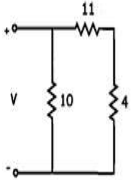
For the given circuit, if all the resistance values are in ohms and the source voltage V = 30 V, then find the source current.

Circuit: source V across a 10 ohm resistor; an 11 ohm resistor in the top lead in series with a 4 ohm resistor forms a second branch across the source

Exam Year(s)

DSSSB AE - 2023,

Answer: A

The 10 ohm resistor is directly across the 30 V source. The other branch is the 11 ohm resistor in series with the 4 ohm resistor, which is 15 ohms, also directly across the source.


\[ \begin{aligned} I_{10} = \frac{30}{10} \\ &= 3\ \text{A},\qquad I_{15} = \frac{30}{15} \\ &= 2\ \text{A} \end{aligned} \]


\[ I_{source} = 3 + 2 = 5\ \text{A} \]


Equivalently the parallel combination of 10 and 15 ohms is 6 ohms and 30/6 = 5 A. The values 6 A, 10 A and 12 A come from ignoring the series resistor or adding the wrong branches. The answer is 5 A, option A.

Please log in or register to report this question.

3.

Nodal Analysis is based on

Exam Year(s)

RSMSSB JE - 2025, RSMSSB - 2025,

Answer: A

Nodal analysis is based on Kirchhoff's current law.

In nodal analysis one node is chosen as reference and the voltages of the other nodes are the unknowns. At each node, the currents in the connected branches, written in terms of the node voltages using Ohm's law, are made to sum to zero, which is KCL. The resulting equations are solved for the node voltages.

Mesh (loop) analysis is the method built on Kirchhoff's voltage law. Ohm's law is used within both methods but is not their basis, and Maxwell's name is attached to loop currents, not to nodal analysis.

Please log in or register to report this question.

4.

For the following circuit, find the voltage needed across a - b terminal so that drop across the 10 Ω resistor is 20 V :

A lattice network. Terminal a is joined to terminal c through 30 ohm and to terminal d through 5 ohm. Terminal c is joined to terminal b through 10 ohm, and terminal b is joined directly to terminal d

Exam Year(s)

MH SET - 2023, SET Exam - 2023,

Answer: D

The voltage needed is 80 V.

With c-d open, the 30 Ω and 10 Ω resistors form one path from a to b (a to c through 30 Ω, then c to b through 10 Ω), and the 5 Ω resistor forms a second path from a to d, which is joined directly to b. The two paths are in parallel across a-b.

For 20 V across the 10 Ω resistor, the current in the 30 Ω and 10 Ω path is

\[ \begin{aligned} I &= \frac{20}{10} = 2\ \text{A} \\ V_{ab} &= 2 \times (30 + 10) = 80\ \text{V} \end{aligned} \]

The 5 Ω path draws its own current but does not change the voltage across the other path. 20 V is the drop across the 10 Ω resistor alone, and 60 V is the drop across the 30 Ω resistor alone.

Please log in or register to report this question.

5.

If the branch in any network has a current source then the analysis is carried out by _______ analysis method.

Exam Year(s)

UGC NET - 2012,

Answer: C

When a branch of a network carries a current source and that source is common to two meshes, the mesh current equation cannot be written for either mesh with the usual voltage drop across the source, because the voltage across an ideal current source is unknown. The two meshes are combined into a supermesh, which goes around the outer path and leaves out the source branch, and the current source supplies the extra equation relating the two mesh currents. The key accordingly gives supermesh analysis. Plain mesh analysis assumes voltage sources or sources that can be handled directly, node analysis and supernode analysis are the dual methods used where a voltage source appears between nodes. The answer is supermesh.

Please log in or register to report this question.

6.

The current \(i_{1}\) in the following network is given by

Circuit with a 1 mA current source pointing down on the left, a 47 kilo-ohm resistor, a dependent voltage source of 4 i1 (minus on the left, plus on the right) in series with a 3.3 kilo-ohm resistor carrying i1 to the right, a 10 kilo-ohm resistor, and a 20 mA current source pointing up on the right

Exam Year(s)

UGC NET - 2013,

Answer: B

The current is \(i_{1} = -4.096\) mA. Take the bottom wire as ground, with kilo-ohms and milliamps giving volts. The dependent source is 4 ohm times \(i_{1}\), so it contributes only about \(0.004\,i_{1}\) volts, negligible beside the kilo-ohm drops. Node equations for the left node \(V_{A}\) and the right node \(V_{B}\):

\[ V_{A} = -47(1 + i_{1}) \]

\[ V_{B} = 10(i_{1} + 20) \]

\[ V_{B} = V_{A} - 3.3\,i_{1} \]

Substituting gives \(10 i_{1} + 200 = -47 - 47 i_{1} - 3.3 i_{1}\), so \(60.3\, i_{1} = -247\) and \(i_{1} \approx -4.096\) mA. The positive values in (C) and (D) have the wrong sign, and \(-40.96\) mA is ten times too large.

Please log in or register to report this question.

Loading…
Tags: Mesh and Nodal Analysis Questions and Answers || Mesh and Nodal Analysis MCQ Questions and Answers || Mesh and Nodal Analysis GK Questions and Answers || Mesh and Nodal Analysis GK MCQ Questions || Mesh and Nodal Analysis Multiple Choice Questions and Answers || Mesh and Nodal Analysis GK || GK on Mesh and Nodal Analysis || Network Analysis Questions and Answers || Network Analysis MCQ Questions and Answers || Network Analysis GK Questions and Answers || GK on Network Analysis