
Machine-translated by Google. Questions are authored in English.
Top

Kinematics of Particles Questions and Answers

Answer: D

An object moving with negative acceleration has a velocity-time graph sloping downwards to the right, because acceleration is the slope of the velocity-time graph. A displacement-time graph that is a straight line represents a constant velocity, a displacement-time graph curving upwards shows an increasing velocity, and a velocity-time graph sloping upwards shows a positive acceleration.

Negative acceleration, or retardation, means that velocity falls with time, so the line has a negative slope on a velocity-time graph.

Please log in or register to report this question.
2.

A particle of unit mass is moving on a plane. Its trajectory, in polar coordinates, is given by \(r(t) = t^{2}, \theta(t) = t\), where \(t\) is time. The kinetic energy of the particle at time \(t = 2\) is

Exam Year(s)

GATE ME - 2017,

Answer: C

The kinetic energy is 16.

In polar coordinates the velocity has a radial part \(\dot{r}\) and a transverse part \(r\dot{\theta}\). At t = 2:

\[ \begin{aligned} \dot{r} &= 2t = 4, \quad r\dot{\theta} = t^{2} \times 1 = 4 \\ KE &= \tfrac{1}{2}(4^{2} + 4^{2}) = 16 \end{aligned} \]

Using only the radial velocity gives 8, and forgetting the factor 1/2 gives 32; neither is offered. 4 and 12 do not follow from these velocity components, and 24 would need one of them to be larger than it is.

Please log in or register to report this question.

3.

A point mass is shot vertically up from ground level with a velocity of 4 m/s at time, \(t = 0\). It loses 20% of its impact velocity after each collision with the ground. Assuming that the acceleration due to gravity is 10 m/s2 and that air resistance is negligible, the mass stops bouncing and comes to complete rest on the ground after a total time (in seconds) of

Exam Year(s)

GATE ME - 2018,

Answer: C

The mass comes to rest after 4 s.

A body launched up at speed v returns to the ground after \(2v/g\). The first flight lasts \(2 \times 4/10 = 0.8\) s. Each bounce leaves with 80% of the impact speed, so each flight lasts 0.8 times the one before, and the times form a geometric series:

\[ \begin{aligned} T &= 0.8(1 + 0.8 + 0.8^{2} + \cdots) \\ &= \frac{0.8}{1 - 0.8} = 4\ \text{s} \end{aligned} \]

The number of bounces is infinite, but their durations shrink geometrically, so the total time is finite; that is the trap in the infinity option. 1 s and 2 s stop the series too early (2 s is roughly the first three flights).

Please log in or register to report this question.

4.

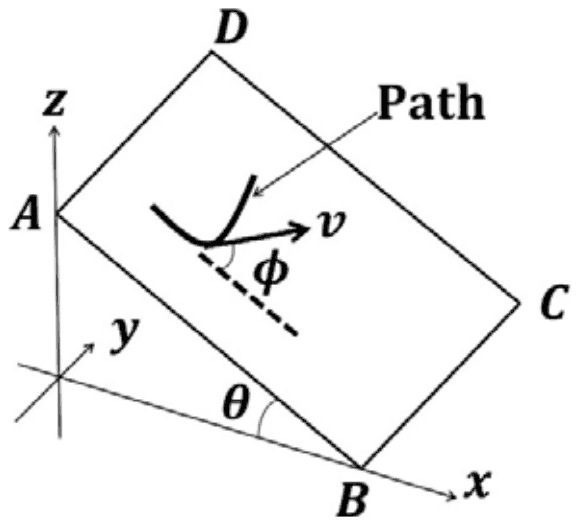
A particle is constrained to move at a constant speed on an inclined plane (ABCD) along the curved path shown in the figure. Edges AD and BC are parallel to the \(y\) axis. The inclined plane makes an angle \(\theta\) with the \(xy\)-plane. The velocity vector of the particle makes an angle \(\phi\) with the dotted line which is parallel to edge \(AB\). If the speed of the particle is 2 m/s, \(\phi = 30^{\circ}\), and \(\theta = 40^{\circ}\), then the \(z\)-component of the velocity of the particle in m/s is __________

An inclined rectangular plane ABCD with edge B on the x-axis and edge AB rising at angle theta; a curved path on the plane with velocity v at angle phi to a dotted line parallel to AB

Exam Year(s)

GATE XE - 2022,

Answer: C

The z-component is \(-1.11\) m/s.

The velocity lies in the plane. Split it along the dotted line parallel to AB, which is the line of steepest slope at angle \(\theta\) to the xy-plane, and along the y direction, which is horizontal. Only the AB component has a vertical part, and the particle moves down the slope:

\[ \begin{aligned} v_{z} &= -v\cos\phi\sin\theta \\ &= -2 \times \cos 30^{\circ} \times \sin 40^{\circ} \\ &= -2 \times 0.866 \times 0.643 = -1.11 \end{aligned} \]

\(-1.32\) uses \(\cos 40^{\circ}\) in place of \(\sin 40^{\circ}\), \(-1.00\) is \(-v\sin\phi\), which ignores the slope altogether, and \(-1.50\) does not follow from these angles.

Please log in or register to report this question.

5.

Two cars P and Q are travelling on a straight path and are 60 m apart as shown in the figure; Car P is moving with a constant velocity of 36 kmph, while car Q is moving at a constant velocity of 18 kmph. At this instant, the driver in car P applies the brake and collision occurs with car Q after 30 seconds.

[The figure shows car P behind car Q, both moving to the right, P at 36 kmph and Q at 18 kmph, with a 60 m gap between them.]

Assuming uniform deceleration due to braking, which one of the following is the CORRECT velocity (in m/s) of the car P just before the collision?

Exam Year(s)

GATE XE - 2025,

Answer: D

Car P hits car Q at 4 m/s.

Convert the speeds: 36 kmph = 10 m/s and 18 kmph = 5 m/s. In 30 s car Q moves 5 × 30 = 150 m, so car P must cover the 60 m gap plus 150 m, that is 210 m, in the same 30 s with uniform deceleration a:

\[ \begin{aligned} 210 &= 10(30) - \tfrac{1}{2}a(30)^{2} \\ 450a &= 90 \Rightarrow a = 0.2\ \text{m/s}^{2} \\ v &= 10 - 0.2 \times 30 = 4\ \text{m/s} \end{aligned} \]

Check: the average speed of P is (10 + 4)/2 = 7 m/s, and 7 × 30 = 210 m, as required.

5 m/s is car Q's speed, which P would have only if it just touched Q without closing on it. 16 m/s is faster than P's starting speed, impossible under braking, and 1 m/s does not satisfy the distance condition.

Please log in or register to report this question.

Loading…
Tags: Kinematics of Particles Questions and Answers || Kinematics of Particles MCQ Questions and Answers || Kinematics of Particles GK Questions and Answers || Kinematics of Particles GK MCQ Questions || Kinematics of Particles Multiple Choice Questions and Answers || Kinematics of Particles GK || GK on Kinematics of Particles || Engineering Mechanics Questions and Answers || Engineering Mechanics MCQ Questions and Answers || Engineering Mechanics GK Questions and Answers || GK on Engineering Mechanics