
Machine-translated by Google. Questions are authored in English.
Top

Plane Motion of Rigid Bodies Questions and Answers

1.

Consider a flywheel of mass 10 kg, uniform thickness 15 mm, and radius 100 mm. If it rotates at 300 RPM, then the KE of the flywheel (in Joules) is:

Exam Year(s)

DSSSB JE - 2023,

Answer: A

The flywheel is a uniform solid disc, so its moment of inertia about its axis is \(I = \tfrac{1}{2}mr^2 = \tfrac{1}{2}(10)(0.1)^2 = 0.05\ \text{kg m}^2\). The speed is 300 rpm, so \(\omega = 2\pi \times 300/60 = 31.42\) rad/s. The rotational kinetic energy is

\[ \begin{aligned} KE = \tfrac{1}{2}I\omega^2 \\ &= \tfrac{1}{2}(0.05)(31.42)^2 \approx 24.7\ \text{J} \end{aligned} \]

The nearest option is 24.65 J. The thickness of 15 mm is not needed since the mass is given. The larger options would come from using the wrong moment of inertia, such as that of a ring (\(mr^2\)), which would double the answer.

Please log in or register to report this question.
2.

Two disks A and B with identical mass (m) and radius (R) are initially at rest. They roll down from the top of identical inclined planes without slipping. Disk A has all of its mass concentrated at the rim, while Disk B has its mass uniformly distributed. At the bottom of the plane, the ratio of velocity of the center of disk A to the velocity of the center of disk B is

Exam Year(s)

GATE ME - 2017,

Answer: A

The ratio is \(\sqrt{3/4}\).

Rolling without slipping, energy conservation gives \(mgh = \tfrac{1}{2}mv^{2}(1 + I/mR^{2})\).

\[ \begin{aligned} \text{A (ring, } I = mR^{2}) &: v_{A}^{2} = gh \\ \text{B (disk, } I = \tfrac{1}{2}mR^{2}) &: v_{B}^{2} = \tfrac{4}{3}gh \\ \frac{v_{A}}{v_{B}} &= \sqrt{\tfrac{3}{4}} \end{aligned} \]

Disk A, with its mass at the rim, stores more of its energy as rotation and so arrives slower. \(\sqrt{3/2}\) and \(\sqrt{2}\) put A ahead, and 1 would hold only if both had the same moment of inertia.

Please log in or register to report this question.
3.

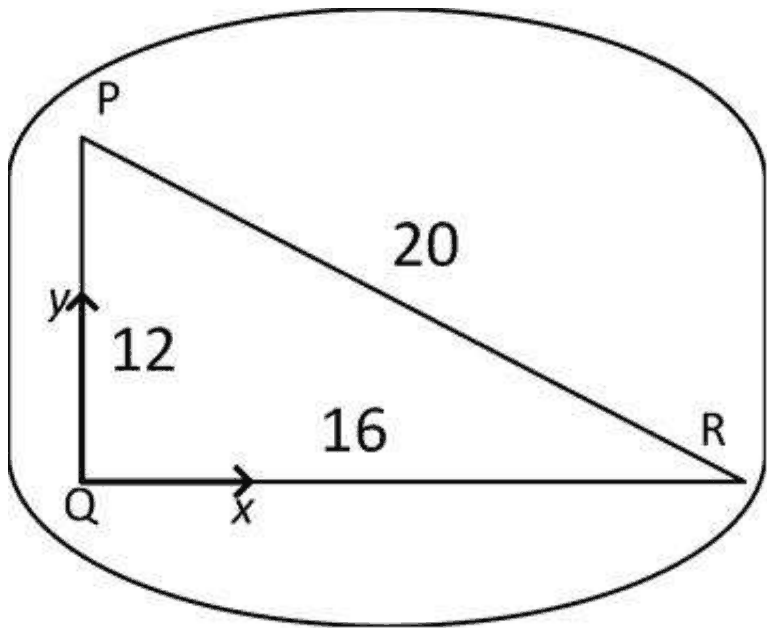
In a rigid body in plane motion, the point R is accelerating with respect to point P at 10∠180° m/s2. If the instantaneous acceleration of point Q is zero, the acceleration (in m/s2) of point R is

Rigid body outline containing a right triangle PQR with the right angle at Q; Q is the origin with x to the right and y upward, P is 12 above Q, R is 16 to the right of Q and PR = 20

Exam Year(s)

GATE ME - 2018,

Answer: D

The acceleration of R is 8∠217° m/s2.

In plane rigid-body motion, the acceleration of one point relative to another is \(\vec{a}_{B/A} = \vec{\alpha}\times\vec{r}_{AB} - \omega^{2}\vec{r}_{AB}\). Its magnitude is \(|r_{AB}|\sqrt{\alpha^{2}+\omega^{4}}\), and it makes the same fixed angle with \(\vec{r}_{AB}\) for every pair of points.

From P to R the distance is 20 and the direction is that of (16, -12), at -36.87° (323.13°). The given relative acceleration is 10 at 180°, so

\[ \begin{aligned} \sqrt{\alpha^{2}+\omega^{4}} &= 10/20 = 0.5 \\ \text{angle offset} &= 180^\circ - 323.13^\circ = -143.13^\circ \end{aligned} \]

Since Q has zero acceleration, \(\vec{a}_{R} = \vec{a}_{R/Q}\). From Q to R the distance is 16 at 0°, so \(|a_{R}| = 16 \times 0.5 = 8\) at 0° - 143.13° = 216.87°, about 217°.

8∠233° has the right size but the wrong direction, and the options with magnitude 10 simply copy the given relative acceleration.

Please log in or register to report this question.
4.

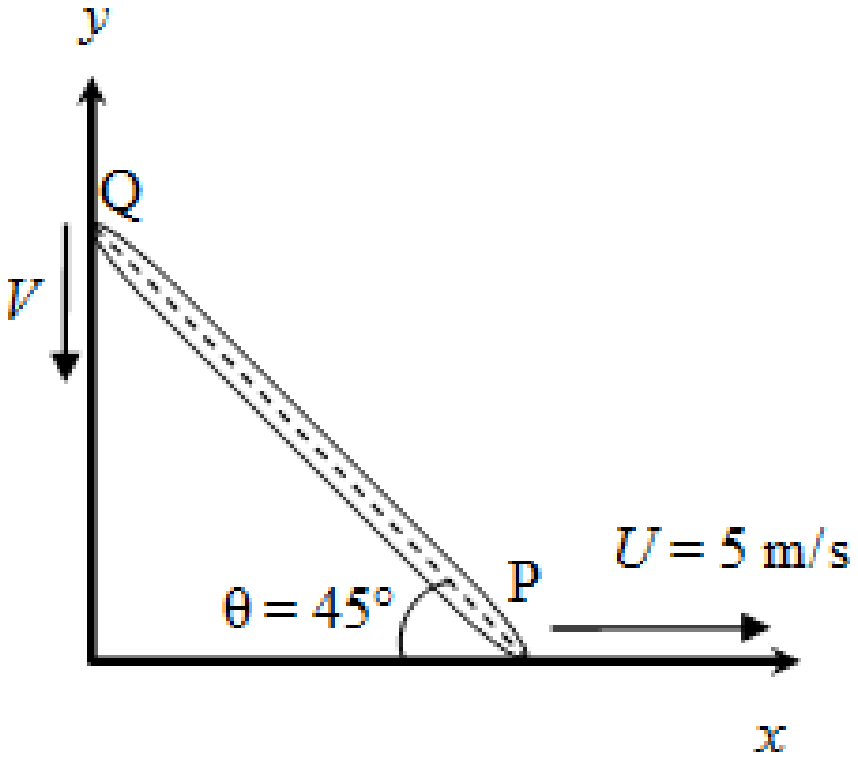
A rigid rod of length 1 m is resting at an angle θ = 45° as shown in the figure. The end P is dragged with a velocity of U = 5 m/s to the right. At the instant shown, the magnitude of the velocity V (in m/s) of point Q as it moves along the wall without losing contact is

Rod PQ with end Q on a vertical wall (y axis) moving down with velocity V and end P on the floor (x axis) moving right with U = 5 m/s; the rod makes theta = 45 degrees with the floor at P

Exam Year(s)

GATE ME - 2018,

Answer: A

The speed of Q is 5 m/s.

Put the corner at the origin, with P at (x, 0) on the floor and Q at (0, y) on the wall. The rod's length fixes \(x^{2} + y^{2} = 1\). Differentiating with respect to time:

\[ \begin{aligned} x\dot{x} + y\dot{y} &= 0 \\ |\dot{y}| &= \frac{x}{y}\,\dot{x} = \cot\theta \times U \end{aligned} \]

At θ = 45°, x = y, so cot θ = 1 and V = U = 5 m/s, directed down the wall.

The same result follows from the instantaneous centre, which lies at the intersection of the normals to the two velocities, equidistant from P and Q when θ = 45°. The rod's length does not affect the speed ratio, and 6, 8 and 10 have no basis in this geometry.

Please log in or register to report this question.
5.

A solid disc of radius r rolls without slipping on a horizontal floor with angular velocity ω and angular acceleration α. The magnitude of the acceleration of the point of contact on the disc is

Exam Year(s)

GATE ME - 2012,

Answer: D

The acceleration of the contact point is \(r\omega^{2}\), directed towards the centre of the disc.

The centre moves horizontally with acceleration \(r\alpha\). Relative to the centre, the contact point has a tangential acceleration \(r\alpha\) and a centripetal acceleration \(r\omega^{2}\). At the bottom of the disc the tangential part points opposite to the centre's acceleration, so the two \(r\alpha\) terms cancel, leaving only the centripetal term, which points straight up.

'Zero' is the velocity of the contact point in rolling without slipping, not its acceleration. \(r\alpha\) is the centre's acceleration, and the square-root expression adds the components that in fact cancel.

Please log in or register to report this question.
6.

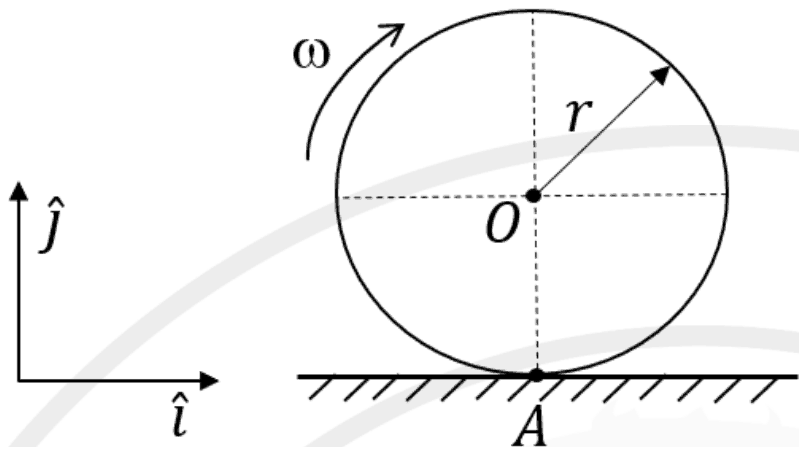
A rigid circular disc of radius \(r\) (in m) is rolling without slipping on a flat surface as shown in the figure below. The angular velocity of the disc is \(\omega\) (in rad \(\text{s}^{-1}\)). The velocities (in m \(\text{s}^{-1}\)) at points \(O\) and \(A\), respectively, are

A disc of radius r with centre O touching the ground at A, rotating clockwise with angular velocity omega; unit vector i points right and j up

Exam Year(s)

GATE ME - 2025,

Answer: A

The velocities are \(r\omega\,\hat{i}\) at O and \(0\,\hat{i}\) at A.

In rolling without slipping, the contact point A has zero velocity, because it does not slide on the ground. The disc turns clockwise, as the arrow shows, so it rolls to the right, in the \(+\hat{i}\) direction.

The centre is a distance \(r\) above the instantaneous centre A, so its speed is \(r\omega\), directed along \(+\hat{i}\). \(-r\omega\,\hat{i}\) would be anticlockwise rolling. The options giving A a velocity of \(\pm r\omega\) contradict the no-slip condition.

Please log in or register to report this question.
7.

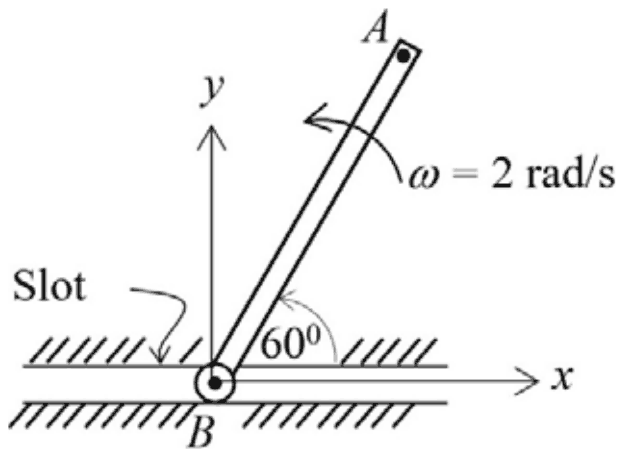
End \(B\) of the 2 m long rigid rod \(AB\) is constrained to move horizontally in the slot as shown in the figure and has a velocity of 1.0 i m/s. The angular velocity of the rod at the instant shown is 2 rad/s. The unit vectors along \(x\) and \(y\) directions are denoted respectively as i and j. The velocity of point \(A\) in m/s is then given by

Rod AB with end B in a horizontal slot along the x-axis, making 60 degrees with the x-axis, rotating anticlockwise at omega = 2 rad/s

Exam Year(s)

GATE XE - 2022,

Answer: A

The velocity of A is \((1 - 2\sqrt{3})\)i + 2j m/s.

The rod makes 60° with the x-axis and is 2 m long, so the position of A relative to B is

\[ \begin{aligned} \mathbf{r}_{A/B} &= 2\cos 60^{\circ}\,\mathbf{i} + 2\sin 60^{\circ}\,\mathbf{j} \\ &= \mathbf{i} + \sqrt{3}\mathbf{j} \end{aligned} \]

It turns anticlockwise, \(\boldsymbol{\omega} = 2\mathbf{k}\):

\[ \begin{aligned} \mathbf{v}_{A} &= \mathbf{v}_{B} + \boldsymbol{\omega} \times \mathbf{r}_{A/B} \\ &= \mathbf{i} + 2\mathbf{k} \times (\mathbf{i} + \sqrt{3}\mathbf{j}) \\ &= \mathbf{i} + 2\mathbf{j} - 2\sqrt{3}\mathbf{i} \end{aligned} \]

\(-2\sqrt{3}\)i + 2j leaves out the velocity of B, and the options with \(-2\)j take the rotation as clockwise.

Please log in or register to report this question.
8.

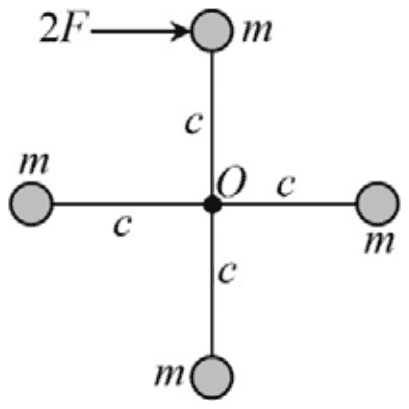
The assembly of four masses connected by rigid mass-less rods is kept on a smooth horizontal floor as shown in the figure. Under the applied force \(2F\), the magnitude of angular acceleration of the assembly at the instant shown is

Four masses m at distance c from a centre O, joined in a cross by rods; a horizontal force 2F acts on the top mass

Exam Year(s)

GATE XE - 2022,

Answer: B

The angular acceleration is \(\frac{F}{2mc}\).

On a smooth floor the assembly is free. Its centre of mass is at O, and the moment of inertia about O is that of four masses at distance c:

\[ \begin{aligned} I_{O} &= 4mc^{2} \\ \tau_{O} &= 2F \cdot c \\ \alpha &= \frac{2Fc}{4mc^{2}} = \frac{F}{2mc} \end{aligned} \]

The force also accelerates the centre of mass, at \(2F/4m\), but that does not change the rotation about the centre of mass. \(F/(mc)\) uses only two of the masses in the inertia, and \(2F/(3mc)\) and \(F/(3mc)\) do not match the inertia \(4mc^{2}\) of four equal masses.

Please log in or register to report this question.

9.

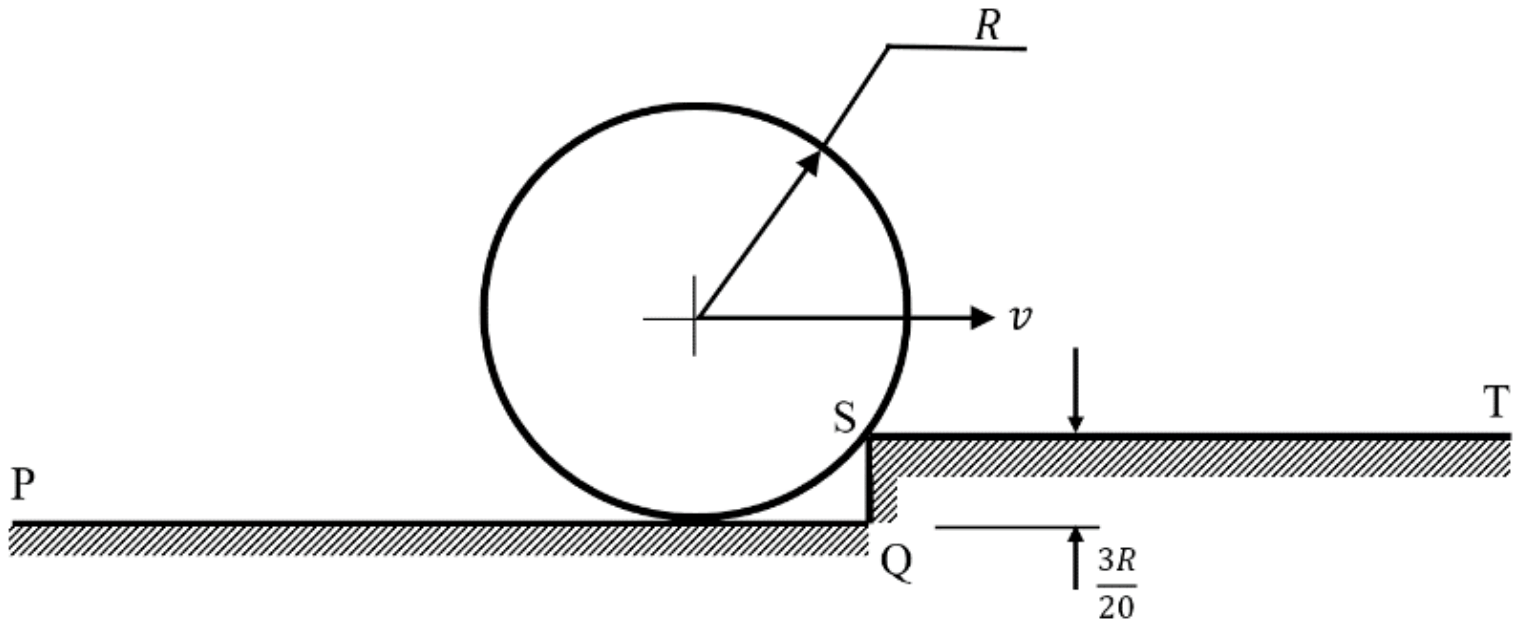
A solid uniform rigid disk of mass \(m\) and radius \(R\) rolls without slipping along a horizontal surface PQ. The speed of the center of the disk is \(v\). The disk then strikes a hurdle of height \(\frac{3R}{20}\) at point S. During the impact, there is no rebound or slip at S and no impulse from the surface PQ. The magnitude of the velocity of the center of the disk immediately after the impact is

A disk of radius R and centre speed v rolling to the right along PQ, which ends at Q in a vertical step of height 3R/20 up to a higher surface ST; the disk touches the top edge S of the step

Exam Year(s)

GATE XE - 2023,

Answer: D

The speed of the centre after impact is \(0.9v\).

The impulse at S passes through S, and there is no impulse from PQ, so angular momentum about S is conserved during the impact. Before impact the centre moves horizontally at \(v\), at height \(R - \frac{3R}{20} = \frac{17R}{20}\) above S, and the disk spins at \(\omega = v/R\):

\[ \begin{aligned} H_{S} &= mv\tfrac{17R}{20} + \tfrac{1}{2}mR^{2}\tfrac{v}{R} \\ &= \tfrac{27}{20}mvR \end{aligned} \]

After impact the disk pivots about S without slip or rebound, with moment of inertia about S of \(\frac{1}{2}mR^{2} + mR^{2} = \frac{3}{2}mR^{2}\):

\[ \begin{aligned} \tfrac{3}{2}mR^{2}\omega' &= \tfrac{27}{20}mvR \\ \omega' &= 0.9\tfrac{v}{R}, \quad v' = \omega' R = 0.9v \end{aligned} \]

Leaving out the spin term \(\frac{1}{2}mR^{2}\omega\) would give only about \(0.57v\); the disk's own rotation carries angular momentum into the impact, which is why the speed falls by only a tenth. 0.1v, 0.3v and 0.7v would all require angular momentum about S to be lost, which the stated conditions rule out.

Please log in or register to report this question.

10.

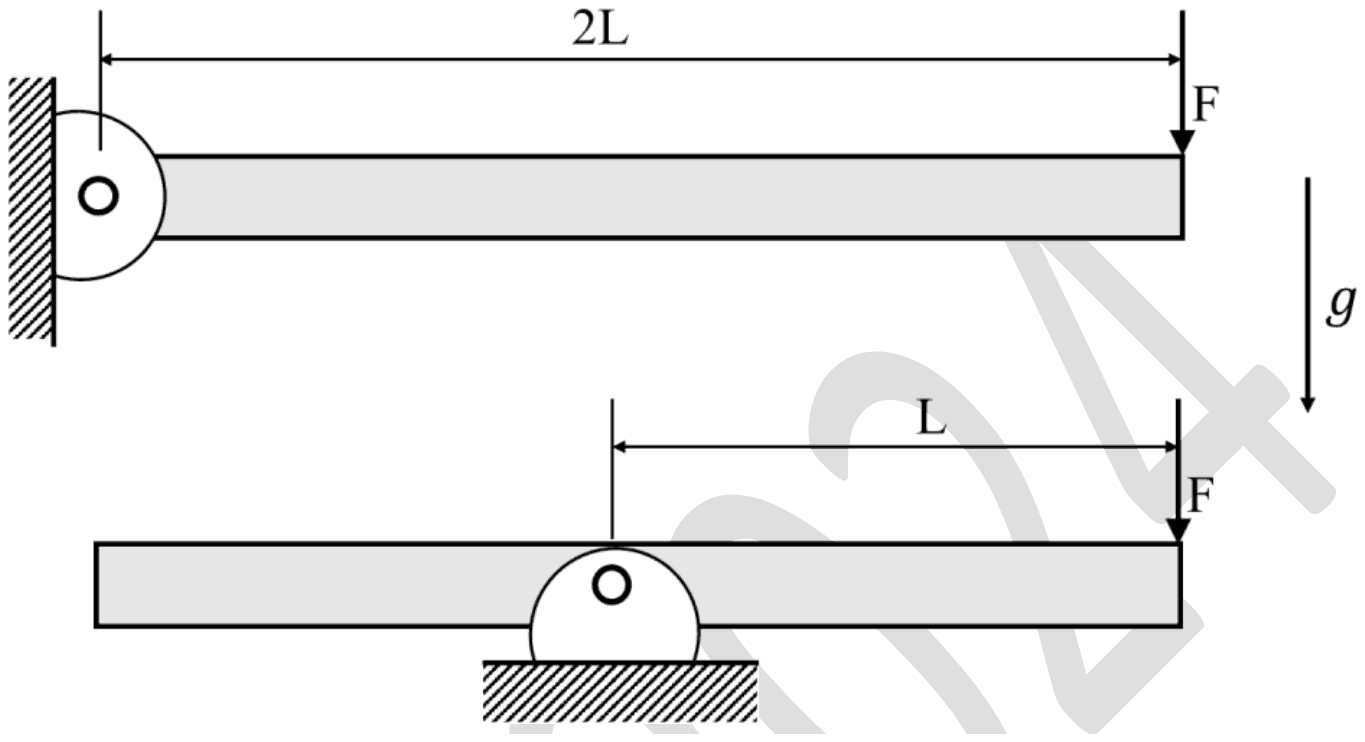
Two identical rigid slender bars of length 2L and mass \(m\) are acted upon by a transverse force F at one of the ends as shown in the figure. In the first case, the bar is pinned at the other end. In the second case, the bar is pinned at its mid-point. What should be the magnitude of the force F such that the resulting angular accelerations of the two bars are equal?

Two horizontal bars with gravity g acting downward: the first, of length 2L, pinned at its left end with a downward force F at its right end; the second pinned at its mid-point with a downward force F at its right end, a distance L away

Exam Year(s)

GATE XE - 2024,

Answer: B

The force must be \(\frac{mg}{2}\).

Both bars are horizontal with F acting downward at the free end, so gravity adds to F in the end-pinned case but has no moment about the centre pin in the second case.

\[ \begin{aligned} \alpha_1 &= \frac{2FL + mgL}{\tfrac{4}{3}mL^{2}} = \frac{3(2F + mg)}{4mL} \\ \alpha_2 &= \frac{FL}{\tfrac{1}{3}mL^{2}} = \frac{3F}{mL} \end{aligned} \]

using \(I = m(2L)^{2}/3\) about an end and \(I = m(2L)^{2}/12\) about the centre. Setting \(\alpha_1 = \alpha_2\) gives \(2F + mg = 4F\), so \(F = mg/2\).

Ignoring gravity would make the two accelerations unequal for any F, and mg, mg/4 and mg/6 do not satisfy the balance above.

Please log in or register to report this question.

Loading…
Tags: Plane Motion of Rigid Bodies Questions and Answers || Plane Motion of Rigid Bodies MCQ Questions and Answers || Plane Motion of Rigid Bodies GK Questions and Answers || Plane Motion of Rigid Bodies GK MCQ Questions || Plane Motion of Rigid Bodies Multiple Choice Questions and Answers || Plane Motion of Rigid Bodies GK || GK on Plane Motion of Rigid Bodies || Engineering Mechanics Questions and Answers || Engineering Mechanics MCQ Questions and Answers || Engineering Mechanics GK Questions and Answers || GK on Engineering Mechanics