
Machine-translated by Google. Questions are authored in English.
Top

Analysis of Trusses and Frames Questions and Answers

Direction for [ Question No: 1 To 2 ] :

Common Data for the next two questions:

Two steel truss members, AC and BC, each having cross sectional area of 100 mm2, are subjected to a horizontal force F as shown in figure. All the joints are hinged.

1.

If F = 1 kN, the magnitude of the vertical reaction force developed at the point B in kN is
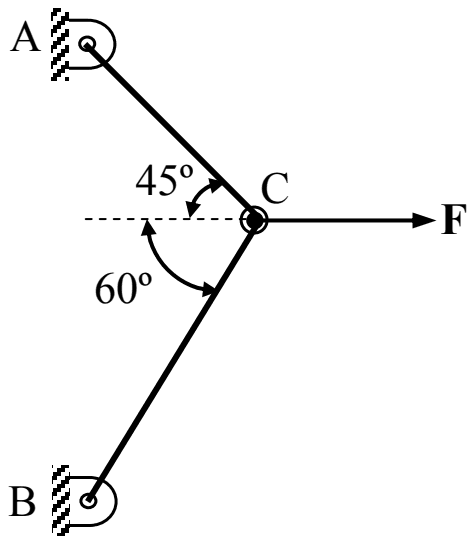
Members AC and BC meet at joint C, where a horizontal force F acts to the right. Both are hinged to a wall on the left: AC rises at 45 degrees to the horizontal and BC falls at 60 degrees

Exam Year(s)

GATE ME - 2012,

Answer: A

The vertical reaction at B is about 0.63 kN.

Resolve forces at joint C. Let the members carry forces FAC (at 45° above the horizontal) and FBC (at 60° below it), both acting from C towards the wall:

\[ \begin{aligned} F_{AC}\sin 45^{\circ} &= F_{BC}\sin 60^{\circ} \\ F_{AC}\cos 45^{\circ}+F_{BC}\cos 60^{\circ} &= F \end{aligned} \]

The first gives \(F_{AC} = 1.225F_{BC}\); then \(0.866F_{BC}+0.5F_{BC} = 1\), so \(F_{BC} = 0.732\) kN and \(F_{AC} = 0.897\) kN. The vertical reaction at B is the vertical component of FBC:

\[ R_{B} = 0.732 \sin 60^{\circ} = 0.634\ \text{kN} \]

0.32 is half of this, and 1.26 and 1.46 are about twice it; none balances the joint.

Please log in or register to report this question.
2.

The maximum force F in kN that can be applied at C such that the axial stress in any of the truss members DOES NOT exceed 100 MPa is

Members AC and BC meet at joint C, where a horizontal force F acts to the right. Both are hinged to a wall on the left: AC rises at 45 degrees to the horizontal and BC falls at 60 degrees

Exam Year(s)

GATE ME - 2012,

Answer: B

The maximum force is about 11.15 kN.

From the joint equilibrium of the previous question, the member forces are proportional to F:

\[ F_{AC} = 0.897F,\quad F_{BC} = 0.732F \]

AC carries the larger force, so it reaches the limit first. A stress of 100 MPa on 100 mm2 is 10 kN:

\[ \begin{aligned} 0.897F &= 10\ \text{kN} \\ F &= 11.15\ \text{kN} \end{aligned} \]

Designing on member BC instead gives 13.66 kN, which would overstress AC. 8.17, 14.14 and 22.30 kN do not follow from the member forces.

Please log in or register to report this question.
3.

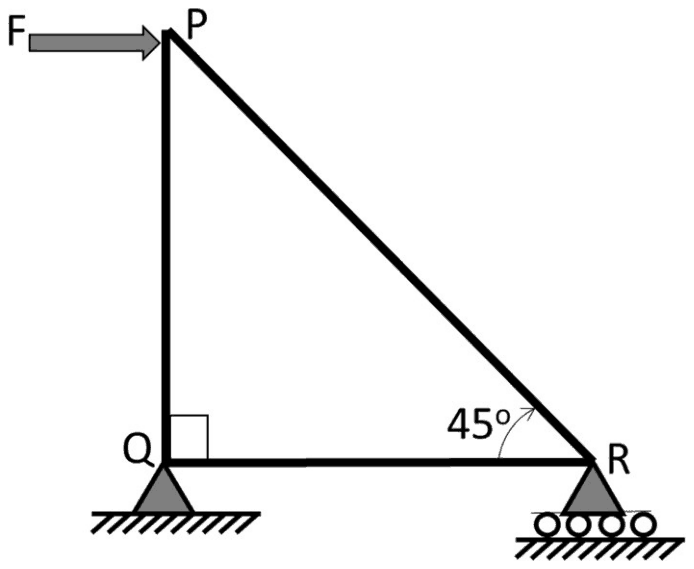
A three-member truss is simply supported at Q and R, and loaded at P by a horizontal force \(F\) as shown. The force in QR is

Right-angled truss: PQ vertical, QR horizontal, PR inclined at 45 degrees to QR at R; pin support at Q, roller at R; F acts horizontally at P towards the right

Exam Year(s)

GATE AE - 2022,

Answer: B

The force in QR is F (tensile).

R is a roller, so its reaction is vertical. With PQ = QR (the 45-degree angle at R), take moments about Q:

\[ \begin{aligned} F \cdot PQ &= R_{R} \cdot QR \\ R_{R} &= F \ \text{(upward)} \end{aligned} \]

At joint R the forces are \(R_{R}\), the member PR at 45 degrees and the horizontal member QR. Vertical balance needs PR to supply F downward, so PR carries \(\sqrt{2}F\) in compression, pushing on R down and to the right. Its horizontal component F must then be balanced by QR pulling R to the left, toward Q, which is tension F.

\(\sqrt{2}F\) is the force in PR, not QR, and it is compressive. Zero would hold only if R took the horizontal load, which a roller cannot.

Please log in or register to report this question.
4.

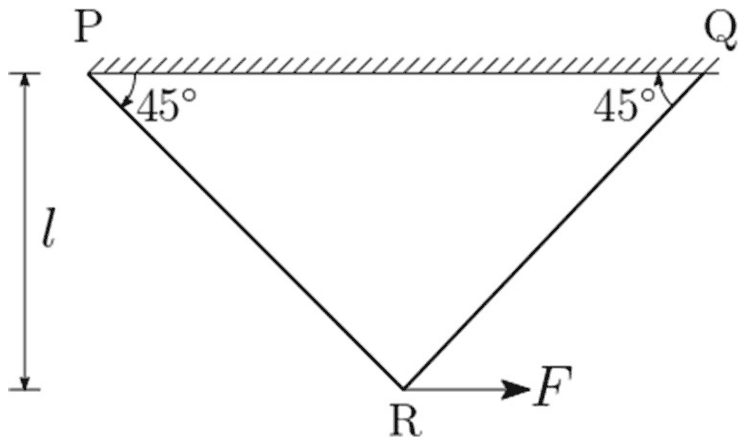
A horizontal load \(F\) is applied at point R on a two-member truss, as shown in the figure. Both the members are prismatic with cross-sectional area, \(A_{0}\), and made of the same material with Young’s modulus \(E\).

The horizontal displacement of point R is:

Two members PR and QR hang from a ceiling at P and Q, each at 45 degrees to it, meeting at R a vertical distance l below; F acts horizontally at R towards the right

Exam Year(s)

GATE AE - 2022,

Answer: C

The horizontal displacement of R is \(\sqrt{2}\frac{Fl}{EA_{0}}\).

Each member runs at 45 degrees from the ceiling down to R, so its length is \(\sqrt{2}l\). At joint R, vertical balance makes the two member forces equal and opposite, and horizontal balance then gives each a magnitude \(F/\sqrt{2}\): one in tension, the other in compression.

By the unit-load method, with n the member forces for a unit horizontal load at R (\(n = \pm 1/\sqrt{2}\)):

\[ \begin{aligned} \delta &= \sum \frac{NnL}{EA_{0}} = 2 \times \frac{(F/\sqrt{2})(1/\sqrt{2})(\sqrt{2}l)}{EA_{0}} \\ &= \sqrt{2}\frac{Fl}{EA_{0}} \end{aligned} \]

Fl/(EA0) results from taking the member length as l instead of \(\sqrt{2}l\), and 2Fl/(EA0) from taking each member force as F. The displacement cannot be zero, since both members change length.

Please log in or register to report this question.

5.

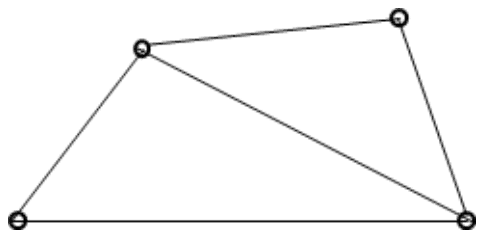
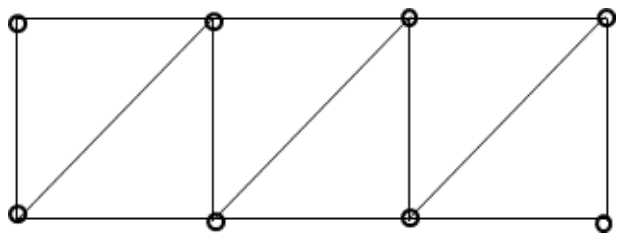
The options show frames consisting of rigid bars connected by pin joints. Which one of the frames is non-rigid?

Exam Year(s)

GATE ME - 2023,

Answer: C

The non-rigid frame is (C).

A pin-jointed frame is rigid when it is built up from triangles, each new joint fixed by two bars to points already fixed. In frame (C) the left bay has a diagonal and the right bay is braced by crossing bars through a central pin, but the middle bay is a plain quadrilateral with no diagonal. Four bars pinned at their ends form a mechanism: the middle bay can sway into a parallelogram, carrying the right bay with it, so the frame as a whole is not rigid.

Frame (A) is two triangles sharing a bar. Frame (B) is a chain of triangles, each sharing an edge with the last, closed by a final triangle at the bottom right. Frame (D) has a diagonal in every bay. All three are rigid.

Please log in or register to report this question.

6.

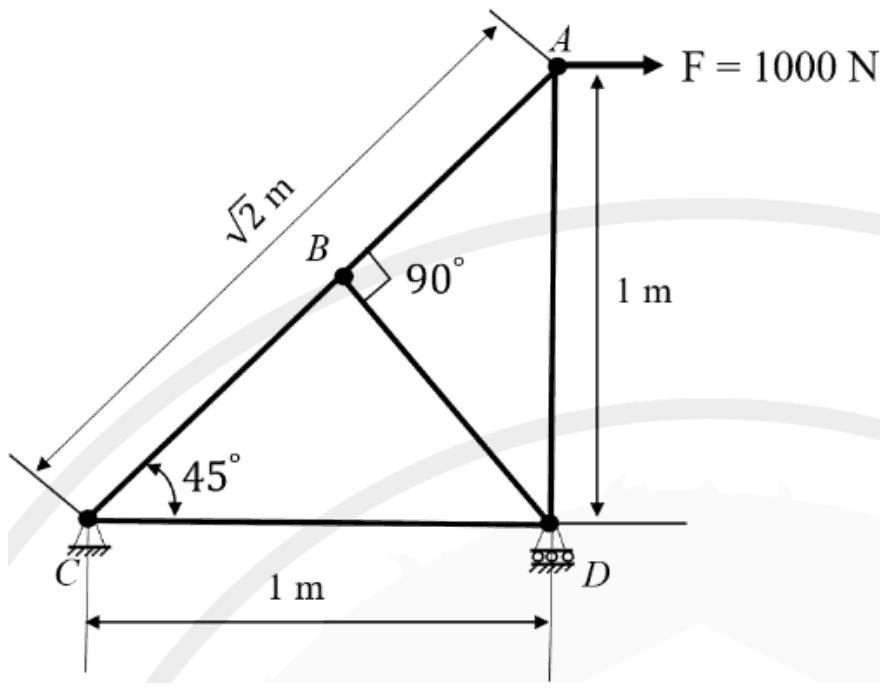
A truss structure is loaded as shown in the figure below. Among the options given, which member in the truss is a zero-force member?

Truss CDA: CD horizontal 1 m with pin at C and roller at D, DA vertical 1 m, CA inclined at 45 degrees; B on CA joined to D by a member perpendicular to CA; horizontal force 1000 N at A

Exam Year(s)

GATE ME - 2025,

Answer: A

The zero-force member is BD.

At joint B, members BA and BC lie on the same straight line CA, and BD is the only member not along that line. No external load acts at B.

Resolving forces at B perpendicular to CA, only BD has a component in that direction, so its force must be zero. BA, BC and AD all carry load: the 1000 N force at A is shared between AC and AD, and the supports at C and D react it.

Please log in or register to report this question.
7.

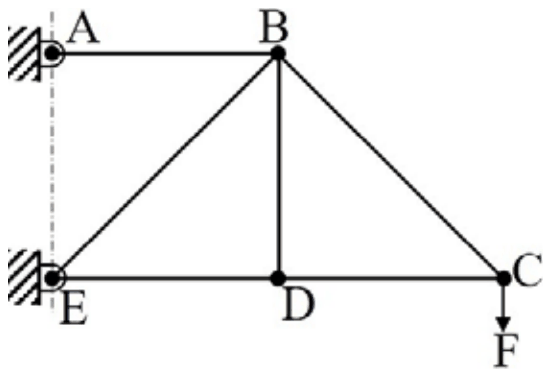
In the truss shown in the figure, all the members are pin jointed to each other. The members AB, BD, DE and DC have the same length. For the given loading, which of the following is the correct statement?

A truss pinned to a wall at A (top) and E (bottom); AB is horizontal at the top, ED and DC horizontal at the bottom, BD vertical, BE and BC diagonal, with a downward load F at C

Exam Year(s)

GATE XE - 2022,

Answer: B

The correct statement is that AB is in tension, ED is in compression, and BD is a zero-force member.

  • Joint D: ED and DC are collinear and there is no load, so the only non-collinear member, BD, carries no force.
  • Joint C: the load F acts down. Only BC has a vertical component, so BC must pull C upward: BC is in tension. Its horizontal pull towards B must be balanced by DC pushing C to the right, so DC, and with it ED, is in compression.
  • Joint B: BC pulls B down and to the right. The diagonal BE must push up, so it is in compression, and that push also has a component to the right. AB must therefore pull B to the left: AB is in tension.

That rules out 'AB and ED in compression', 'DC in tension, BC in compression' and 'ED in tension'.

Please log in or register to report this question.
8.

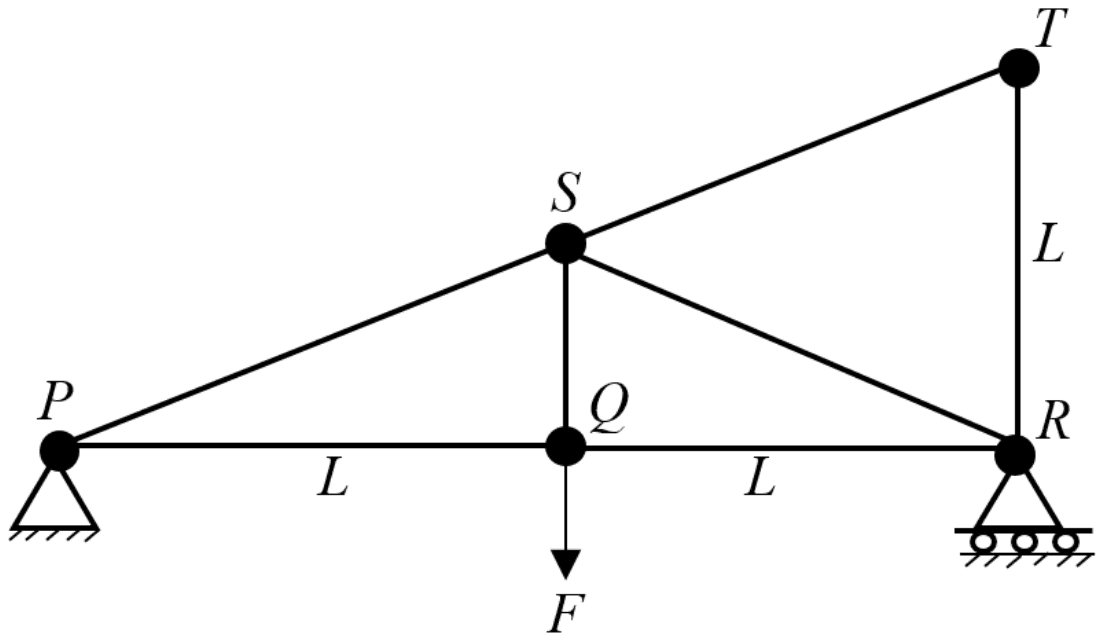
A plane truss is simply supported at \(P\) and \(R\) as shown. A downward force \(F\) is applied at hinge \(Q\). The axial force developed in member \(PS\) is

Plane truss with P, Q and R on a horizontal line, PQ = QR = L; P is a pinned support and R a roller. T is a distance L vertically above R and S is the midpoint of PT, directly above Q. Members PS, ST, TR, SR, SQ, PQ and QR; the downward force F acts at Q

Exam Year(s)

GATE XE - 2023,

Answer: B

The force in \(PS\) is \(\frac{\sqrt{5}}{2}F\) Compressive.

The load \(F\) at \(Q\) sits midway between the supports, so each support carries \(F/2\) upward. At joint \(P\) only two members meet: \(PQ\) (horizontal) and \(PS\), which rises \(L/2\) over a run of \(L\), so its length is \(\frac{\sqrt{5}}{2}L\) and \(\sin\alpha = \frac{1}{\sqrt{5}}\).

Vertical equilibrium of joint \(P\), taking member forces as tensile:

\[ \begin{aligned} \tfrac{F}{2} + F_{PS}\sin\alpha &= 0 \\ F_{PS} &= -\tfrac{F}{2}\sqrt{5} = -\tfrac{\sqrt{5}}{2}F \end{aligned} \]

The negative sign means compression: the inclined member pushes down on the support to balance its upward reaction. \(\sqrt{5}F\) comes from using the full load \(F\) instead of the reaction \(F/2\), and the tensile options have the sign reversed.

Please log in or register to report this question.
9.

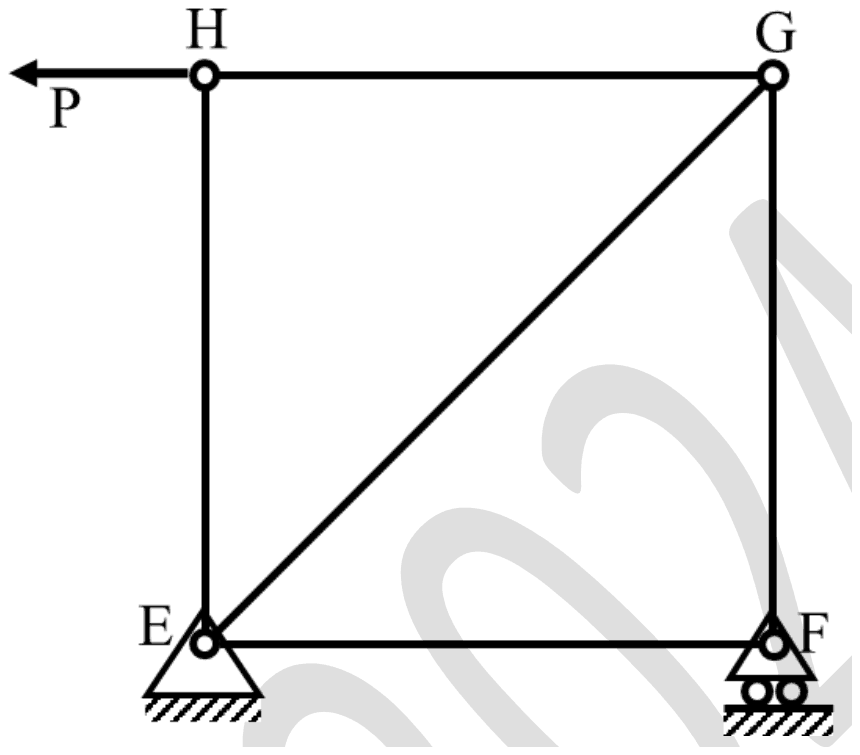
A pin-jointed truss has a pin support at the point E and a roller support at the point F. A horizontal force P is applied at pin H as shown in the figure. Which one of the members is in compression ?

Square truss with H top left, G top right, E bottom left on a pin and F bottom right on a roller; members HG, GF, FE, EH and the diagonal EG; force P pulls H horizontally to the left

Exam Year(s)

GATE XE - 2024,

Answer: C

The member in compression is EG.

Taking moments about E, the leftward force P at H (height a) must be balanced by the roller at F, whose reaction is therefore P downwards. Then the joints can be solved in turn:

  1. Joint H: the only vertical member, EH, has nothing to balance, so EH = 0; HG carries P in tension to balance P.
  2. Joint F: FG must balance the downward reaction, so FG carries P in tension; EF has no horizontal load, so EF = 0.
  3. Joint G: tensions in HG and FG pull G left and down by P each, so the diagonal must push G up and to the right: EG is in compression, with force \(P\sqrt{2}\).

EF and EH are zero-force members, and FG is in tension, so only EG is compressed.

Please log in or register to report this question.
10.

Identify the zero-force member in the truss structure as shown in the figure.

Truss with bottom chord P, S, T (P to S 1 m, S to T 1 m) and top chord Q, R 1 m higher, Q above S and R above T; members PQ, QS, SR, QR, RT, PS and ST; P is pinned, T is on a roller, and a 10 kN load acts down at S

Figure is not to scale

Exam Year(s)

GATE XE - 2026,

Answer: A

The zero-force member is ST.

Look at joint T. It meets only two members, ST (horizontal) and RT (vertical), and the roller support there gives only a vertical reaction. There is no horizontal external force at T, so horizontal equilibrium of the joint gives the force in ST as zero. RT then carries the support reaction.

The rule of thumb: at an unloaded joint, or one loaded only along one member, where two non-collinear members meet, the member not aligned with the load carries nothing.

SR, SP and SQ all carry load: the 10 kN acts at S, and SQ, SP and SR are needed to carry it to the supports.

Please log in or register to report this question.
Loading…
Tags: Analysis of Trusses and Frames Questions and Answers || Analysis of Trusses and Frames MCQ Questions and Answers || Analysis of Trusses and Frames GK Questions and Answers || Analysis of Trusses and Frames GK MCQ Questions || Analysis of Trusses and Frames Multiple Choice Questions and Answers || Analysis of Trusses and Frames GK || GK on Analysis of Trusses and Frames || Engineering Mechanics Questions and Answers || Engineering Mechanics MCQ Questions and Answers || Engineering Mechanics GK Questions and Answers || GK on Engineering Mechanics