
Machine-translated by Google. Questions are authored in English.
Top

Free Electron Model Questions and Answers

1.

Crystal structures of two metals A and B are two-dimensional square lattices with same lattice constant a. Electrons in metals behave as free electrons. The Fermi surfaces corresponding to A and B are shown by solid circles in figures.
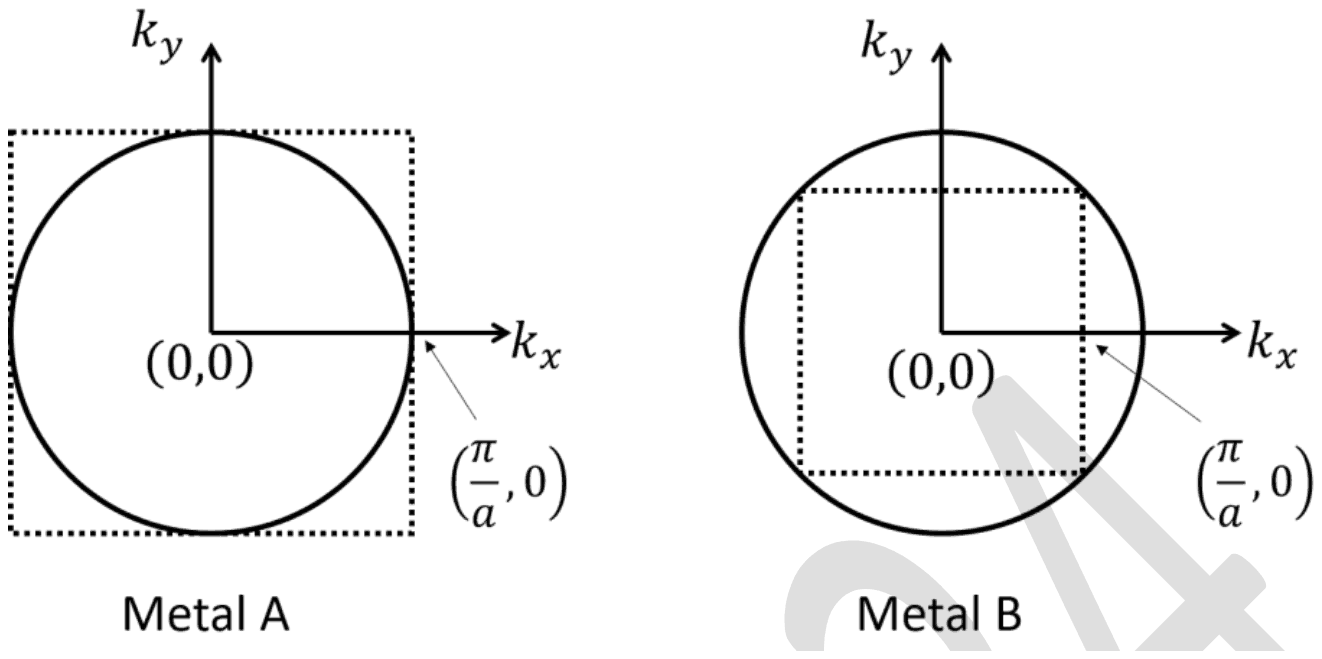
Two k-space diagrams with a dotted square of half-width pi/a. Metal A: the Fermi circle touches the middle of each side of the square, at (pi/a, 0). Metal B: the Fermi circle passes through the four corners of the square

The electron concentrations in A and B are \(n_{A}\) and \(n_{B}\), respectively. The value of \(\left(\dfrac{n_{B}}{n_{A}}\right)\) is

Exam Year(s)

GATE Physics - 2024,

Answer: B

The ratio nB/nA is 2.

For free electrons in two dimensions the electron concentration is proportional to the area of the Fermi circle, πkF2, so n ∝ kF2.

  • Metal A: the circle touches the zone boundary at (π/a, 0), so kF = π/a.
  • Metal B: the circle passes through the corners of the square zone, at (π/a, π/a), so kF = √2 π/a.

\[ \begin{aligned} \frac{n_{B}}{n_{A}} &= \left(\frac{\sqrt{2}\,\pi/a}{\pi/a}\right)^{2} \\ &= 2 \end{aligned} \]

√2 is the ratio of the Fermi wavevectors, not of the concentrations. 3 and 3√3 would need other radii, and 3√3 a three-dimensional kF3 scaling.

Please log in or register to report this question.

2.

As per the Drude model of metals, the electrical resistance of a metallic wire of length \(L\) and cross-section area \(A\) is

(Consider \(\tau\) as the relaxation time, \(m\) as electron mass, \(n\) as carrier concentration and \(e\) as electronic charge)

Exam Year(s)

GATE Physics - 2025,

Answer: A

The resistance is \(\frac{mL}{ne^{2}A\tau}\).

In the Drude model an electron accelerated by a field \(E\) gains drift velocity \(v_{d} = \frac{eE\tau}{m}\) between collisions, so the current density is

\[ \begin{aligned} J &= nev_{d} = \frac{ne^{2}\tau}{m}E \Rightarrow \sigma = \frac{ne^{2}\tau}{m} \\ R &= \frac{L}{\sigma A} = \frac{mL}{ne^{2}A\tau} \end{aligned} \]

The other options carry spurious factors of 2 or 4 that the Drude derivation does not produce: the resistance is simply the length over conductivity times area.

Please log in or register to report this question.

3.

Consider one mole of a monovalent metal at absolute zero temperature, obeying the free electron model. Its Fermi energy is \(E_{F}\). The energy corresponding to the filling of \(\frac{N_{A}}{2}\) electrons, where \(N_{A}\) is the Avogadro number, is \(2^{n}E_{F}\). The value of \(n\) is

Exam Year(s)

GATE Physics - 2025,

Answer: A

The value is \(n = -\frac{2}{3}\).

In the free electron model the Fermi energy depends on the electron density as \(E_{F} \propto N^{2/3}\) (for a fixed volume), since \(E_{F} = \frac{\hbar^{2}}{2m}(3\pi^{2}N/V)^{2/3}\). Filling only half the electrons gives

\[ E = E_{F}\left(\frac{1}{2}\right)^{2/3} = 2^{-2/3}E_{F} \]

so \(n = -\frac{2}{3}\). The energy must be less than \(E_{F}\), which rules out \(+\frac{2}{3}\); \(-\frac{1}{3}\) and \(-1\) use the wrong power of the density.

Please log in or register to report this question.

4.

The Fermi-momentum and dimension of a mono-atomic 2D square crystal are given by kF and L. If each atom is contributing one electron to the Fermi gas, the size of the primitive cell is :

Exam Year(s)

MH SET - 2018, SET Exam - 2018,

Answer: A

The primitive cell has area \( \frac{2\pi}{k_{F}^{2}} \).

In two dimensions each \( k \)-state occupies an area \( (2\pi/L)^{2} \), and each holds two electrons. Filling a Fermi circle of radius \( k_{F} \):

\[ \begin{aligned} N &= 2 \times \frac{\pi k_{F}^{2}}{(2\pi/L)^{2}} = \frac{k_{F}^{2}L^{2}}{2\pi} \\ \frac{L^{2}}{N} &= \frac{2\pi}{k_{F}^{2}} \end{aligned} \]

With one electron per atom, N is also the number of atoms, so \( L^{2}/N \) is the area of one primitive cell. \( \pi/k_{F}^{2} \) forgets the spin factor of 2, and the options containing L grow with the size of the crystal, whereas the area of one cell cannot depend on L.

Please log in or register to report this question.

5.

Density of states in conduction band for electrons assumed to be essentially free in two dimensions is proportional to :

Exam Year(s)

MH SET - 2018, SET Exam - 2018,

Answer: B

In two dimensions the density of states is independent of energy.

The number of states with energy below E is proportional to the area of the circle of radius \( k \) in k-space, \( \pi k^{2} \), and \( E = \hbar^{2}k^{2}/2m \) makes \( k^{2} \propto E \). So N(E) grows linearly with E and its derivative is constant:

\[ g(E) = \frac{mA}{\pi\hbar^{2}} \]

for area A including spin. \( E^{1/2} \) is the three-dimensional result and \( E^{-1/2} \) the one-dimensional one.

Please log in or register to report this question.

Loading…

Other Subjects

Tags: Free Electron Model Questions and Answers || Free Electron Model MCQ Questions and Answers || Free Electron Model GK Questions and Answers || Free Electron Model GK MCQ Questions || Free Electron Model Multiple Choice Questions and Answers || Free Electron Model GK || GK on Free Electron Model || Solid State Physics Questions and Answers || Solid State Physics MCQ Questions and Answers || Solid State Physics GK Questions and Answers || GK on Solid State Physics