
Machine-translated by Google. Questions are authored in English.
Top

Thin and Thick Cylinders Questions and Answers

Direction for [ Question No: 1 To 1 ] :

A steel cylindrical pressure vessel has an inner radius of 1.8 m and a wall thickness of 20 mm.

1.

At which of the following internal pressures will the cylindrical vessel yield as per the Tresca criterion if the yield strength of the material in tension is 320 MPa

Exam Year(s)

GATE XE - 2012,

Answer: A

The vessel yields at an internal pressure of about 3.55 MPa.

In a thin cylinder the principal stresses are the hoop stress, the axial stress (half of it) and a negligible radial stress. Tresca says yield occurs when the largest difference of principal stresses reaches the tensile yield strength; here that is hoop minus radial:

\[ \begin{aligned} \sigma_{h} &= \frac{pr}{t} = \frac{p(1800)}{20} = 90p \\ 90p &= 320 \Rightarrow p = 3.55\ \text{MPa} \end{aligned} \]

7.1 MPa uses the hoop-minus-axial difference (45p) as if the radial stress were not the minimum. 1.775 MPa is half the correct value, and 4.0 MPa does not follow from the hoop stress.

Please log in or register to report this question.
2.

A thin walled spherical shell is subjected to an internal pressure. If the radius of the shell is increased by 1% and the thickness is reduced by 1%, with the internal pressure remaining the same, the percentage change in the circumferential (hoop) stress is

Exam Year(s)

GATE ME - 2012,

Answer: D

The hoop stress rises by about 2.02 %.

For a thin spherical shell the stress is the same in every direction in the wall:

\[ \sigma = \frac{pr}{2t} \]

With the pressure unchanged, the stress scales as r/t:

\[ \frac{\sigma_{new}}{\sigma} = \frac{1.01}{0.99} = 1.0202 \]

So the stress increases by 2.02 %. Adding the two 1 % changes gives 2 %, close but not exact; 1 % counts only one of the two changes; and 0 would need the changes to cancel, but a larger radius and a thinner wall both raise the stress.

Please log in or register to report this question.
3.

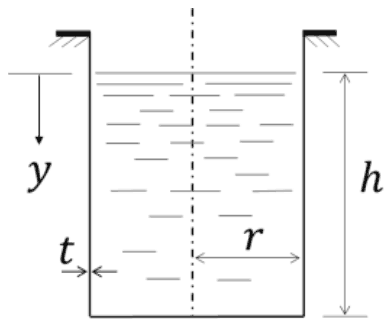
The figure shows a thin-walled open-top cylindrical vessel of radius \(r\) and wall thickness \(t\). The vessel is held along the brim and contains a constant-density liquid to height \(h\) from the base. Neglect atmospheric pressure, the weight of the vessel and bending stresses in the vessel walls.

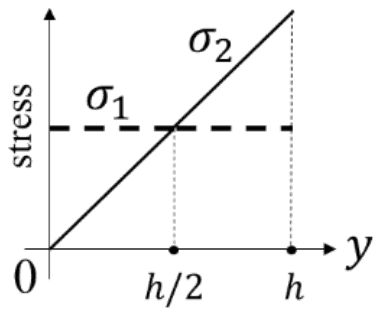
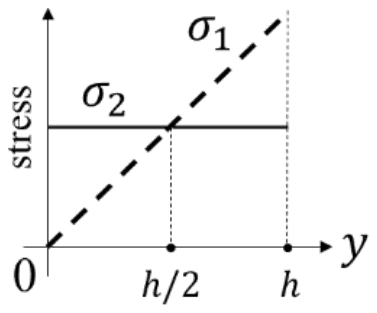
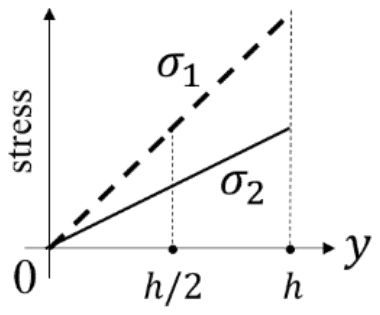
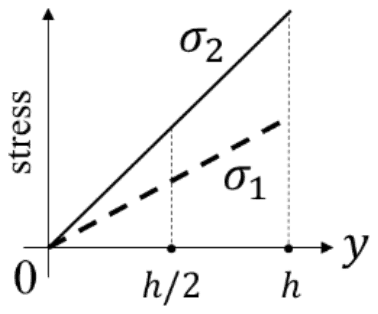
Which one of the plots depicts qualitatively CORRECT dependence of the magnitudes of axial wall stress (\(\sigma_{1}\)) and circumferential wall stress (\(\sigma_{2}\)) on \(y\)?

Open-top cylindrical vessel hung from its brim, liquid of depth h, with y measured downward from the liquid surface

Exam Year(s)

GATE ME - 2023,

Answer: A

The correct plot is (A): \(\sigma_{1}\) constant, \(\sigma_{2}\) rising linearly from zero and equal to \(\sigma_{1}\) at \(y = h/2\).

With \(y\) measured down from the liquid surface, the pressure at depth \(y\) is \(\rho g y\). The hoop (circumferential) stress of a thin cylinder is

\[ \sigma_{2} = \frac{pr}{t} = \frac{\rho g y\, r}{t} \]

which is zero at the surface and grows linearly with depth. Pressure on the vertical walls acts horizontally, so the only vertical load is the liquid's weight pressing on the base, \(\rho g h \cdot \pi r^{2}\). Hanging from the brim, every section of the wall carries that same load:

\[ \begin{aligned} \sigma_{1} &= \frac{\rho g h\,\pi r^{2}}{2\pi r t} \\ &= \frac{\rho g h\, r}{2t} \end{aligned} \]

which does not depend on \(y\). Setting \(\sigma_{2} = \sigma_{1}\) gives \(y = h/2\), and at the base \(\sigma_{2} = 2\sigma_{1}\), exactly as plot (A) shows. (B) swaps the two stresses. (C) and (D) make the axial stress grow with depth, which would need the wall load to change along its height.

Please log in or register to report this question.
4.

A thin cylinder (thickness, t and diameter, d) with closed ends is subjected to an internal pressure, p. The ratio of hoop stress to longitudinal stress developed in the wall of the cylinder is

Exam Year(s)

GATE XE - 2018,

Answer: D

The ratio is 2:1.

For a thin cylinder with closed ends, a force balance on a longitudinal section gives the hoop stress, and one on a transverse section gives the longitudinal stress:

\[ \begin{aligned} \sigma_{h} &= \frac{pd}{2t} \\ \sigma_{l} &= \frac{pd}{4t} \end{aligned} \]

so \(\sigma_{h}/\sigma_{l} = 2\). The hoop stress is the larger, which is why thin pipes split along their length. 1:2 inverts the ratio, and 1:1 would hold only for a thin sphere, where the stress is \(pd/4t\) in every direction.

Please log in or register to report this question.
5.

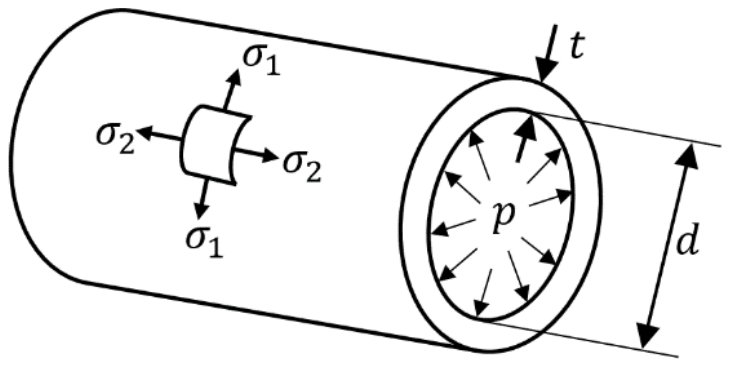
A thin walled, closed cylindrical vessel of inside diameter \(d\) and wall thickness \(t\) contains a fluid under pressure \(p\). The figure below shows a part of the cylindrical vessel; end caps are not shown. Consider the small element shown with sides parallel and perpendicular to the axis of the cylinder. The stresses \(\sigma_{1}\) and \(\sigma_{2}\) are

Part of a thin walled closed cylinder with inside diameter d, wall thickness t and internal pressure p; on a small wall element sigma 1 acts in the circumferential direction and sigma 2 along the axis

Exam Year(s)

GATE XE - 2023,

Answer: A

The stresses are \(\sigma_{1} = \frac{pd}{2t}\); \(\sigma_{2} = \frac{pd}{4t}\).

\(\sigma_{1}\) is the hoop (circumferential) stress. Cutting a length \(\ell\) of the cylinder along a diameter, the pressure force \(p d \ell\) is resisted by two walls of area \(t\ell\): \(\sigma_{1} = \frac{pd}{2t}\).

\(\sigma_{2}\) is the longitudinal stress, set up because the ends are closed. The pressure on the end, \(p\frac{\pi d^{2}}{4}\), is carried by the wall ring of area about \(\pi d t\): \(\sigma_{2} = \frac{pd}{4t}\), half the hoop stress.

The option with \(\sigma_{1}\) and \(\sigma_{2}\) swapped assigns the hoop stress to the axial direction. \(\frac{pd}{t}\) forgets that two walls share the hoop load, and \(\sigma_{2} = 0\) would hold only for an open-ended cylinder, but this vessel is closed.

Please log in or register to report this question.
6.

A closed thin cylindrical tank with a mean diameter d = 300 mm and thickness t = 2 mm, is subjected to a uniform internal gas pressure p. The allowable shear stress on the curved wall of the tank is 70 MPa.

Based on the Tresca criteria, which one of the following options for the maximum safe value of p (in MPa) is CORRECT?

Exam Year(s)

GATE XE - 2025,

Answer: C

The maximum safe pressure is 1.87 MPa.

For a thin closed cylinder the wall stresses are the hoop stress, the longitudinal stress and, on the inside, a radial stress that is small enough to take as zero:

\[ \begin{aligned} \sigma_{h} &= \frac{pd}{2t} = \frac{300p}{4} = 75p \\ \sigma_{l} &= \frac{pd}{4t} = 37.5p, \quad \sigma_{r} \approx 0 \end{aligned} \]

The Tresca criterion uses the largest shear stress in three dimensions, half the difference between the largest and smallest principal stresses, here \(\sigma_{h}\) and \(\sigma_{r} = 0\):

\[ \begin{aligned} \tau_{max} &= \frac{75p - 0}{2} = 37.5p = 70 \\ \Rightarrow p &= 1.87\ \text{MPa} \end{aligned} \]

3.73 MPa is what the in-plane shear stress \((\sigma_{h} - \sigma_{l})/2 = 18.75p\) alone would allow; it ignores the larger out-of-plane shear. 7.46 and 5.60 MPa would put the absolute maximum shear stress above 70 MPa.

Please log in or register to report this question.
7.

The design of thin cylindrical shells is based on :

Exam Year(s)

RSMSSB JE - 2025, RSMSSB - 2025,

Answer: A

Thin cylindrical shells are designed on the basis of hoop stress.

For internal pressure p, diameter d and thickness t, the hoop stress is \(\frac{pd}{2t}\) and the longitudinal stress \(\frac{pd}{4t}\). The hoop stress is twice as large, so it governs the thickness needed.

Designing on the longitudinal stress, or on any mean of the two, would give a wall too thin to resist the larger hoop stress.

Please log in or register to report this question.

8.

A thin cylindrical pressure vessel with closed ends is subjected to internal pressure. The ratio of circumferential (hoop) stress to the longitudinal stress is:

Exam Year(s)

RSMSSB JE - 2025, RSMSSB - 2025,

Answer: D

The ratio of hoop stress to longitudinal stress is 2 : 1.

\[ \begin{aligned} \sigma_{h} &= \frac{pd}{2t}, \quad \sigma_{l} = \frac{pd}{4t} \\ \frac{\sigma_{h}}{\sigma_{l}} &= 2 \end{aligned} \]

The hoop stress resists the pressure across a length of the cylinder, while the longitudinal stress resists it only over the circular end, which halves the ratio of force to wall area. 1:1 would hold only for a sphere, where both stresses equal \(\frac{pd}{4t}\).

Please log in or register to report this question.

Loading…
Tags: Thin and Thick Cylinders Questions and Answers || Thin and Thick Cylinders MCQ Questions and Answers || Thin and Thick Cylinders GK Questions and Answers || Thin and Thick Cylinders GK MCQ Questions || Thin and Thick Cylinders Multiple Choice Questions and Answers || Thin and Thick Cylinders GK || GK on Thin and Thick Cylinders || Strength of Materials Questions and Answers || Strength of Materials MCQ Questions and Answers || Strength of Materials GK Questions and Answers || GK on Strength of Materials