
Machine-translated by Google. Questions are authored in English.
Top

Design of Riveted Joints Questions and Answers

1.

Consider the schematic of a riveted lap joint subjected to tensile load F, as shown below. Let d be the diameter of the rivets, and Sf be the maximum permissible tensile stress in the plates. What should be the minimum value for the thickness of the plates to guard against tensile failure of the plates? Assume the plates to be identical.
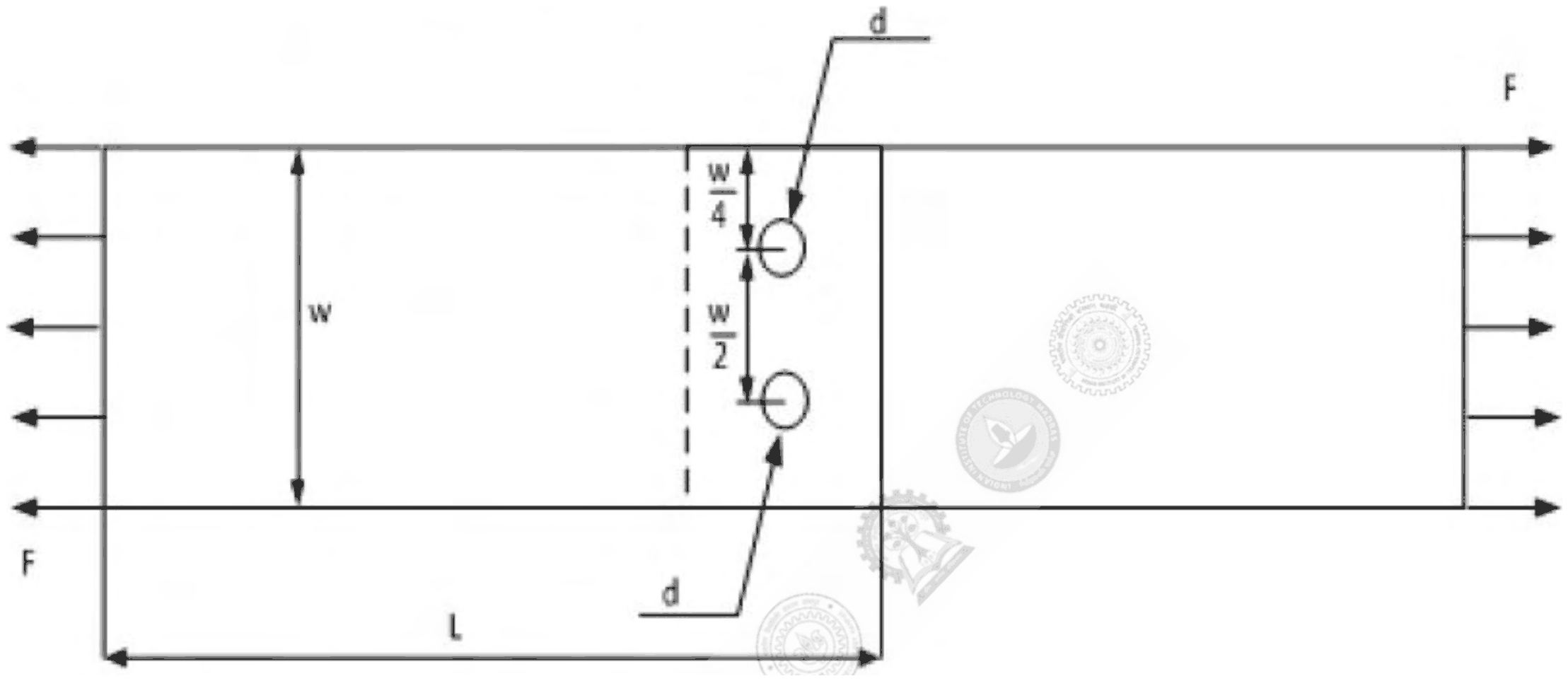
Two plates of width W overlap over a length L and are joined by two rivets of diameter d in one row across the width, W/4 from the edge and W/2 apart; each plate is pulled by F

Exam Year(s)

GATE ME - 2017,

Answer: A

The minimum plate thickness is \(\frac{F}{S_{f}(W - 2d)}\).

The weakest tensile section of each plate is the line through the rivet holes. Two rivets of diameter d lie in that row, so the net width there is W - 2d, and the whole load F passes through it:

\[ \begin{aligned} S_{f}\,t\,(W - 2d) &\ge F \\ t &\ge \frac{F}{S_{f}(W - 2d)} \end{aligned} \]

F/(SfW) ignores the holes (the gross section). W - d removes only one hole, and 2F/(SfW) doubles the load without removing any holes.

Please log in or register to report this question.
2.

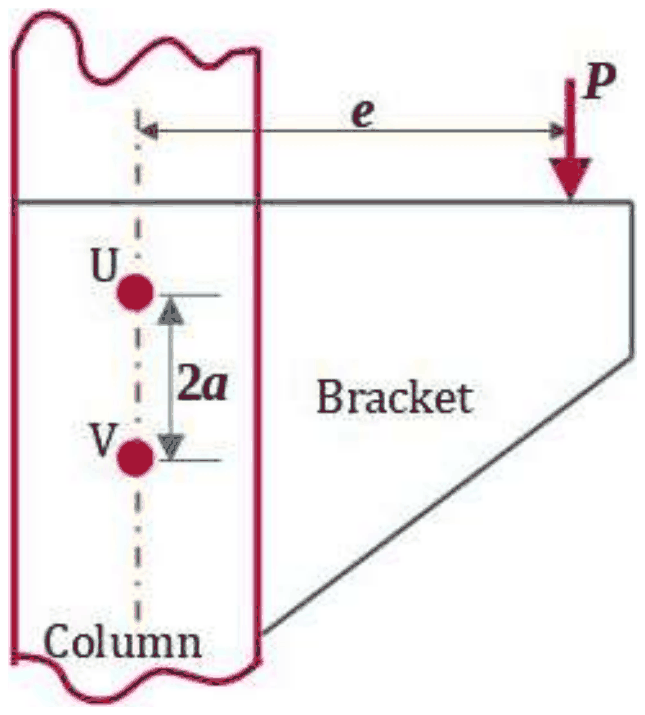
A bracket is attached to a vertical column by means of two identical rivets U and V separated by a distance of \(2a\) = 100 mm, as shown in the figure. The permissible shear stress of the rivet material is 50 MPa. If a load \(P\) = 10 kN is applied at an eccentricity \(e = 3\sqrt{7}\,a\), the minimum cross-sectional area of each of the rivets to avoid failure is ___________ mm2.

Bracket fixed to a column by rivets U and V one above the other, 2a apart; a downward load P acts at horizontal distance e from the rivet line

Exam Year(s)

GATE ME - 2022,

Answer: A

Each rivet needs at least 800 mm2.

The rivets are one above the other, a distance \(a = 50\) mm from their centroid. The load gives each rivet a direct shear \(P/2 = 5\) kN downwards, and the moment \(Pe\) gives each a secondary shear at right angles to the line of rivets, that is horizontal:

\[ \begin{aligned} F_{s} &= \frac{Pe\,a}{2a^{2}} = \frac{P e}{2a} = \frac{10 \times 3\sqrt{7}}{2} \\ &= 15\sqrt{7} \approx 39.7\ \text{kN} \end{aligned} \]

The two components are perpendicular, so each rivet carries

\[ \begin{aligned} F &= \sqrt{5^{2} + (15\sqrt{7})^{2}} = \sqrt{25 + 1575} = 40\ \text{kN} \\ A &= \frac{40000}{50} = 800\ \text{mm}^{2} \end{aligned} \]

200 mm2 ignores the moment, \(100\sqrt{7}\) and 25 mm2 do not follow from combining the two shears. Adding the components directly would apply only if the rivets were side by side.

Please log in or register to report this question.

Loading…
Tags: Design of Riveted Joints Questions and Answers || Design of Riveted Joints MCQ Questions and Answers || Design of Riveted Joints GK Questions and Answers || Design of Riveted Joints GK MCQ Questions || Design of Riveted Joints Multiple Choice Questions and Answers || Design of Riveted Joints GK || GK on Design of Riveted Joints || Design of Machine Elements Questions and Answers || Design of Machine Elements MCQ Questions and Answers || Design of Machine Elements GK Questions and Answers || GK on Design of Machine Elements