Machine-translated by Google. Questions are authored in English.
Top

Interaction of Radiation with Matter Questions and Answers

1.

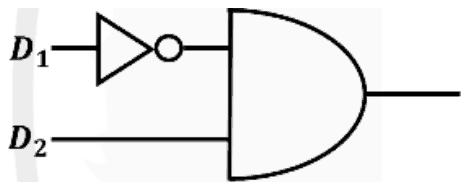
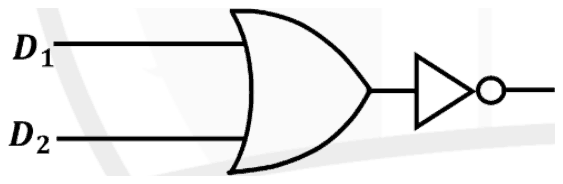
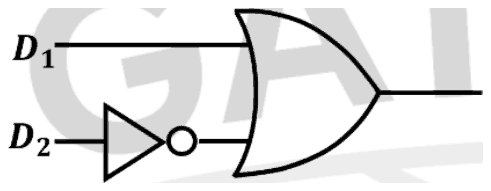
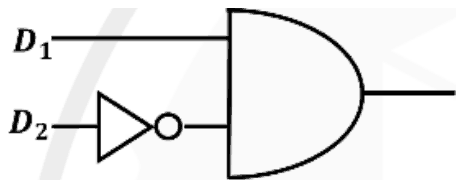
An \(\alpha\) particle is scattered from an Au target at rest as shown in the figure. \(D_{1}\) and \(D_{2}\) are the detectors to detect the scattered \(\alpha\) particle at an angle \(\theta\) and along the beam direction, respectively, as shown. The signals from \(D_{1}\) and \(D_{2}\) are converted to logic signals and fed to logic gates. When a particle is detected, the signal is 1 and is 0 otherwise. Which one of the following circuits detects the particle scattered at the angle \(\theta\) only?
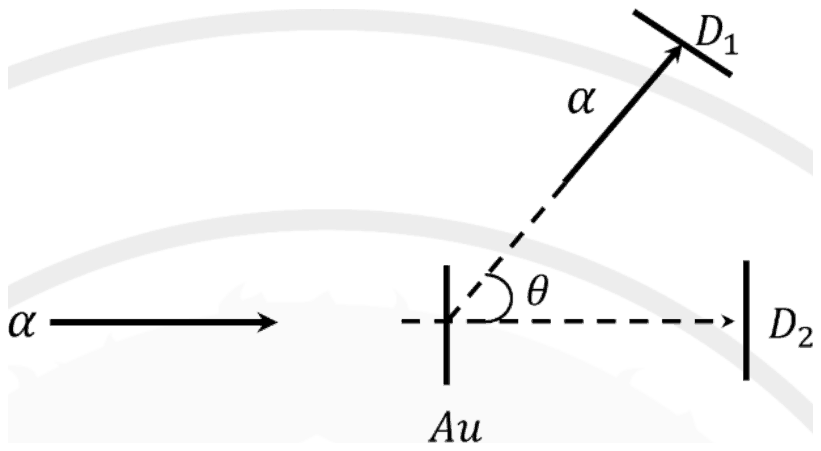
Alpha beam striking an Au foil; detector D1 off the beam axis at angle theta, detector D2 on the beam axis beyond the foil

Exam Year(s)

GATE Physics - 2025,

Answer: A

The required circuit is (A): \(D_{1}\) AND (NOT \(D_{2}\)).

'Scattered at angle \(\theta\) only' means \(D_{1}\) fires and \(D_{2}\) does not. The output must be 1 exactly when \(D_{1} = 1\) and \(D_{2} = 0\), which is \(D_{1}\cdot\overline{D_{2}}\): invert \(D_{2}\) and AND it with \(D_{1}\).

(B) gives \(\overline{D_{1}}D_{2}\), which selects the unscattered particles going straight to \(D_{2}\). (C) is a NOR, \(\overline{D_{1} + D_{2}}\), which is 1 only when neither detector fires. (D), \(D_{1} + \overline{D_{2}}\), is also 1 when nothing is detected at all.

Please log in or register to report this question.

2.

A gamma-ray of 3.43 MeV energy undergoes pair production. The electron and positron formed move with equal kinetic energy in opposite direction to each other. The kinetic energy of the positron is nearly :

Exam Year(s)

MH SET - 2019, SET Exam - 2019,

Answer: C

The positron's kinetic energy is nearly 1.20 MeV.

Creating the pair uses \(2m_{e}c^{2} = 1.022\) MeV; the rest is shared equally as kinetic energy:

\[ \begin{aligned} K &= \frac{3.43 - 1.022}{2} \\ &= \frac{2.408}{2} \approx 1.20\ \text{MeV} \end{aligned} \]

The option 1.022 MeV is the threshold energy itself, and 0.511 MeV is the rest energy of one particle; neither is a kinetic energy here.

Please log in or register to report this question.

Loading…
Tags: Interaction of Radiation with Matter Questions and Answers || Interaction of Radiation with Matter MCQ Questions and Answers || Interaction of Radiation with Matter GK Questions and Answers || Interaction of Radiation with Matter GK MCQ Questions || Interaction of Radiation with Matter Multiple Choice Questions and Answers || Interaction of Radiation with Matter GK || GK on Interaction of Radiation with Matter || Nuclear Physics Questions and Answers || Nuclear Physics MCQ Questions and Answers || Nuclear Physics GK Questions and Answers || GK on Nuclear Physics