Machine-translated by Google. Questions are authored in English.
Top

Alpha Beta and Gamma Decay Questions and Answers

1.

Match the order of β-decays given in the left column to appropriate clause in the right column. Here \(X(I^{\pi})\) and \(Y(I^{\pi})\) are nuclei with intrinsic spin \(I\) and parity \(\pi\).

1. \(X\left(\frac{1}{2}^{+}\right) \rightarrow Y\left(\frac{1}{2}^{+}\right)\)i) First forbidden β-decay
2. \(X\left(\frac{1}{2}^{-}\right) \rightarrow Y\left(\frac{5}{2}^{+}\right)\)ii) Second forbidden β-decay
3. \(X(3^{+}) \rightarrow Y(0^{+})\)iii) Third forbidden β-decay
4. \(X(4^{-}) \rightarrow Y(0^{+})\)iv) Allowed β-decay

Exam Year(s)

GATE Physics - 2022,

Answer: B

The match is 1-iv, 2-i, 3-ii, 4-iii.

The order of forbiddenness is set by the spin change \(\Delta I\) and whether the parity changes. Allowed decays have \(\Delta I = 0, 1\) and no parity change. A forbidden decay of order \(n\) needs \(n\) units of orbital angular momentum, with parity change for odd \(n\); a unique transition has \(\Delta I = n + 1\).

  • 1: \(\frac{1}{2}^{+} \to \frac{1}{2}^{+}\), \(\Delta I = 0\), no parity change: allowed.
  • 2: \(\frac{1}{2}^{-} \to \frac{5}{2}^{+}\), \(\Delta I = 2\), parity changes: first forbidden (unique).
  • 3: \(3^{+} \to 0^{+}\), \(\Delta I = 3\), no parity change: second forbidden (unique).
  • 4: \(4^{-} \to 0^{+}\), \(\Delta I = 4\), parity changes: third forbidden (unique).

The other options misplace the allowed decay or reverse the order of the forbidden ones.

Please log in or register to report this question.
2.

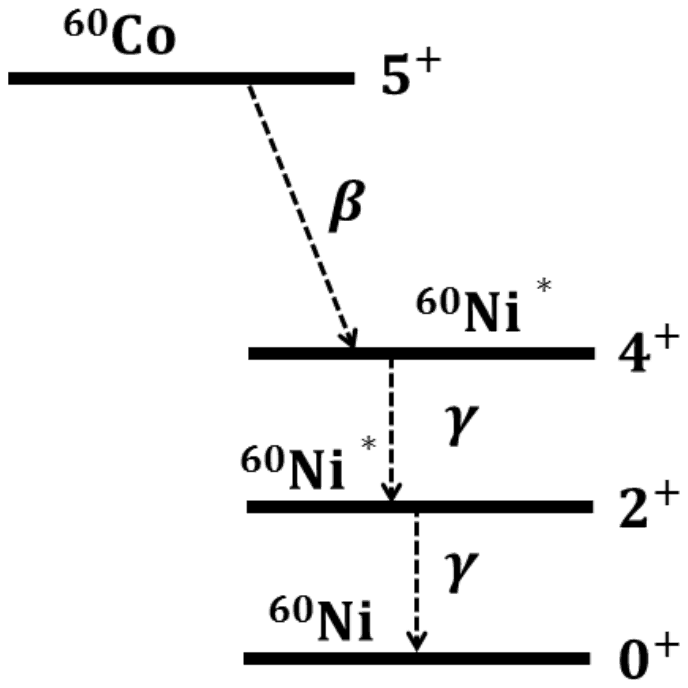
A 60Co nucleus emits a β-particle and is converted to 60Ni* with \(J^{P} = 4^{+}\), which in turn decays to the 60Ni ground state with \(J^{P} = 0^{+}\) by emitting two photons in succession, as shown in the figure. Which one of the following statements is CORRECT?

Level scheme: 60Co 5+ beta-decays to 60Ni* 4+, which emits a gamma ray to 60Ni* 2+, which emits a gamma ray to the 60Ni 0+ ground state

Exam Year(s)

GATE Physics - 2023,

Answer: C

The correct statement is \(2^{+} \rightarrow 0^{+}\) is an electric quadrupole transition.

A photon of multipolarity \(L\) must satisfy \(|J_{i} - J_{f}| \le L \le J_{i} + J_{f}\) (and \(L \ge 1\)). An electric \(EL\) transition changes parity by \((-1)^{L}\) and a magnetic \(ML\) transition by \((-1)^{L+1}\).

For \(2^{+} \rightarrow 0^{+}\), only \(L = 2\) is allowed, and there is no parity change, so it must be E2, electric quadrupole. M2 would need a parity change.

For \(4^{+} \rightarrow 2^{+}\), \(L\) runs from 2 to 6 with no parity change, so the allowed multipoles are E2, M3, E4, M5, E6, and E2 dominates. An electric octupole (E3) or a magnetic quadrupole (M2) would both change parity, so the first two statements are wrong, as is the last.

Please log in or register to report this question.

3.

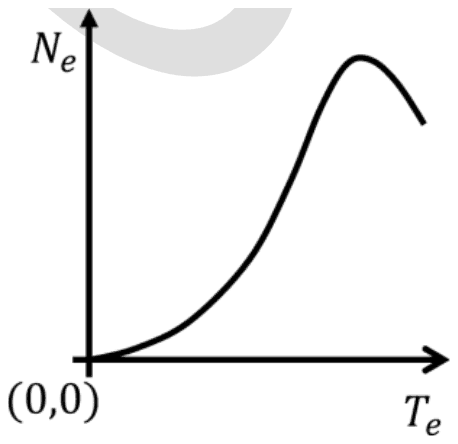
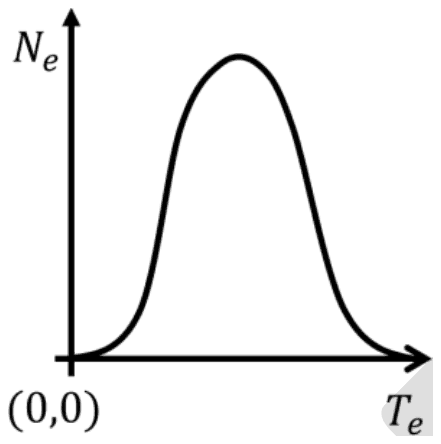
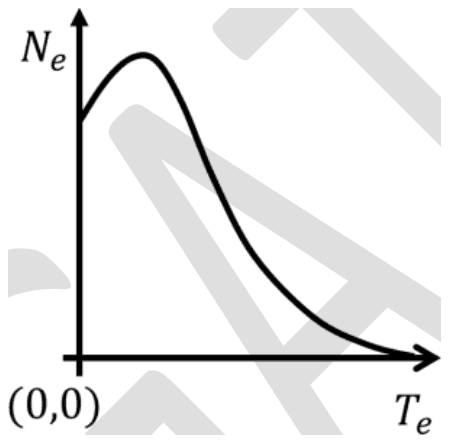
Let \(N_{e}\) and \(T_{e}\), respectively, denote number and kinetic energy of electrons produced in a nuclear beta decay. Which one of the following distributions is correct?

Exam Year(s)

GATE Physics - 2024,

Answer: C

The correct distribution is the continuous curve that starts above zero, peaks at low energy and falls to zero (C).

In beta decay the available energy is shared among three bodies: the electron, the antineutrino and the recoiling nucleus. So the electron energy is not fixed but spread continuously from 0 up to the endpoint energy, which rules out the single line of (A), the shape expected for a two-body decay.

For electron (β-) emission the Coulomb attraction of the daughter nucleus slows the electrons, piling them up at low energy; the number at very low energy stays finite rather than vanishing, and the spectrum then falls off towards the endpoint. Curve (C) has exactly this shape.

A symmetric bell curve that vanishes at zero energy (B) ignores that Coulomb effect, and a curve peaking near the maximum energy (D) would mean the neutrino usually carries almost nothing, which is not what is observed.

Please log in or register to report this question.
4.

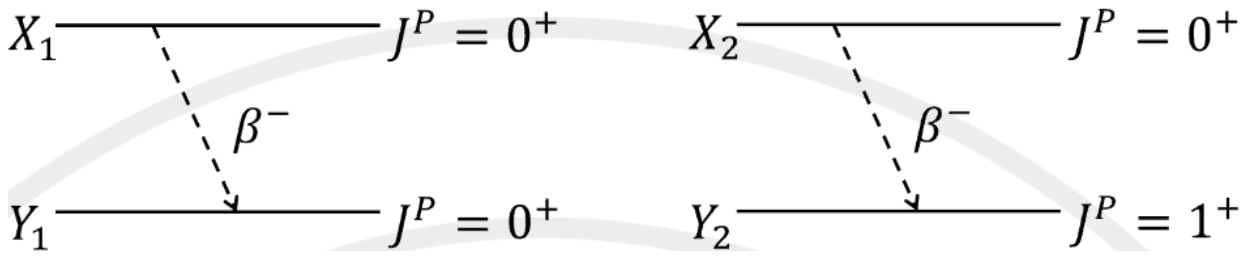
Consider two hypothetical nuclei \(X_{1}\) and \(X_{2}\) undergoing \(\beta\) decay, resulting in nuclei \(Y_{1}\) and \(Y_{2}\), respectively. The decay scheme and the corresponding \(J^{P}\) values of the nuclei are given in the figure. Which of the following option(s) is/are correct? (\(J\) is the total angular momentum and \(P\) is parity)

Energy levels: X1 (JP 0+) decays by beta minus to Y1 (JP 0+); X2 (JP 0+) decays by beta minus to Y2 (JP 1+)

Exam Year(s)

GATE Physics - 2025,

Answer: B

The correct option is \(X_{1} \to Y_{1}\) is a Fermi transition and \(X_{2} \to Y_{2}\) is a Gamow-Teller transition.

In allowed beta decay there is no change of parity, and the selection rules depend on how the electron and neutrino spins combine. In a Fermi transition their spins are antiparallel (total 0), so \(\Delta J = 0\). In a Gamow-Teller transition they are parallel (total 1), so \(\Delta J = 0, \pm 1\), except that \(0 \to 0\) is forbidden.

\(0^{+} \to 0^{+}\) (\(X_{1} \to Y_{1}\)) cannot be Gamow-Teller, so it is a pure Fermi transition. \(0^{+} \to 1^{+}\) (\(X_{2} \to Y_{2}\)) has \(\Delta J = 1\), which a Fermi transition cannot provide, so it is pure Gamow-Teller.

That rules out every other combination. (This is a multiple-select question; the key accepts this option alone.)

Please log in or register to report this question.
Loading…
Tags: Alpha Beta and Gamma Decay Questions and Answers || Alpha Beta and Gamma Decay MCQ Questions and Answers || Alpha Beta and Gamma Decay GK Questions and Answers || Alpha Beta and Gamma Decay GK MCQ Questions || Alpha Beta and Gamma Decay Multiple Choice Questions and Answers || Alpha Beta and Gamma Decay GK || GK on Alpha Beta and Gamma Decay || Nuclear Physics Questions and Answers || Nuclear Physics MCQ Questions and Answers || Nuclear Physics GK Questions and Answers || GK on Nuclear Physics