
Machine-translated by Google. Questions are authored in English.
Top

Elementary Particles Questions and Answers

1.

The elementary particle \(\Xi^{0}\) is placed in the baryon decuplet, shown below, at
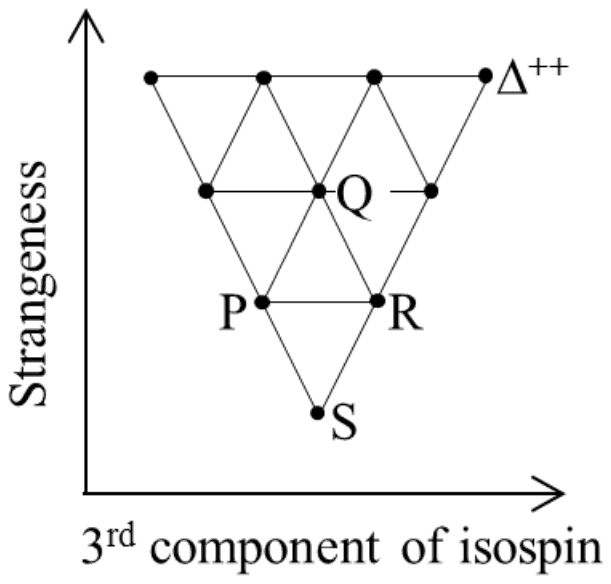
The baryon decuplet drawn as an inverted triangle of ten points, strangeness on the vertical axis and the third component of isospin on the horizontal; Delta++ at the top right, Q in the second row, P and R in the third row and S at the bottom

Exam Year(s)

GATE Physics - 2018,

Answer: C

\(\Xi^{0}\) is at point R.

In this drawing strangeness increases upward and the third component of isospin, \(I_{3}\), to the right. The top row, with \(\Delta^{++}\) at the right end, is the four \(\Delta\) baryons with \(S = 0\). Going down, the rows are the three \(\Sigma^{*}\) (\(S = -1\)), the two \(\Xi^{*}\) (\(S = -2\)) and the single \(\Omega^{-}\) (\(S = -3\)) at the bottom.

The \(\Xi\) row holds P and R. The two members have \(I_{3} = -\tfrac{1}{2}\) (\(\Xi^{-}\)) and \(I_{3} = +\tfrac{1}{2}\) (\(\Xi^{0}\)); charge \(Q = I_{3} + (B + S)/2\) gives \(Q = 0\) for the right-hand one, so \(\Xi^{0}\) is R and \(\Xi^{-}\) is P.

Q is the \(\Sigma^{*0}\) in the middle of the second row, and S is the \(\Omega^{-}\).

Please log in or register to report this question.
2.

In the decay, \(\mu^{+} \rightarrow e^{+} + \nu_{e} + X\), what is \(X\)?

Exam Year(s)

GATE Physics - 2018,

Answer: D

\(X\) is the muon antineutrino, \(\bar{\nu}_{\mu}\).

The decay is \(\mu^{+} \to e^{+} + \nu_{e} + \bar{\nu}_{\mu}\). Check the lepton family numbers. On the left, \(\mu^{+}\) has muon number \(L_{\mu} = -1\) and electron number \(L_{e} = 0\). On the right, \(e^{+}\) has \(L_{e} = -1\) and \(\nu_{e}\) has \(L_{e} = +1\), cancelling, so the remaining particle must carry \(L_{\mu} = -1\) and no charge: the muon antineutrino.

A photon carries no lepton number, so \(\gamma\) leaves \(L_{\mu}\) unbalanced. \(\bar{\nu}_{e}\) would make \(L_{e} = -1\) and leave \(L_{\mu}\) unbalanced. \(\nu_{\mu}\) has \(L_{\mu} = +1\), the wrong sign; it is the partner in the \(\mu^{-}\) decay.

Please log in or register to report this question.
3.

The \(\Xi^{0*}\) particle is a member of the Baryon decuplet with isospin state \(|I, I_{3}\rangle = |\frac{1}{2}, \frac{1}{2}\rangle\) and strangeness quantum number -2. In the quark model, which one of the following is the flavour part of the \(\Xi^{0*}\) wavefunction?

Exam Year(s)

GATE Physics - 2023,

Answer: B

The flavour wavefunction is \(\frac{1}{\sqrt{3}}(uss + sus + ssu)\).

Strangeness -2 means two strange quarks; with total isospin projection +1/2 the third quark is a \(u\). The baryon decuplet is the totally symmetric flavour multiplet of SU(3) (its spin part is symmetric too, and colour supplies the antisymmetry), so the state must be the symmetric sum of all distinct orderings of \(u, s, s\), normalised by \(1/\sqrt{3}\).

The two \(1/\sqrt{2}\) options leave out the \(sus\) ordering, so they are neither symmetric nor complete; \(uss - ssu\) is also antisymmetric under exchange of the first and third quarks. The option with \(-sus\) is not symmetric under exchanging neighbouring quarks.

Please log in or register to report this question.
4.

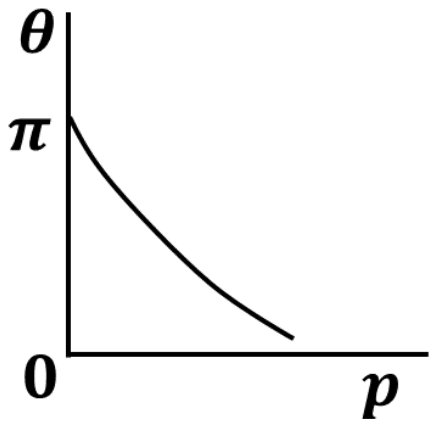
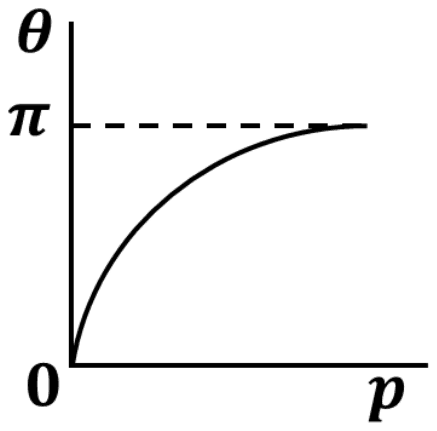
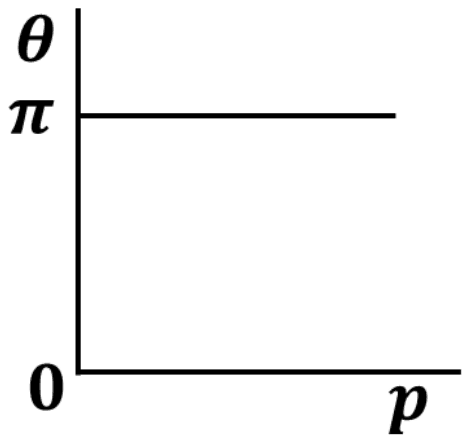
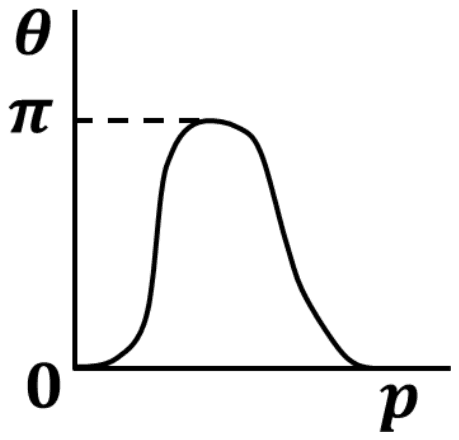
In a hadronic interaction, \(\pi^{0}\)’s are produced with different momenta, and they immediately decay into two photons with an opening angle \(\theta\) between them. Assuming that all these decays occur in one plane, which one of the following figures depicts the behaviour of \(\theta\) as a function of the \(\pi^{0}\) momentum \(p\)?

Exam Year(s)

GATE Physics - 2023,

Answer: A

The opening angle falls from \(\pi\) toward zero as the momentum increases, graph (A).

In the rest frame of the \(\pi^{0}\) the two photons fly apart back to back, so for a pion at rest \(\theta = \pi\). In the laboratory a moving pion's photons are beamed forward, and the faster the pion, the smaller the angle between them. For the symmetric decay, which gives the minimum (and most probable) opening angle,

\[ \begin{aligned} \sin\frac{\theta}{2} &= \frac{m_{\pi}c^{2}}{E} \\ &= \frac{m_{\pi}c}{\sqrt{p^{2} + m_{\pi}^{2}c^{2}}} \end{aligned} \]

which equals 1 (\(\theta = \pi\)) at \(p = 0\) and tends to 0 as \(p\) grows.

Graph (B) has the trend reversed, (C) ignores relativistic beaming, and (D) starts from zero at rest, which would require the photons to be emitted in the same direction from a stationary pion, violating momentum conservation.

Please log in or register to report this question.
5.

Under parity and time reversal transformations, which of the following statements is(are) TRUE about the electric dipole moment p and the magnetic dipole moment μ?

Exam Year(s)

GATE Physics - 2023,

Answer: A

The true statement is p is odd under parity and μ is odd under time reversal; it is the only one the key accepts in this multiple-select question.

The electric dipole moment \(\mathbf{p} = \sum q\mathbf{r}\) is built from position vectors. Parity sends \(\mathbf{r} \rightarrow -\mathbf{r}\), so \(\mathbf{p}\) is odd under parity; time reversal leaves positions unchanged, so \(\mathbf{p}\) is even under T.

The magnetic dipole moment comes from circulating currents or spin, \(\boldsymbol{\mu} \propto \mathbf{r} \times \mathbf{v}\) or \(\propto \mathbf{S}\), an axial vector like angular momentum. It is even under parity (both factors change sign) but odd under time reversal, since reversing time reverses every velocity and spin.

So 'μ is even under time reversal' and 'p is even under parity' are both false, which rules out the other three statements.

Please log in or register to report this question.

Answer: A

The possible process is \(\nu_{e} + {}_{z}P^{A} \rightarrow {}_{z+1}Q^{A} + e^{-}\).

This is neutrino capture, the inverse of beta decay: inside the nucleus a neutron absorbs the electron neutrino and turns into a proton, emitting an electron (νe + n → p + e-). Charge is conserved (0 + z = z + 1 - 1), the mass number is unchanged, and the lepton number (+1 on both sides) and electron flavour are conserved.

Producing a positron with a neutrino would violate lepton number: the left side has +1 and the right side -1. Creating an e+e- pair leaves the neutrino's lepton number unaccounted for, and the last option destroys the neutrino and creates only a photon, again violating lepton number.

Please log in or register to report this question.

7.

Which one of the following baryons has strangeness quantum number \(S = -1\)?

Exam Year(s)

GATE Physics - 2025,

Answer: A

The baryon with \(S = -1\) is \(\Sigma^{*0}\).

Strangeness counts strange quarks, each contributing \(S = -1\). The \(\Sigma^{*0}\) (the spin-3/2 partner of the \(\Sigma^{0}\)) has quark content \(uds\), one strange quark, so \(S = -1\).

The neutron (\(udd\)) and the \(\Delta^{0}\) (\(udd\)) contain no strange quark and have \(S = 0\). The \(\Xi^{*0}\) (\(uss\)) has two strange quarks and \(S = -2\).

Please log in or register to report this question.

Answer: A

The allowed process is \(\pi^{-} + p \to \pi^{0} + n\).

This charge exchange reaction conserves charge (−1 + 1 = 0 + 0), baryon number (1 = 1), and isospin and strangeness, so it proceeds by the strong interaction and is observed.

\(\pi^{0} \to 3\gamma\) is forbidden by charge conjugation: the \(\pi^{0}\) has C = +1, and each photon carries C = −1, so three photons have C = −1. \(p + \bar{p} \to \Lambda^{0} + \Lambda^{0}\) has baryon number 0 before and 2 after (and strangeness 0 before, −2 after). \(p + \bar{p} \to \gamma\) cannot conserve both energy and momentum: in the centre of mass frame the total momentum is zero, but a single photon always carries momentum.

Please log in or register to report this question.

Answer: B

The true statement is the decay \(\Lambda \to p^{+} + \pi^{-}\) is allowed and strangeness is violated.

The \(\Lambda\) has strangeness −1, while the proton and pion have strangeness 0. Charge, baryon number and energy are conserved (1116 MeV against 938 + 140 MeV), so the decay proceeds through the weak interaction, which does not conserve strangeness. It is the main decay mode of the \(\Lambda\).

CPT invariance holds in every local relativistic field theory and is not violated in muon decay. \(p^{+} \to e^{+} + \gamma\) violates baryon and lepton number conservation and has never been seen. \(\Omega^{-} \to \Xi^{0} + K^{-}\) is forbidden by energy: \(1315 + 494 = 1809\) MeV exceeds the \(\Omega^{-}\) mass of 1672 MeV.

Please log in or register to report this question.

Loading…
Tags: Elementary Particles Questions and Answers || Elementary Particles MCQ Questions and Answers || Elementary Particles GK Questions and Answers || Elementary Particles GK MCQ Questions || Elementary Particles Multiple Choice Questions and Answers || Elementary Particles GK || GK on Elementary Particles || Nuclear Physics Questions and Answers || Nuclear Physics MCQ Questions and Answers || Nuclear Physics GK Questions and Answers || GK on Nuclear Physics