
Machine-translated by Google. Questions are authored in English.
Top

Surfaces, Interfaces and Colloids Questions and Answers

1.

Adsorption of a gas with pressure P on a solid obeys the Langmuir adsorption isotherm. For a fixed fractional coverage, the correct relation between K and P at a fixed temperature is

[\(K = k_{a}/k_{b}\), \(k_{a}\) and \(k_{b}\) are the rate constants for adsorption and desorption, respectively. Assume non-dissociative adsorption.]

Exam Year(s)

GATE Chemistry - 2022,

Answer: C

At fixed coverage, \(K \propto P^{-1}\).

For non-dissociative adsorption the Langmuir isotherm gives the fractional coverage as

\[ \theta = \frac{KP}{1 + KP} \]

If \(\theta\) is held fixed, the product \(KP\) must be fixed, \(KP = \theta/(1-\theta)\), so K is inversely proportional to P.

\(K \propto P\) inverts the relation. The square-root forms belong to dissociative adsorption, where \(\theta\) depends on \((KP)^{1/2}\), which the question rules out.

Please log in or register to report this question.

2.

Critical micellar concentration of a surfactant is 0.008 M in water at 25 °C. If the aggregation number of the micelles is 80, the concentration of the micelles (in M) present in 0.088 M aqueous solution of the surfactant at 25 °C is

Exam Year(s)

GATE Chemistry - 2024,

Answer: B

The micelle concentration is 0.001 M.

Above the critical micelle concentration, surfactant in excess of the CMC goes into micelles, while the CMC amount stays as free monomer:

\[ \begin{aligned} [\text{surfactant in micelles}] &= 0.088 - 0.008 = 0.080\ \text{M} \\ [\text{micelles}] &= \frac{0.080}{80} = 0.001\ \text{M} \end{aligned} \]

Dividing the full 0.088 M by 80 gives 0.0011 M, close but not the intended value; 0.008 M is the CMC itself and 0.088 M the total concentration, neither of which is a micelle concentration.

Please log in or register to report this question.
3.

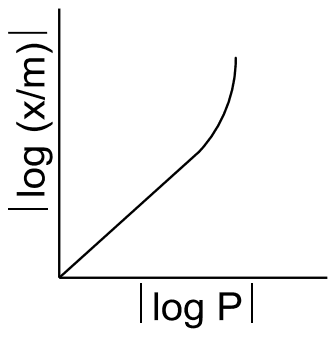
For adsorption of a gas on a solid surface, the plot that represents Freundlich isotherm is
(x = mass of gas, m = mass of adsorbent, P = pressure)

Exam Year(s)

IIT JAM - 2018,

Answer: D

The Freundlich isotherm is plot (D).

The isotherm is \(x/m = kP^{1/n}\). Taking logarithms gives a straight line:

\[ \log\frac{x}{m} = \log k + \frac{1}{n}\log P \]

The line has a positive slope \(1/n\) and a positive intercept \(\log k\), which is what (D) shows. (A) levels off to a plateau, the shape of a Langmuir isotherm as the surface saturates, which is not a log-log line. (B) is a line through the origin that turns upward, and (C) has a negative slope, so neither fits the equation.

Please log in or register to report this question.

Answer: D

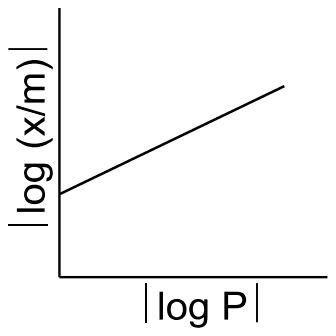
The untrue statement is It catalyses the non-spontaneous reactions.

A catalyst lowers the activation energy, providing a faster route, but it does not change \(\Delta G\) or the equilibrium constant. It can therefore only speed up reactions that are already thermodynamically feasible; it cannot make a non-spontaneous reaction go.

The other statements are true: catalysts speed up spontaneous reactions, a small amount suffices because it is regenerated, and it leaves both the Gibbs energy change and \(K\) unchanged.

Please log in or register to report this question.
5.

Sodium lauryl sulphate

Exam Year(s)

MPPSC Forest Service - 2023,

Answer: B

Sodium lauryl sulphate is an anionic detergent.

Its formula is \(\mathrm{CH_3(CH_2)_{11}OSO_3^-\,Na^+}\). In water the sodium ion separates and the long-chain sulphate ion, which carries the negative charge, does the cleaning, so it is anionic. It is common in shampoos and toothpastes.

Cationic detergents, such as cetyltrimethylammonium bromide, have a positively charged head; non-ionic detergents, such as polyethylene glycol esters, carry no charge.

Please log in or register to report this question.

6.

In the hydrogenation of C2H4 on a Ni surface both the alkene and H2 are adsorbed on similar active sites of the catalyst surface. Which of the following figures depict the reaction ?

Exam Year(s)

MH SET - 2018, SET Exam - 2018,

Answer: C

The correct plot is C, a rise to a maximum followed by a fall.

When both reactants compete for the same sites (the Langmuir-Hinshelwood mechanism) the rate is proportional to the product of their fractional coverages:

\[ \begin{aligned} r &= \frac{k K_{A}K_{B} p_{A} p_{B}}{D^{2}} \\ D &= 1 + K_{A}p_{A} + K_{B}p_{B} \end{aligned} \]

At constant ethylene pressure the rate first rises with pH2, because more hydrogen is adsorbed. At high pH2 the denominator grows as p2, hydrogen crowds the alkene off the surface and the rate falls. A constant rate (A), a saturation curve (B) and a straight line (D) describe zero-order, single-site or first-order behaviour, not competitive adsorption. The axis labels print C2H6 for ethylene.

Please log in or register to report this question.

Answer: B

The correct statement is that at least one reactant must be chemisorbed on the catalyst.

A heterogeneous catalyst works by forming chemical bonds with an adsorbed reactant, which weakens its bonds and lowers the activation energy. Physisorption, held by weak van der Waals forces, does not change the molecule enough to activate it, so it is not required; chemisorption of at least one reactant is.

The number of active sites increases, not decreases, with surface area, which is why catalysts are finely divided or dispersed on supports. Surface area is measured by gas adsorption, as in the BET method with nitrogen, not by spectroscopy.

Please log in or register to report this question.

8.

A surface of Li metal (sample X) was suspected to be completely coated with a thin layer of Li2O (sample Y). When X and Y are analysed by X-ray photoelectron spectroscopy :

Exam Year(s)

MH SET - 2018, SET Exam - 2018,

Answer: A

The kinetic energy of the photoelectrons from X (Li metal) will be higher than from Y (Li2O).

In XPS the measured kinetic energy is

\[ KE = h\nu - BE - \phi \]

In Li2O lithium is present as Li+. The loss of electron density makes the remaining 1s electrons more tightly held, so the Li 1s binding energy is higher in the oxide than in the metal (a chemical shift). For the same X-ray energy, a higher binding energy means a lower kinetic energy.

So Y gives photoelectrons of lower kinetic energy, ruling out D, and the binding energy for Y is higher, not lower, ruling out C. Option B compares Y with itself.

Please log in or register to report this question.

9.

Surface tension of Br2(I) water and mercury are 41.0 mNm−1, 72.0 mN/m and 486.2 mNm−1 respectively at 25°C. These values imply that :

(i) Metallic bonding is weaker than covalent bonding
(ii) Hydrogen bonding is stronger than van der Waals bonding
(iii) Metallic bonding is stronger than hydrogen bonding
(iv) All types of intermolecular forces are of similar strength

Exam Year(s)

MH SET - 2018, SET Exam - 2018,

Answer: B

The values imply (ii) and (iii).

Surface tension reflects the strength of the forces holding the liquid together. Bromine, held by van der Waals forces, has the lowest value (41.0 mN m−1); water, held by hydrogen bonds, is higher (72.0); and mercury, held by metallic bonding, is far higher (486.2).

So hydrogen bonding is stronger than van der Waals bonding (ii), and metallic bonding is stronger than hydrogen bonding (iii). Statement (iv) is contradicted by the twelvefold range of values, and statement (i) is not supported, since no liquid here is held by covalent bonds between molecules and mercury's value is the highest.

Please log in or register to report this question.

Loading…
Tags: Surfaces, Interfaces and Colloids Questions and Answers