
Machine-translated by Google. Questions are authored in English.
Top

Molecular Structure and Bonding Theory Questions and Answers

1.

Let \(\phi_{x}^{C}\) and \(\phi_{z}^{C}\) denote the wavefunctions of the 2px and 2pz orbitals of carbon, respectively, and \(\phi_{x}^{O}\) and \(\phi_{z}^{O}\) represent the wavefunctions of the 2px and 2pz orbitals of oxygen, respectively. If \(c_{1}\) and \(c_{2}\) are constants used in linear combinations and the CO molecule is oriented along the z axis, then, according to molecular orbital theory, the π-bonding molecular orbital has a wavefunction given by

Exam Year(s)

GATE Chemistry - 2012,

Answer: D

The π-bonding orbital is \(c_{1}\phi_{x}^{C} + c_{2}\phi_{x}^{O}\).

With the molecule along the z axis, a π orbital is built from p orbitals perpendicular to the bond, that is, 2px (or 2py), and only orbitals of the same symmetry about the axis can combine. So the π MO combines 2px on carbon with 2px on oxygen, in phase for the bonding combination.

2pz on carbon with 2pz on oxygen point along the bond and give a σ orbital, not a π orbital. A 2pz with a 2px on the other atom has zero net overlap by symmetry: one is symmetric and the other antisymmetric under reflection through the yz plane, so the two mixed options describe no bond at all.

Please log in or register to report this question.
Answer: B

The order of polarity is BF3 < NF3 < NH3.

BF3 is trigonal planar, so its three B-F bond dipoles cancel and its dipole moment is zero. NH3 and NF3 are both pyramidal with a lone pair on nitrogen. In NH3 the N-H bond dipoles point towards nitrogen, the same way as the lone-pair dipole, so they add: about 1.47 D. In NF3 the N-F bond dipoles point away from nitrogen, against the lone-pair dipole, so they largely cancel: about 0.23 D.

Any order placing NF3 above NH3 forgets that opposition, and any order not putting BF3 first ignores its symmetry.

Please log in or register to report this question.

Answer: A

The shapes are T-shape, T-shape, linear and trigonal bipyramidal.

  • ClF3: three bonds and two lone pairs on Cl, five electron pairs in a trigonal bipyramid with the lone pairs equatorial, leaving a T shape.
  • XeOF2: Xe forms one double bond to O and two bonds to F and keeps two lone pairs; three bonded positions and two equatorial lone pairs again give a T shape.
  • N3−: 16 valence electrons, isoelectronic with CO2, so linear.
  • XeO3F2: five bonded groups and no lone pair on Xe, so trigonal bipyramidal.

Calling ClF3 or XeOF2 trigonal planar ignores their lone pairs, azide is not bent, and XeO3F2 has no lone pair to make it square pyramidal.

Please log in or register to report this question.

4.

1sA and 1sB are the normalized eigenfunctions of two hydrogen atoms HA and HB, respectively. If \(S = \langle 1s_{A} | 1s_{B} \rangle\), the option that is ALWAYS CORRECT is

Exam Year(s)

GATE Chemistry - 2022,

Answer: D

The statement that is always correct is \(0 \le S \le 1\).

The 1s functions are real, positive everywhere and normalised. Their overlap integral is therefore a real number that cannot be negative, and by the Schwarz inequality it cannot exceed the product of the norms, 1. It equals 1 only when the two nuclei coincide and approaches 0 as they move far apart.

\(S = 1\) holds only at zero separation and \(S = 0\) only at infinite separation, so neither is always true. The overlap of two real functions is real, so it is never an imaginary constant.

Please log in or register to report this question.

5.

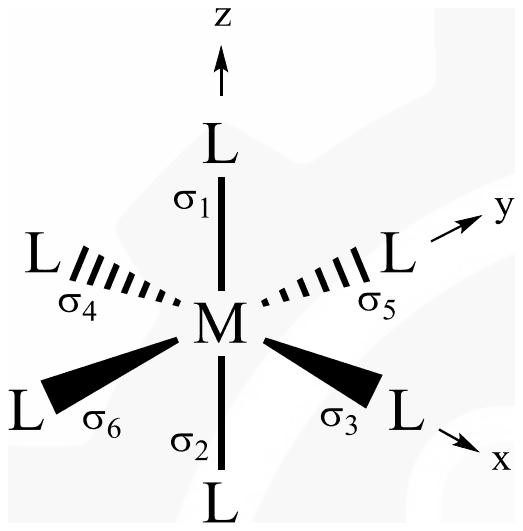
Consider the figure given below, where M is a metal and L is a monodentate ligand. The σ-bonding ligand group orbital (LGO) having same symmetry with \(d_{z^{2}}\) orbital of M in the octahedral coordination geometry is

Octahedral complex ML6: ligands L on the +z axis (sigma 1), -z axis (sigma 2), +x (sigma 3), -y (sigma 4), +y (sigma 5) and -x (sigma 6), with M at the centre and the x, y, z axes marked

Exam Year(s)

GATE Chemistry - 2026,

Answer: A

The ligand group orbital is \(\frac{1}{\sqrt{12}}(2\sigma_1+2\sigma_2-\sigma_3-\sigma_4-\sigma_5-\sigma_6)\).

In \(O_{h}\) the \(d_{z^{2}}\) orbital belongs to eg. Its LGO must copy the orbital's shape: large positive lobes along +z and -z, where \(\sigma_{1}\) and \(\sigma_{2}\) point, and the smaller negative collar in the xy plane, where \(\sigma_{3}\) to \(\sigma_{6}\) point. So \(\sigma_{1}\) and \(\sigma_{2}\) take the same positive weight, twice that of the four equatorial orbitals, which take a negative sign. The normalising factor is

\[ \frac{1}{\sqrt{4 + 4 + 1 + 1 + 1 + 1}} = \frac{1}{\sqrt{12}} \]

The all-positive combination \(\frac{1}{\sqrt{6}}(\sigma_{1} + \dots + \sigma_{6})\) is the a1g LGO that matches the 4s orbital. The \(2\sigma_{1} - 2\sigma_{2}\) option changes sign between +z and -z, which a gerade d orbital never does. The \(\frac{1}{\sqrt{6}}\) option with equal weights of opposite sign is not a symmetry-adapted orbital at all: it is a mixture of the a1g and eg combinations.

Please log in or register to report this question.

6.

The hybridization of atomic orbitals of sulphur in SF4 is

Exam Year(s)

GATE Life Sciences - 2012,

Answer: C

Sulphur in SF4 is sp\(^{3}\)d hybridised.

Sulphur has six valence electrons. Four form bonds to fluorine and the remaining two make one lone pair, giving five electron pairs around the central atom. Five pairs need five hybrid orbitals, sp3d, arranged as a trigonal bipyramid; the lone pair occupies an equatorial position, so the molecule has a see-saw shape.

sp3 would allow only four pairs (as in SCl2 with two lone pairs, or a tetrahedral molecule), dsp2 gives a square planar set of four, and sp3d2 six pairs, as in SF6.

Please log in or register to report this question.

7.

As predicted by MO theory, the bond order and magnetic nature of NO+ are

Exam Year(s)

GATE Life Sciences - 2012,

Answer: D

NO+ has bond order three and is diamagnetic.

NO+ has 10 valence electrons (5 from N, 6 from O, minus 1), the same as N2 and CO. Filling the molecular orbitals:

\[ \begin{aligned} &\sigma_{2s}^{2}\,\sigma_{2s}^{*2} \\ &\pi_{2p}^{4}\,\sigma_{2p}^{2} \end{aligned} \]

\[ \text{bond order} = \frac{8 - 2}{2} = 3 \]

All electrons are paired, so the ion is diamagnetic. Neutral NO has one more electron, in a \(\pi^{*}\) orbital, giving bond order 2.5 and paramagnetism; options with bond order two or paramagnetism describe neither species correctly.

Please log in or register to report this question.

8.

Among the following, the one having smallest bond angle is

Exam Year(s)

GATE Life Sciences - 2022,

Answer: A

The smallest bond angle is in PH3, about 93°.

The measured angles are roughly NH3 107°, NF3 102°, PF3 98° and PH3 93°.

Going down the group from N to P, the central atom becomes larger and less electronegative. Its bonding pairs sit farther from the nucleus and repel each other less, and the bonds use orbitals of nearly pure p character, so the angle closes toward 90°. That puts both phosphorus compounds below both nitrogen compounds.

Within the nitrogen pair, fluorine pulls the bonding pairs away from N, reducing their mutual repulsion, so NF3 has a smaller angle than NH3. Between the phosphorus compounds, PH3 is the smaller; PF3 is opened slightly by the bulk of the fluorine atoms and by their lone pairs interacting with phosphorus.

Please log in or register to report this question.

9.

The bond order in \(\mathrm{N_{2}^{2-}}\) species is

Exam Year(s)

GATE Life Sciences - 2025,

Answer: A

The bond order of \(\mathrm{N_{2}^{2-}}\) is 2.

N2 has 10 valence electrons; the dianion has 12. Filling the molecular orbitals in the order used for N2:

\[ \begin{aligned} &\sigma_{2s}^{2}\,\sigma_{2s}^{*2}\,\pi_{2p}^{4} \\ &\sigma_{2p}^{2}\,\pi_{2p}^{*2} \end{aligned} \]

That is 8 bonding and 4 antibonding electrons, so

\[ \text{bond order} = \frac{8 - 4}{2} = 2 \]

3 is the bond order of neutral N2, and 2.5 is that of N2−, where only one electron has entered \(\pi^{*}\). Each extra electron goes into an antibonding orbital and lowers the bond order by half, so 3.5 is impossible here.

Please log in or register to report this question.

10.

A few species are given in Column I. Column II contains the hybrid orbitals used by the central atom of the species for bonding.

The CORRECT match for the species to their central atom hybridization is

(Given: Atomic numbers of B: 5; C: 6; O: 8; F: 9; P: 15; Cl: 17; I: 53)

Column I
Species
Column II
Hybrid orbitals used by the central atom for bonding
i. I3−a. sp
ii. PCl3b. sp2
iii. BF3c. sp3
iv. CO2d. sp3d

Exam Year(s)

GATE Life Sciences - 2025,

Answer: A

The correct match is i-d, ii-c, iii-b, iv-a.

Count the electron domains (bond pairs plus lone pairs) on the central atom; that number fixes the hybridization.

  • I3−: the central I has 2 bonds and 3 lone pairs, 5 domains, so sp3d (linear ion, lone pairs equatorial).
  • PCl3: 3 bonds and 1 lone pair, 4 domains, so sp3 (pyramidal).
  • BF3: 3 bonds and no lone pair, so sp2 (trigonal planar).
  • CO2: two double bonds, 2 domains, so sp (linear).

The other options give I3− sp (counting only its two bonds), or swap PCl3 with BF3, or give CO2 a trigonal hybrid; each fails one of these counts.

Please log in or register to report this question.

Loading…
Tags: Molecular Structure and Bonding Theory Questions and Answers